

TL;DR:
- Stock indices are curated performance measures with specific rules and biases shaping returns.
- Understanding the construction and weighting methods of indices improves investment decisions and risk assessment.
- Passive investing based solely on market-cap indices can unintentionally lead to concentrated risks in mega-caps and sectors.
Most portfolios and news reports reference indices daily, yet even experienced investors sometimes misunderstand how these benchmarks are actually built and what their structures mean for real returns. An index is not just a number scrolling across a ticker; it is a carefully constructed framework with rules, weightings, and biases that shape every passive fund and benchmark comparison you use. This guide breaks down how indices work, how they are constructed, and how that knowledge translates into sharper, more confident investment decisions.
Key Takeaways
| Point | Details |
|---|---|
| Index makeup matters | How an index is built and weighted shapes your investment risks and potential returns. |
| Benchmarks aren’t one-size-fits-all | Picking the right index means matching its composition to your goals and portfolio. |
| Diversification vs. concentration | Cap-weighted indices can overexpose you to a few giants; other methods may improve diversification. |
| Practical application | Understanding indices helps you select better funds, assess performance, and manage risk smartly. |
What are stock market indices and why do they matter?
With the goal in mind, let's start by understanding what indices actually are and why they're central to investment decisions.
A stock market index is a group of selected stocks tracked together to represent the performance of a market, sector, or theme. Think of it as a curated scorecard: it tells you how a defined slice of the market is performing at any given moment. Investors use indices for three primary purposes: benchmarking their own portfolio returns, accessing markets through passive index funds, and reading broader market health signals.
The differences between major indices are significant and often underappreciated:
| Index | Stocks tracked | Weighting method | Market coverage |
|---|---|---|---|
| S&P 500 | 500 large-cap U.S. companies | Market-cap weighted | ~80% of U.S. market cap |
| Dow Jones Industrial Average | 30 blue-chip companies | Price weighted | Narrow, blue-chip only |
| Nasdaq-100 | 100 largest Nasdaq companies | Market-cap weighted | Tech and growth focused |
Key facts worth knowing:
- The S&P 500 is the primary benchmark for U.S. equity performance, covering the vast majority of investable market value.
- The Dow Jones tracks only 30 stocks, making it a narrow snapshot rather than a broad market gauge.
- The Nasdaq-100 skews heavily toward technology and growth companies, which amplifies both upside and downside.
For investors exploring S&P 500 filter strategies, understanding what each index actually measures is the first step toward using them effectively rather than reflexively.
How stock indices are built: weighting methods explained
Now that you see why indices matter, let's break down how they're actually constructed and why those details can make a dramatic difference.
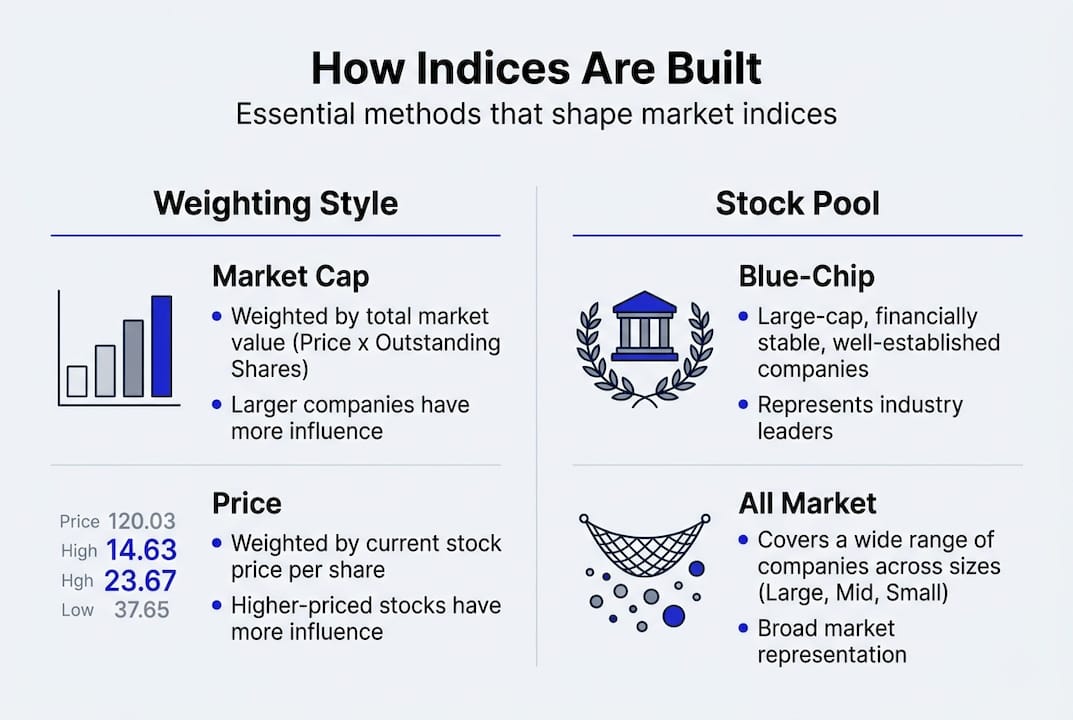
The most common construction method is market-capitalization weighting, where each company's influence on the index is proportional to its total market value. Larger companies move the needle more. This approach is efficient and self-adjusting, but it concentrates risk in the biggest names. When you look at the market cap leaders globally, a handful of mega-caps can represent a disproportionate share of an entire index.

Other methodologies include equal weighting, capped weighting, and fundamental weighting, each with distinct tradeoffs:
| Method | How it works | Pros | Cons |
|---|---|---|---|
| Cap-weighted | Weight by market value | Efficient, low turnover | Concentrates in mega-caps |
| Price-weighted | Weight by share price | Simple to calculate | Distorted by stock splits |
| Equal-weighted | Same weight for all stocks | Better diversification | Higher turnover and costs |
| Fundamental-weighted | Weight by earnings, sales, or dividends | Value-oriented, less bubble risk | More complex, higher costs |
Here is a practical way to evaluate any index fund before you invest:
- Identify the weighting method used.
- Check the top 10 holdings and their combined percentage weight.
- Assess sector concentration relative to your existing portfolio.
- Review rebalancing frequency, which affects costs and tax efficiency.
For investors interested in large-cap stocks, cap-weighted indices will feel familiar, but understanding the fundamental weighting rationale can open up alternative strategies that reduce bubble exposure.
Pro Tip: Always check the weighting method before selecting an index fund. Two funds tracking "the market" can behave very differently depending on how their underlying index assigns weights.
Risks, hidden biases, and edge cases in popular indices
Understanding construction is crucial, but there's more beneath the surface: certain indices come with hidden biases or risks that can surprise investors.
Cap-weighted indices dominated by mega-caps can distort the picture significantly. When a small number of stocks account for 30% or more of an index, your "diversified" fund may not be as diversified as you think. Price-weighted indices face their own distortions from stock splits, while float adjustment changes how weights are calculated by removing insider-held shares from the equation.
Here are the key risks to watch across popular indices:
- Mega-cap concentration: The top five or ten stocks in a cap-weighted index can drive the majority of returns, masking weakness in hundreds of smaller holdings.
- Sector tilt: The Nasdaq is tech-focused, with approximately 50% of its weight in technology, making it more volatile and less representative of the broader economy.
- Dow distortions: A high-priced stock in the Dow carries more weight than a lower-priced one, regardless of actual company size or economic relevance.
- Float adjustment: Shares held by insiders or governments are excluded, which can shift weightings in ways that are not immediately obvious from headline numbers.
An index is only as representative as its construction rules allow. Before using any index as a benchmark, verify what it actually measures and what it leaves out.
For analysts tracking U.S. equities, reviewing NASDAQ stocks and NYSE stocks side by side can reveal how differently these markets are composed.
Pro Tip: Always check for sector, company, and concentration risks in any index before using it as a benchmark or building a fund strategy around it.
How to use indices for smarter investment decisions
With risks and structure in mind, it's time to turn knowledge into power. Here's how to use indices for sharper investment outcomes.
One of the most common mistakes investors make is benchmarking a technology-heavy portfolio against the S&P 500, then feeling either falsely reassured or unnecessarily alarmed. The S&P 500 delivers roughly 10% long-term, but the Nasdaq has historically returned more with considerably higher volatility. Picking the right benchmark requires matching it to your actual exposure.
Here is a practical four-step process for integrating index knowledge into your investing:
- Match your benchmark to your portfolio. If you hold mostly tech stocks, the Nasdaq-100 is a more relevant benchmark than the S&P 500.
- Evaluate index funds by construction, not just name. Two S&P 500 funds are largely identical; two "total market" funds may differ significantly based on weighting rules.
- Use sector weights as a risk check. If an index is 35% financials and your portfolio is 10%, you are making an active bet whether you realize it or not.
- Revisit your benchmarks annually. Index compositions change as companies grow, shrink, or get added and removed.
For those interested in outperforming the S&P 500, understanding index structure is actually the starting point, not a detour.
Pro Tip: Don't chase past returns based on index headlines. Understand the index structure first, because that structure shapes future behavior more reliably than recent performance.
Why 'simple' index investing is more complicated than it looks
Before wrapping up, let's set aside the crowd wisdom and revisit indices with a skeptical, investor-first lens.
The conventional wisdom that passive index investing is always the safe, low-effort choice is worth questioning. Cap-weighted indices, by design, force you to buy more of what has already risen and less of what has fallen. In a prolonged bull market for a single sector, that means you are systematically increasing exposure to the most expensive assets. That is not passive risk management; it is momentum investing in disguise.
Smart investors look beyond the ticker and ask what is inside. Digging into fundamentals alongside index mechanics gives you a clearer picture of whether your index fund is genuinely diversified or quietly concentrated. True index understanding leads to better portfolio alignment, more deliberate risk control, and more informed choices between active and passive strategies.
Explore Tickerplace tools for index and stock analysis
If you want to move from learning to action, practical analysis tools can make your new knowledge stick.
Tickerplace gives you the research and screening tools to match index structures with real portfolio decisions. Use the stock screener to filter equities by sector, market cap, and fundamental criteria, aligning your selections with the index construction logic you now understand.
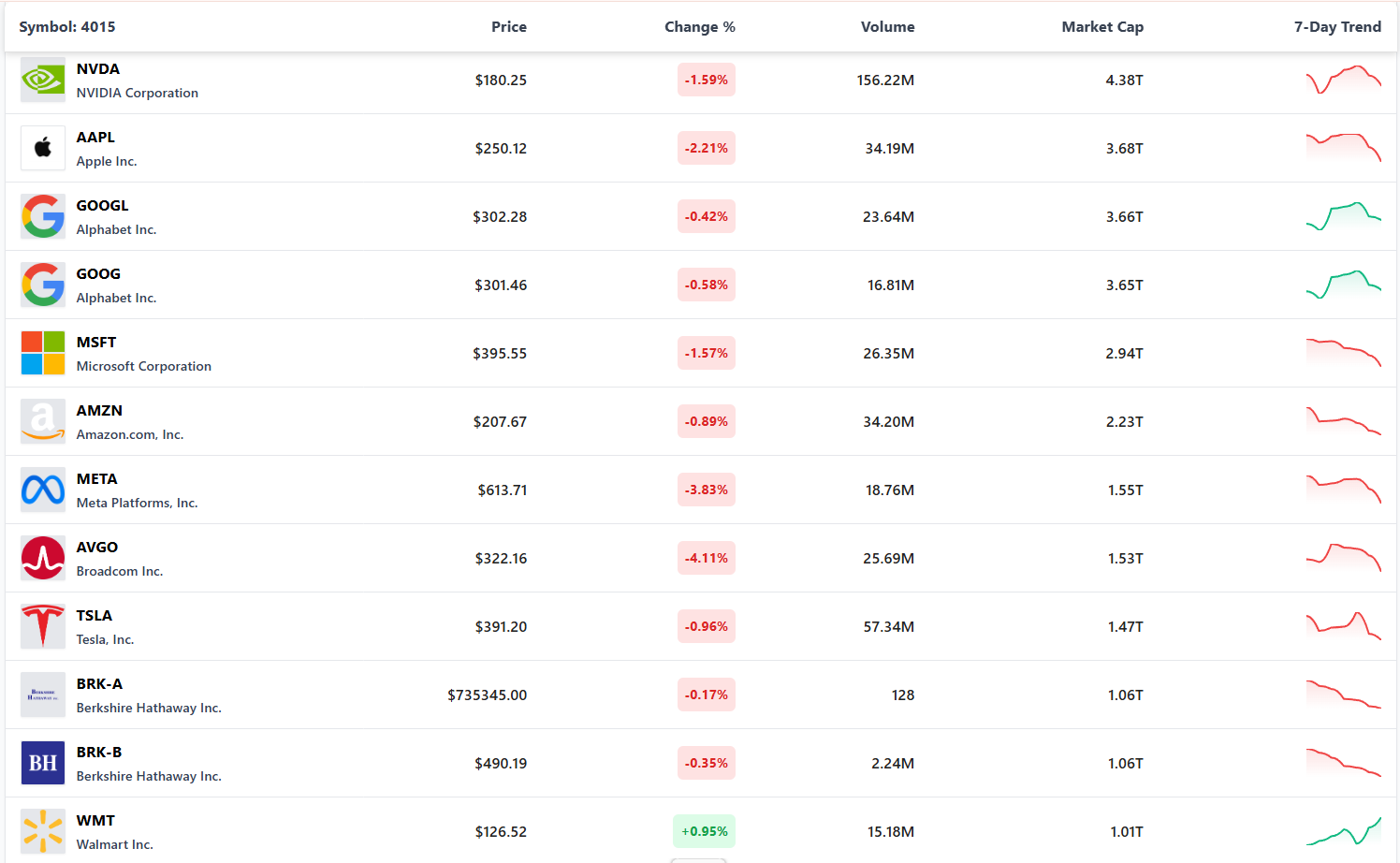
For deeper context on indices, sectors, and equity research, the investing education hub connects data with actionable insight. Whether you are benchmarking performance or building a fund strategy, Tickerplace puts the right tools directly in your hands.
Frequently asked questions
What is the difference between the S&P 500, Dow Jones, and Nasdaq indices?
The S&P 500 covers ~80% of the U.S. market with 500 companies; the Dow tracks only 30 blue-chip stocks using price weighting, while the Nasdaq is tech-focused and considerably more volatile than either.
Why does the weighting method of an index matter?
Weighting determines which stocks drive index performance most; cap-weighted indices can be dominated by a few mega-caps, while equal or fundamental weighting spreads influence more broadly across holdings.
Should investors always use the S&P 500 as a benchmark?
Not necessarily; the best benchmark matches your portfolio's actual sector mix and risk level, which may differ from the S&P 500's composition and long-term return profile.
What is float adjustment in an index?
Float adjustment removes shares unavailable for public trading, such as insider or government holdings, producing a more accurate measure of true investable market exposure.