
Many investors struggle to decode the flood of charts, volume figures, and financial metrics that stream across their screens daily. Without a clear framework, market data can feel overwhelming, leading to hesitant decisions or missed opportunities. This guide breaks down the essential steps to interpret market signals confidently, combining technical chart analysis with fundamental metrics so you can make informed investment choices. You’ll learn how to read price action, confirm moves with volume, assess company health through ratios, and integrate multiple data sources into a coherent strategy that works for your goals.
Key Takeaways
| Point | Details |
|---|---|
| Chart types and trends | Learn to read candlestick and line charts to identify uptrends, downtrends, and sideways ranges. |
| Volume confirms moves | Use volume bursts to confirm price moves and assess institutional participation during breakouts. |
| Timeframe alignment | Match chart timeframes to your investment horizon to avoid signal misreads. |
| Combine data sources | Combine technical signals with fundamental metrics to improve decision accuracy. |
Understanding market charts and price action
Reading market data starts with mastering chart types: candlestick charts show open, high, low, and close prices for each period, revealing precise intraday behavior and patterns like bullish engulfing or hammer formations. Each candlestick tells a story about buyer and seller balance during that timeframe. If you’re new to charting, line charts simplify by plotting only closing prices, making it easier to spot broad trends without the noise of intraday swings.

Trends come in three flavors: uptrends feature higher highs and higher lows, signaling sustained buying pressure; downtrends show lower highs and lower lows, indicating persistent selling; sideways or range-bound markets oscillate horizontally between support and resistance. Identifying these patterns helps you align trades with momentum rather than fighting the prevailing direction. Support levels act as floors where buying interest historically emerges, while resistance levels serve as ceilings where sellers step in. When price breaks through these zones with conviction, new trends often begin.
Your chart timeframe should match your investment horizon. Day traders focus on one-minute to hourly charts for rapid entries and exits, swing traders examine daily and weekly views to capture multi-day moves, and long-term investors rely on weekly or monthly charts to filter out short-term noise. Volume confirmation adds another layer of confidence: a breakout accompanied by surging volume suggests strong institutional participation, while low-volume moves often fizzle. Explore investing education resources to deepen your understanding of chart patterns and timeframe selection.
Pro Tip: Always check multiple timeframes before committing capital. A bullish signal on a five-minute chart means little if the daily chart shows a clear downtrend.
Analyzing volume and open interest to confirm market moves
Volume confirms price moves by measuring how many shares or contracts changed hands during a period. High volume during a breakout signals institutional conviction, suggesting the move has legs and isn’t just retail noise. When a stock surges on twice its average volume, you can trust that large players are behind the action. Conversely, low-volume breakouts often indicate weak participation, making reversals more likely as soon as profit-taking begins.
Volume spikes also reveal accumulation and distribution phases. Accumulation occurs when smart money quietly buys shares over time, often visible as rising volume on down days and falling volume on up days. Distribution is the opposite: insiders and institutions offload positions, pushing volume higher on rallies as they sell into strength. Recognizing these patterns helps you anticipate major moves before they fully unfold.
Open interest tracks the total number of outstanding options or futures contracts and provides insight into market sentiment. Changes in out-of-the-money short-lived options predict future returns by revealing informed trading activity. When open interest rises alongside price, the trend is healthy and likely to continue. When open interest falls while price climbs, fewer new participants are entering, signaling potential exhaustion.
Put/call ratios derived from open interest data help gauge sentiment extremes. Ratios above 1.0 suggest bearish positioning, while readings below 0.7 indicate bullish confidence. Extreme readings often precede reversals as the crowd tends to be wrong at turning points. Combining volume and open interest gives you a fuller picture: volume shows immediate activity, while open interest reveals longer-term positioning and conviction.
Pro Tip: Watch for divergence between price and open interest. If a stock rallies but open interest in calls declines, it may signal that informed traders are taking profits rather than adding exposure.
Using financial ratios and benchmarks to enhance market data analysis
Financial ratios from market data provide a snapshot of company health beyond price charts. Return on equity measures how efficiently management generates profit from shareholder capital, with readings above 15% generally considered strong. Profit margins reveal pricing power and cost control: gross margin shows production efficiency, operating margin reflects core business profitability, and net margin captures the bottom line after all expenses and taxes.
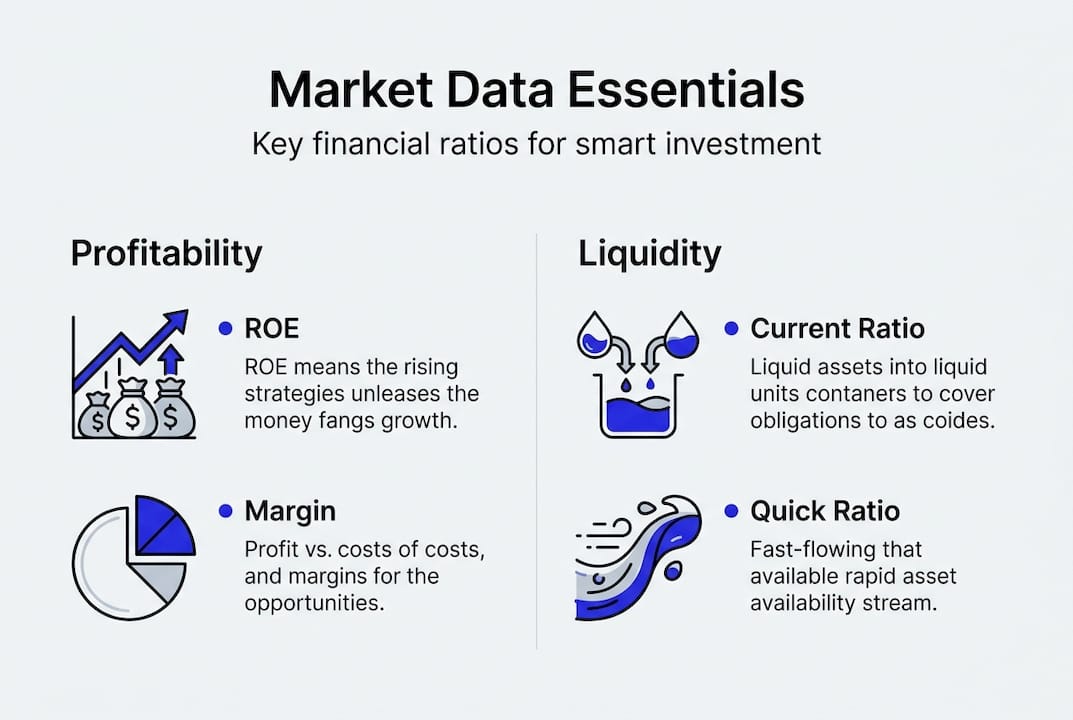
Liquidity ratios like the current ratio and quick ratio assess a company’s ability to meet short-term obligations. A current ratio above 1.5 suggests healthy liquidity, while readings below 1.0 raise red flags about potential cash crunches. Solvency ratios such as debt-to-equity and interest coverage gauge long-term financial stability. Companies with debt-to-equity below 0.5 carry less risk, though some capital-intensive industries naturally run higher leverage.
DuPont analysis breaks down ROE into three components: profit margin, asset turnover, and financial leverage. This decomposition reveals whether strong ROE stems from operational excellence, efficient asset use, or simply high debt. Common-size analysis expresses each line item as a percentage of revenue or total assets, enabling apples-to-apples comparisons across companies of different sizes. Trend analysis tracks how ratios evolve over quarters and years, highlighting improving or deteriorating fundamentals.
Benchmark data like S&P 500 option volumes provide context for individual stock activity. SPX options open interest reached 2.8 million contracts in July 2023, up 45% year-over-year, with average daily volume of 1.9 million. Put/call ratios averaged 0.68 in bull markets and 1.45 in bear markets, illustrating how sentiment shifts with market conditions. Comparing your stock’s metrics to sector and index averages highlights relative strength or weakness.
| Ratio Category | Key Metrics | What They Reveal |
|---|---|---|
| Profitability | ROE, gross margin, net margin | Earnings power and pricing strength |
| Liquidity | Current ratio, quick ratio | Ability to cover short-term debts |
| Solvency | Debt-to-equity, interest coverage | Long-term financial stability |
| Efficiency | Asset turnover, inventory turnover | How well management uses resources |
Regularly tracking these ratios alongside price and volume data sharpens your ability to distinguish genuine value from hype. Check out SUN financials and the financial metrics guide to see how professionals apply ratio analysis in real-world scenarios.
Pro Tip: Compare ratios across at least three competitors and the sector median to identify outliers. A single company’s ratios mean little without context.
Integrating technical and fundamental analysis for informed decisions
Technical analysis excels at short-term timing by using price patterns, volume, and momentum indicators to pinpoint entry and exit points. It assumes all available information is already reflected in price, so studying charts reveals collective market psychology. Fundamental analysis takes the opposite approach, digging into financial statements, competitive positioning, and macroeconomic factors to assess intrinsic value and long-term potential. Neither method is complete on its own: technical signals can trigger trades in overvalued stocks, while fundamental picks may languish if timing is poor.
Combining both methods reduces blind spots. Use fundamental analysis to build a watchlist of companies with strong earnings growth, reasonable valuations, and solid balance sheets. Then apply technical analysis to time your entries when charts show bullish setups like breakouts, pullbacks to support, or momentum reversals. This hybrid approach ensures you’re buying quality names at favorable technical moments, stacking probabilities in your favor.
Backtesting strategies against historical data is critical because empirical edge decays as markets evolve and other participants discover the same patterns. Rigorous testing reveals whether a strategy works across different market regimes or only during specific conditions like bull markets or low volatility. Regime monitoring tracks whether current conditions match your strategy’s sweet spot, helping you avoid applying trend-following tactics in choppy sideways markets or mean-reversion plays during strong trends.
Watch for divergence signals that hint at weakening trends. If price makes new highs but open interest or volume declines, fewer participants are supporting the move, suggesting exhaustion. Similarly, if a stock rallies but momentum indicators like RSI fail to confirm by making lower highs, a reversal may be near. Continual learning through books, courses, and market observation keeps your skills sharp as market dynamics shift. Explore investing education to access frameworks and case studies that illustrate successful integration of technical and fundamental approaches.
Pro Tip: Create a decision checklist that requires both technical and fundamental criteria to be met before entering a trade. This discipline prevents impulsive decisions driven by a single data point.
Explore tools and resources to master market data
Applying the concepts in this guide becomes far easier when you have the right tools at your fingertips. Specialized platforms save time by aggregating charts, financial statements, volume data, and screening capabilities in one place, letting you focus on analysis rather than data collection. Tickerplace offers a comprehensive stock market research and analysis tool that integrates real-time quotes, technical charts, and fundamental metrics, aligning perfectly with the hybrid approach outlined here.
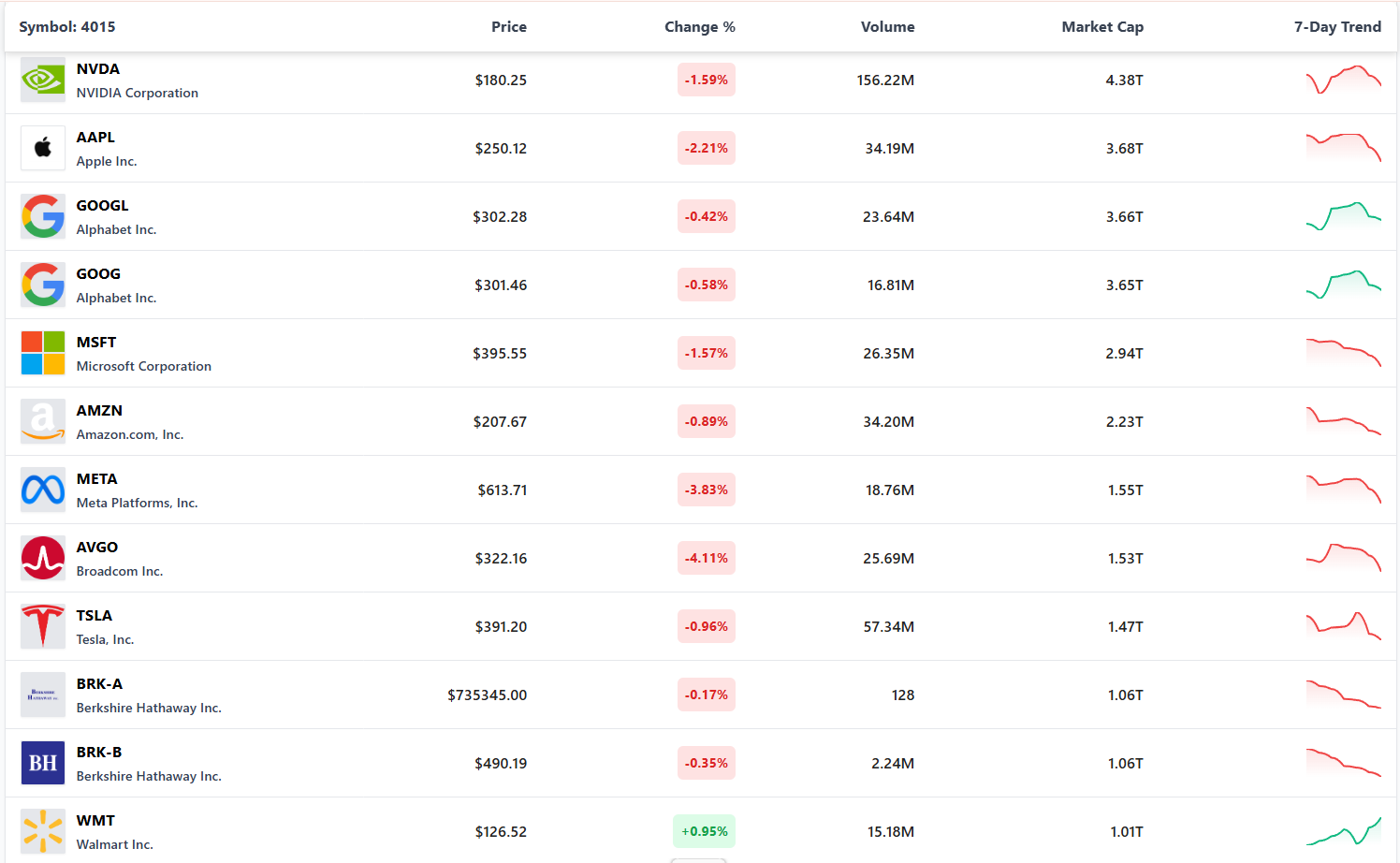
The stock screener tool lets you filter thousands of stocks by criteria like P/E ratio, volume spikes, or ROE thresholds, quickly surfacing candidates that match your strategy. Access to integrated financials, historical charts, and benchmark comparisons simplifies decision-making by presenting all relevant data in a unified interface. Regular use of these tools solidifies your understanding by applying concepts in real market conditions, turning theory into practical skill. Dive into investing education resources to complement your platform usage with tutorials and best practices that accelerate your learning curve.
Frequently asked questions
What are the best chart types for beginner investors?
Line charts are the simplest starting point because they plot only closing prices, making it easy to identify overall trends without getting lost in intraday volatility. Once you’re comfortable spotting uptrends, downtrends, and support levels on line charts, candlestick charts provide richer detail by showing open, high, low, and close data, revealing patterns like reversals and continuation signals that line charts miss.
How does volume help confirm price movements?
High volume during breakouts signals strong market conviction from institutional players, increasing the likelihood that the move will continue rather than reverse quickly. Low-volume breakouts often indicate weak participation, making them prone to failure as soon as early buyers take profits. Comparing current volume to the stock’s average daily volume helps you gauge whether a move has genuine support or is just noise.
What financial ratios are essential for market data analysis?
Return on equity, profit margins, current ratio, and debt-to-equity are foundational metrics that reveal profitability, liquidity, and solvency at a glance. Analyzing these financial metrics alongside price and volume data gives you a complete view of whether a stock’s movement reflects underlying business strength or just speculative momentum. Ratios become even more powerful when compared to industry peers and historical trends to spot improving or deteriorating fundamentals.
Can combining technical and fundamental analysis improve investing?
Absolutely. Technical analysis provides precise timing for entries and exits based on price patterns and momentum, while fundamental analysis ensures you’re investing in companies with solid earnings, reasonable valuations, and sustainable competitive advantages. This hybrid approach balances short-term trading opportunities with long-term value, helping you navigate market dynamics more effectively than relying on either method alone. Many successful investors use fundamentals to select what to buy and technicals to decide when to buy it.