
Many investors assume that buying shares in a well-known, household-name company is essentially a risk-free move. That assumption is worth examining carefully. Large cap stocks represent some of the most recognized companies in the world, yet they are not immune to volatility, sector downturns, or broader economic pressure. Understanding what large cap stocks actually are, how they are measured, and what role they play in a portfolio gives you a meaningful edge. This article covers the definition, key examples, benefits, risks, and practical steps to identify large cap stocks with confidence.
Key Takeaways
| Point | Details |
|---|---|
| Large cap means big companies | Large cap stocks are companies with market values over $10 billion, known for stability and influence. |
| Comparison is key | Evaluating large cap stocks alongside mid and small caps helps balance your investment portfolio. |
| Tools simplify research | Market cap calculators and stock screeners make it easy to identify large cap opportunities. |
| Blue chip overlap | While most blue chips are large caps, not all large caps have blue chip status or reputation. |
| Diversify for stability | Including large caps in your strategy may boost stability but should be balanced with other investments. |
Defining large cap stocks
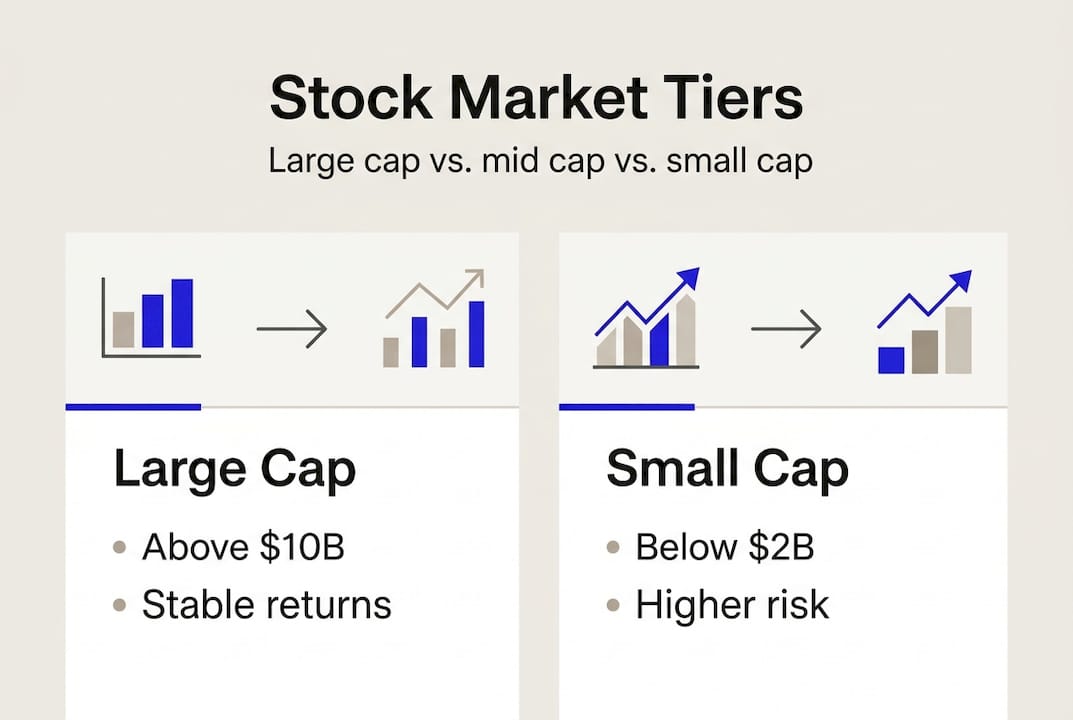
A large cap stock is a publicly traded company with a market capitalization above $10 billion in the U.S. Market capitalization, often shortened to market cap, is calculated by multiplying a company’s current share price by its total number of shares outstanding. It is the most widely used measure of a company’s total value on the stock market.
Why does market cap matter to investors? It directly influences three critical factors:
-
Risk profile: Larger companies tend to have more diversified revenue streams, which can cushion against sudden losses.
-
Stability: Large caps generally show less dramatic price swings than smaller companies.
-
Liquidity: High trading volumes make it easier to buy or sell shares quickly without significantly affecting the price.
It is worth noting that the $10 billion threshold is a U.S. convention. Other markets may apply slightly different cutoffs, and some financial data providers set the bar at $5 billion or higher depending on their classification system. Always check which definition a specific index or fund is using. You can explore market capitalization explained in detail or use the market cap calculator to verify figures yourself.
| Market cap tier | Typical threshold (U.S.) |
|---|---|
| Large cap | Above $10 billion |
| Mid cap | $2 billion to $10 billion |
| Small cap | $300 million to $2 billion |
| Micro cap | Below $300 million |
With the basics established, let’s see how large cap compares to other categories.
Large cap vs. mid cap and small cap stocks
Understanding where large cap fits within the broader market requires a clear look at how each tier differs. Market cap ranges for small, mid, and large cap stocks reflect not just size but also investor expectations around growth, risk, and income.
| Category | Market cap range | Growth potential | Stability | Risk level |
|---|---|---|---|---|
| Large cap | Above $10 billion | Moderate | High | Lower |
| Mid cap | $2B to $10 billion | High | Moderate | Moderate |
| Small cap | $300M to $2 billion | Very high | Low | Higher |
Here is how each category tends to behave:
-
Large cap stocks suit investors who prioritize capital preservation, steady dividends, and lower volatility. They are common anchors in retirement portfolios.
-
Mid cap stocks offer a balance between growth and stability, often appealing to investors with a medium risk tolerance and a longer time horizon.
-
Small cap stocks carry higher risk but can deliver outsized returns, making them attractive for growth-focused investors willing to accept more volatility.
The right mix depends on your goals, timeline, and comfort with risk. Many seasoned investors hold all three tiers to balance growth with stability. For a deeper look at calculating market cap across different company sizes, the methodology is consistent regardless of tier.
Now that you know how large cap stacks up to other categories, let’s look at examples you might recognize.
Examples of large cap companies
Some of the most influential companies in the world are large caps. The world’s largest companies by market capitalization in 2026 include names that appear in nearly every major index and institutional portfolio.
| Company | Sector | Why it qualifies |
|---|---|---|
| Apple | Technology | Consistently above $2 trillion market cap |
| Microsoft | Technology | Major index component, global enterprise reach |
| Amazon | Consumer/Cloud | Diversified revenue across retail and AWS |
| Alphabet (Google) | Technology/Advertising | Dominant search and cloud market share |
| Saudi Aramco | Energy | One of the largest companies globally by market cap |
These companies span multiple sectors, which illustrates an important point: large cap is not synonymous with technology. Energy, healthcare, financials, and consumer staples all have significant large cap representation.
Large cap stocks also carry outsized influence on major indices. In the S&P 500, the top 10 holdings by market cap often account for more than 30% of the index’s total weight. That means when Apple or Microsoft moves sharply, the index moves with it. This concentration effect is something every index investor should understand.
-
Large caps often set the tone for broader market sentiment.
-
Institutional investors, including pension funds and mutual funds, hold large caps as core positions.
-
Earnings reports from large cap companies can move entire sectors, not just individual stocks.
Understanding the makeup of large cap stocks leads to the question: what makes them attractive, or not, for investors?
Why invest in large cap stocks?
Large cap stocks offer a distinct set of advantages, but they also come with trade-offs that investors should weigh honestly.
Advantages:
-
Established track records: These companies have typically survived multiple economic cycles, providing historical data for analysis.
-
Higher liquidity: You can enter and exit positions with minimal slippage, which matters for both individual investors and larger accounts.
-
Dividend income: Many large caps pay regular dividends, offering a reliable income stream alongside potential price appreciation.
-
Analyst coverage: Extensive research coverage means more publicly available data to inform your decisions.
-
Index inclusion: Large caps are core components of major indices, giving them built-in demand from passive funds.
Drawbacks:
-
Slower growth: A company already worth $500 billion has far less room to double in size than a $1 billion company.
-
Economic sensitivity: Large multinationals can be exposed to currency risk, geopolitical shifts, and regulatory changes across multiple markets.
-
Valuation risk: Popular large caps can become overvalued, meaning you may pay a premium that limits future returns.
A common myth is that large cap stocks are essentially safe. They are relatively more stable, but large cap investments still carry meaningful risk. During the 2008 financial crisis and the 2020 market crash, many large caps fell 30% to 50% in value.
“Stability is not the same as safety. Large cap stocks can and do experience significant drawdowns during market stress.”
Pro Tip: Avoid over-concentrating your portfolio in large caps alone. Balancing them with mid cap and small cap positions can improve your overall risk-adjusted returns over time.
Let’s clarify the difference between large cap and an often-confused term: blue chip stocks.
Large cap stocks vs. blue chip stocks
The terms large cap and blue chip are often used interchangeably, but they are not identical. Understanding the difference between large cap and blue chip stocks helps you make more precise portfolio decisions.
The term “blue chip” comes from poker, where blue chips hold the highest value at the table. In investing, it refers to companies with a long history of financial strength, consistent earnings, and a reputation for reliability.
Here is how the two concepts overlap and diverge:
-
Most blue chips are large cap: Companies like Johnson & Johnson or Coca-Cola are both large cap and blue chip.
-
Not all large caps are blue chip: A recently listed tech company with a $15 billion market cap may qualify as large cap but lacks the decades-long track record that defines a blue chip.
-
Blue chip criteria go beyond size: Consistent dividend payments, low debt levels, and a durable competitive advantage are hallmarks of blue chip status.
-
Risk implications differ: Blue chips are generally considered more conservative investments within the large cap universe.
For portfolio strategy, this distinction matters. If you are building an income-focused, lower-volatility portfolio, targeting blue chip large caps is more precise than simply filtering by market cap. You can find additional investing insights to help refine your approach.
Now let’s get practical so you can identify and evaluate large cap stocks for yourself.
How to identify large cap stocks
Finding large cap stocks is straightforward once you know the process. The market cap calculation is simple, and the data is widely available.
-
Find the share price: Look up the company’s current stock price on any financial data platform or brokerage.
-
Find shares outstanding: This figure appears in the company’s most recent quarterly or annual filing, or on most financial data sites.
-
Multiply the two figures: Share price multiplied by shares outstanding equals market cap. For example, a stock trading at $150 with 10 billion shares outstanding has a market cap of $1.5 trillion.
-
Compare to the threshold: If the result exceeds $10 billion, the company qualifies as large cap under U.S. conventions.
-
Verify with a tool: Use the market cap calculator tool to confirm your calculation, or run a filter on the stock screener to pull a list of large cap companies instantly.
Pro Tip: Always confirm that the data you are using is current. Market caps shift daily as share prices move. A company that was large cap last quarter may have dropped into mid cap territory after a significant price decline, or vice versa.
Once you know how to spot large cap stocks, let’s wrap up with how you can further leverage tools and resources.
Advance your large cap investing with Tickerplace
Researching large cap stocks requires reliable, up-to-date data and tools that let you filter, compare, and analyze efficiently. That is exactly what Tickerplace is built for.
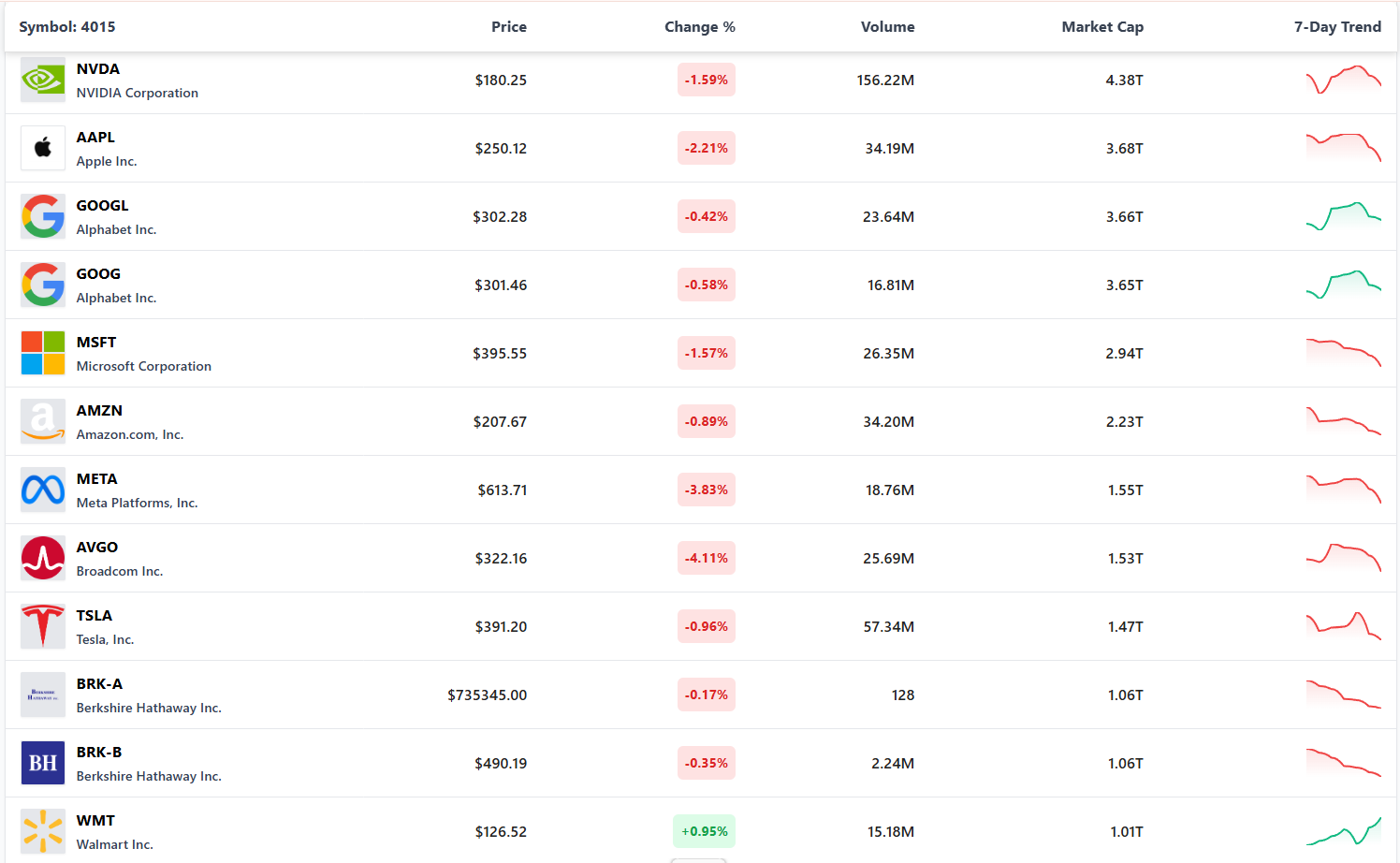
With Tickerplace, you can screen for large cap stocks by market cap, sector, dividend yield, and dozens of other criteria using the large cap stock screener. You can also verify market cap figures instantly with the market cap calculator, track real-time price movements, and access fundamental and technical analysis all in one place. Whether you are building a new position or reviewing an existing one, Tickerplace gives you the data infrastructure to make decisions grounded in facts, not assumptions. Start exploring today and put your large cap research on a stronger foundation.
Frequently asked questions
What is considered a large cap stock?
In the U.S., a large cap stock typically refers to a public company with a market cap above $10 billion. Some providers set slightly different thresholds, so always check the specific definition used by the index or fund you are referencing.
How do I find out if a stock is large cap?
Multiply the company’s current share price by its total shares outstanding to get the market cap; if it exceeds $10 billion, it is generally large cap. You can also use a stock screener to filter by market cap directly.
Are large cap stocks always safer than small caps?
Large cap stocks are generally more stable but can still experience significant volatility, particularly during recessions or sector-specific downturns. Stability and safety are related but not the same thing.
What is the difference between large cap and blue chip stocks?
Most blue chip stocks are large cap, but blue chips are defined by their long track record, consistent dividends, and financial strength, not just their size. A company can be large cap without meeting blue chip standards.
Can large cap stocks offer growth opportunities?
Yes. Some large cap companies in fast-moving sectors like technology and healthcare continue to deliver strong growth, even at scale. Growth potential varies significantly by company and sector.