

TL;DR:
Tracking Coles shares requires using real-time data sources to avoid misleadingly delayed quotes that are often 15 to 20 minutes old.
Investors should analyze technical indicators, moving averages, and dividend impact alongside fundamental factors to make informed trading decisions.
Tracking the price of Coles shares sounds straightforward until you realize that many investors are working with data that is already 15 to 20 minutes old. Coles Group Limited, listed on the Australian Securities Exchange under the ticker ASX:COL, is one of Australia’s most recognized consumer staples stocks. But accessing the right price at the right moment requires more than a quick web search. This guide walks you through how to find the Coles shares current price, how to interpret what you see, and how to apply that data to smarter investment decisions.
Key takeaways
| Point | Details |
|---|---|
| Real-time data matters | Delayed quotes can mislead trade timing; always verify the timestamp on any price source. |
| Price context is critical | A falling price on ex-dividend day is mechanical, not a signal of business deterioration. |
| Technical indicators add depth | Moving averages and 52-week ranges help you assess whether current pricing reflects fair value. |
| Low beta means lower volatility | Coles shares carry a beta of ~0.29, making them a relatively stable holding in a diversified portfolio. |
| Combine data sources | Pairing live price feeds with fundamental analysis produces more reliable buy and sell decisions. |
What drives the price of Coles shares
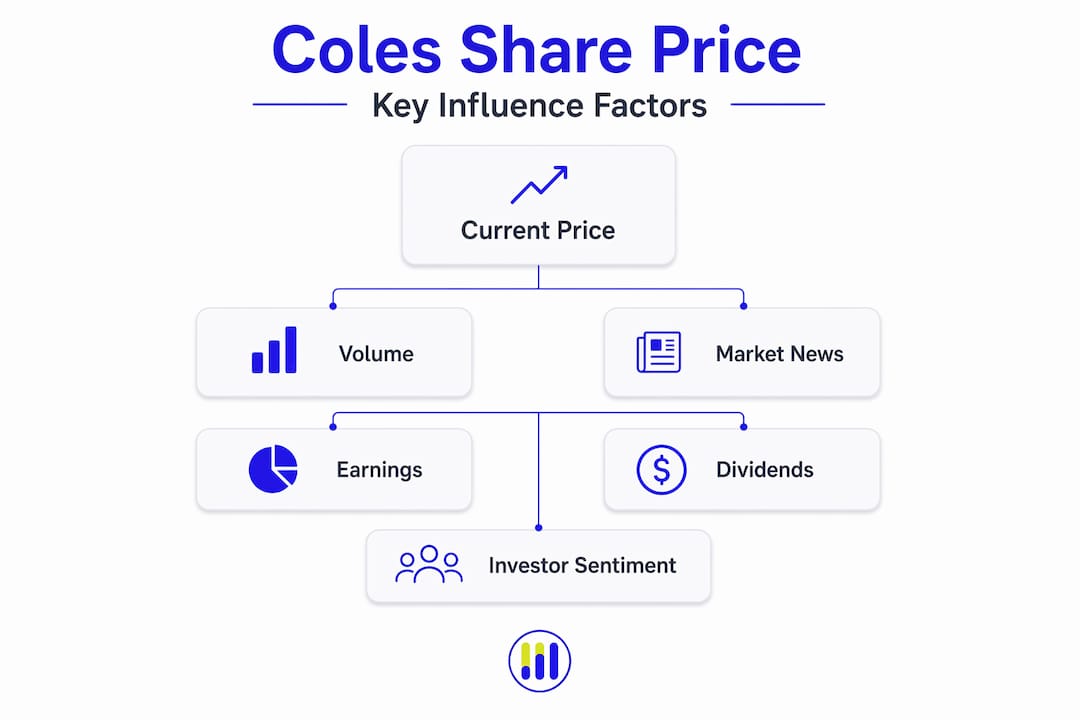
Share price is simply the most recent price at which a buyer and seller agreed to transact on the exchange. For Coles Group, that transaction occurs on the ASX during regular trading hours, and the price shifts continuously based on supply and demand. As of the close on May 27, 2026, the Coles share price sat at $21.36 AUD, with a day’s trading range of $21.09 to $21.36.
Several factors move Coles Group’s share price on any given day:
-
Company performance: Quarterly sales results, margin trends, and earnings guidance updates directly affect investor confidence and, by extension, the stock’s price.
-
Sector sentiment: As a consumer staples business, Coles tends to attract defensive capital during uncertain economic periods, which can support its price even when the broader market declines.
-
Macroeconomic conditions: Interest rate decisions by the Reserve Bank of Australia influence the discount rate applied to future earnings, affecting valuations across the market.
-
Corporate actions: Dividends, share buybacks, and capital raisings all have measurable effects on share price. Specifically, ex-dividend price drops confuse many new investors who mistake a mechanical price adjustment for a negative business signal.
When you look at a live quote, you will typically see the open price, the current or last traded price, the day’s high and low, and trading volume. Volume matters because a significant price move accompanied by high volume carries more conviction than the same move on thin trading activity.
Pro Tip: Always check volume alongside price. A 1% move on double the average daily volume is far more meaningful than the same move on half the average volume.
How to find the Coles stock price today
The starting point for any Coles share market analysis is finding a price source you can trust. The official Coles investor page displays the share price with a clear 4:00pm AEST timestamp, which tells you the data reflects the official closing price for that trading day. That timestamp is not a minor detail. It is the difference between making a decision on yesterday’s close and today’s close.
Here is a comparison of common sources investors use to track the Coles stock price today:
| Source | Data type | Delay | Best for |
|---|---|---|---|
| Coles Group investor page | Official closing price | End of day | Verifying official close |
| ASX website (asx.com.au) | Live during market hours | ~10 minutes | General price reference |
| Financial data platforms | Live or near-live | Varies | Technical analysis, screening |
| Social media / screenshots | Unknown | Often hours or days | Not recommended |
The risk with screenshots and social media posts is obvious. A screenshot of a price taken at 10:30am on a volatile trading day could be $0.40 away from where the stock actually closes. For investors using that figure to assess entry points, the distortion is material.
Financial platforms that specialize in ASX equities offer real-time or near-real-time pricing with additional context like historical price data and technical overlays, which makes them more useful for active analysis than a single price snapshot. According to Tickerplace’s guidance on ASX data, real-time price tracking and technical indicators help investors time market entry and exit more effectively than delayed or summary data.
Pro Tip: Bookmark the ASX:COL page on your preferred financial platform and check the data timestamp before acting on any price you see. If the timestamp is more than 20 minutes old during market hours, refresh or find a live source.
Reading Coles share price trends and technical signals
Understanding where a stock is trading right now is only half the picture. Experienced investors also ask: where has it been, and what does its current position suggest about momentum?

Coles shares currently trade below their 50-day and 200-day moving averages, with the stock at approximately A$21.63 against a 50-day simple moving average of A$21.95 and a 200-day SMA of A$22.11. When a stock trades below both of these averages, it generally signals cautious market sentiment, though it does not automatically mean the stock is a poor investment. Context matters.
The 52-week price range for Coles shares sits between approximately A$19.46 and A$23.68. Trading near the middle of that range suggests the market is neither overly optimistic nor deeply pessimistic about Coles Group’s near-term prospects.
Two additional metrics worth tracking:
-
Beta: Coles shares carry a beta of approximately 0.29, indicating that the stock moves roughly 71% less than the broader market in either direction. This reflects its defensive consumer staples profile and makes it attractive to investors seeking stability.
-
Dividend yield: The current dividend yield sits at around 3.15%, which is below the 5-year average of 3.76%. That compression reflects a combination of price appreciation and dynamic dividend changes. Yield below historical average can indicate the stock is relatively more expensive on a yield basis than it has been historically.
Understanding these data points together gives you a far richer view of Coles share value than any single metric can provide on its own.
Using price data to make buy or sell decisions
Knowing the Coles shares current price is necessary but not sufficient. The goal is to translate that number into a decision with a logical basis. Here is a practical framework:
-
Anchor your view in the 52-week range. If the stock is trading near its 52-week low, understand why before assuming it’s a bargain. News-driven dips and ex-dividend adjustments require different responses.
-
Check moving averages for directional context. Trading below the 200-day SMA does not automatically trigger a sell signal, but it does warrant closer attention to whether momentum is recovering or continuing to deteriorate.
-
Set price alerts, not price fixations. Most financial platforms allow you to set alerts at specific price levels. Use them to track support and resistance zones rather than watching the screen continuously.
-
Account for ex-dividend dates. When you see the ex-dividend effect pull the share price down mechanically, recognize that the drop represents a distribution of value to shareholders, not a deterioration in the business.
-
Pair price data with fundamental research. Reviewing Coles Group’s financial statements alongside live price data gives you a complete picture before committing capital.
Pro Tip: Using an investment return calculator alongside live price data helps you model potential outcomes at different entry points before you commit to a trade.
My perspective on tracking Coles share price
In my experience watching investors approach ASX stocks like Coles Group, the most common mistake is treating price as a standalone verdict. A price drop triggers panic selling, while a price rise triggers FOMO buying. Both reactions ignore the underlying business.
What I have found is that Coles Group’s low beta profile is both a feature and a source of misunderstanding. Investors who expect dramatic short-term gains will consistently be disappointed. Investors who understand that Coles is a steady, dividend-paying consumer staples business will find the price data confirms that steadiness rather than contradicting it.
The ex-dividend day price adjustment is the single most misunderstood price movement I see discussed. A stock does not “fall” on ex-dividend day as a sign of weakness. It adjusts mathematically because shareholders have received capital through the dividend. Reacting to that adjustment as though it signals trouble is a costly error.
My advice: build your price-tracking habit around timestamps, moving averages, and dividend calendars. Then step back and ask whether the underlying business has changed before making any trade.
— Tickerplace
Track Coles shares with Tickerplace
Tickerplace gives individual investors the tools to go beyond a single price snapshot. The platform provides live market data, technical analysis overlays, and stock screening capabilities that help you contextualize the Coles stock price today within a broader investment framework. Whether you want to screen for ASX stocks meeting specific price-to-earnings or yield criteria, or you need to review Coles Group’s financial history before your next trade, Tickerplace brings all of that into one place. Visit Tickerplace to access real-time share prices, company financials, and research tools designed for investors who take their decisions seriously. You can also use the stock screener to compare Coles against peers in the consumer staples sector.
FAQ
What is the current price of Coles shares?
As of the close on May 27, 2026, the Coles share price was $21.36 AUD. Always check the official Coles investor page or the ASX for the most current quote with a verified timestamp.
What ASX ticker do Coles shares trade under?
Coles Group trades on the Australian Securities Exchange under the ticker symbol COL. You will find it listed as ASX:COL on most financial platforms.
How do I buy Coles shares?
To buy Coles shares, you need a brokerage account with ASX access. Once your account is funded, you can place a market or limit order for ASX:COL through your broker’s platform during ASX trading hours.
Why did the Coles share price drop on ex-dividend day?
The price drops mechanically on ex-dividend day because the dividend value is redistributed to eligible shareholders, reducing the stock’s theoretical worth by approximately the dividend amount. This is a normal, predictable adjustment and does not reflect any change in business performance.
What is the 52-week price range for Coles shares?
The 52-week trading range for Coles Group shares spans approximately A$19.46 at the low to A$23.68 at the high, placing the current price in the middle portion of that band.