

TL;DR:
- Market data includes price, volume, fundamentals, economic, and sentiment information crucial for investment decisions.
- Combining fundamental and technical analysis enhances accuracy and confidence in stock selection and timing.
- Multi-factor models and disciplined use of data confluence improve chances of outperforming the market.
Market data is the foundation of every informed investment decision, yet many individual investors assume it belongs exclusively to institutional traders with Bloomberg terminals and quant teams. That assumption is wrong, and it's costing retail investors real returns. Price, volume, financial statements, and economic indicators all serve as foundational inputs for smarter stock trading and portfolio management. This guide breaks down what market data actually is, how both fundamental and technical analysts use it, and how you can apply it systematically to strengthen your own investment process.
Key Takeaways
| Point | Details |
|---|---|
| Foundation of investing | Market data—like price, volume, and financials—drives better investment decisions. |
| Multiple analysis methods | Combining fundamental and technical analysis using market data offers more robust strategies. |
| Advanced models add value | Multi-factor approaches integrate diverse data for optimized stock selection. |
| Mind the limits | No data approach is foolproof—success needs discipline, benchmarking, and awareness of costs. |
What is market data and why does it matter?
At its core, market data is any quantifiable information that describes the behavior of financial markets and the companies within them. It is not a single number or a single source. It is a layered system of signals that, when read correctly, tells you where value exists and where risk is hiding.
The main categories include:
- Price data: Real-time and historical stock prices, bid/ask spreads, and intraday movements
- Volume data: The number of shares traded, which confirms or contradicts price trends
- Corporate fundamentals: Earnings per share (EPS), revenue, debt-to-equity ratios, and free cash flow
- Macroeconomic indicators: Interest rates, inflation figures, GDP growth, and employment data
- Sentiment data: Analyst ratings, options flow, and news sentiment scores
Reliable sources range from exchange feeds and SEC filings to accessible portals. Learning the basics of reading market data is the first practical step any serious investor should take.
"Market data, including price, volume, financial statements, and economic indicators, serves as the foundational input for decision-making in stock trading and portfolio management."
| Data type | Primary use | Example metric |
|---|---|---|
| Price | Trend identification | 52-week high/low |
| Volume | Signal confirmation | Average daily volume |
| Fundamentals | Valuation | P/E ratio, EPS |
| Macro indicators | Risk context | Fed funds rate |
| Sentiment | Contrarian signals | Put/call ratio |
Without accurate data, risk management becomes guesswork, portfolio allocation loses its rationale, and timing decisions rely on instinct rather than evidence.
How market data powers fundamental and technical analysis
Once you understand what market data is, the next question is how investors actually use it. Two primary schools of analysis dominate: fundamental and technical. Both rely on market data, but they draw from different subsets and pursue different goals.
Fundamental analysis uses earnings, revenue, and debt ratios like P/E and EPS to assess a company's intrinsic value. It answers the question: is this business worth owning at the current price? This approach suits long-term investors focused on portfolio management and compounding returns over years.

Technical analysis leverages historical price and volume patterns, including moving averages, RSI, and MACD, to identify momentum and optimal entry or exit points. It answers a different question: is now the right time to act?
| Factor | Fundamental analysis | Technical analysis |
|---|---|---|
| Primary inputs | Financial statements, ratios | Price, volume, indicators |
| Time horizon | Long-term (months to years) | Short to medium-term |
| Typical users | Value investors, analysts | Traders, active managers |
| Output | Intrinsic value estimate | Buy/sell timing signals |
Understanding company fundamentals before acting on a technical signal gives you higher conviction. Similarly, trading volume can confirm whether a fundamental breakout has real market participation behind it.
To integrate both methods, follow these steps:
- Screen for stocks with strong fundamental scores (low P/E, high ROE, growing revenue)
- Apply technical filters to identify favorable price setups within that shortlist
- Confirm with volume data that momentum aligns with the fundamental thesis
- Set entry, stop-loss, and target levels based on technical levels
- Reassess fundamentals quarterly to ensure the thesis remains intact
Pro Tip: When fundamentals and technicals align on the same stock, your probability of a successful trade increases significantly. Divergence between the two is often a warning sign worth heeding.
Multi-factor models and advanced data integration
Single-factor investing, relying solely on P/E ratios or a single moving average, leaves money on the table. Professional analysts have long known that combining multiple data streams into a unified scoring framework produces more consistent results across different market regimes.
Multi-factor models normalize fundamental, technical, and sentiment data into composite scores, often using z-scores, to rank stocks on a comparable scale. A stock scoring in the top quartile on return on invested capital (ROIC), price momentum, and positive analyst sentiment simultaneously is a far stronger candidate than one excelling on only one dimension.
Commonly used factors include:
- Quality: ROIC, gross margin stability, earnings consistency
- Value: Price-to-book, EV/EBITDA, free cash flow yield
- Momentum: 12-month minus 1-month price return
- Sentiment: Earnings revision direction, short interest changes
- Low volatility: Beta, standard deviation of returns
| Factor category | Data source | Score contribution |
|---|---|---|
| Quality (ROIC) | Financial statements | 30% |
| Momentum | Price history | 30% |
| Value (EV/EBITDA) | Fundamental data | 25% |
| Sentiment | Analyst revisions | 15% |
For analyzing stocks with multi-factor models, the key advantage is reducing single-factor bias. When momentum fades in a choppy market, quality and value factors can carry the composite score, keeping your selections grounded.
Pro Tip: You do not need to build a quant model from scratch. Pre-built screeners that filter on multiple factors simultaneously give individual investors access to the same logic institutional desks use.
Practical tips: Using market data for better investment outcomes
Frameworks are only useful when applied with discipline. Here is a practical checklist for data-driven investing that avoids the most common pitfalls:
- Source reliable data first. Exchange feeds, SEC filings, and reputable finance platforms minimize noise. Traditional market data from exchanges and filings is reliable for risk management but can carry noise in sentiment readings.
- Align your method to market conditions. Momentum strategies work better in trending markets; value strategies tend to recover in mean-reverting environments.
- Track all costs. Slippage, commissions, and bid/ask spreads erode theoretical returns quickly.
- Benchmark consistently. Always compare your strategy's performance against the S&P 500 to assess whether active data use is actually adding value.
- Avoid overfitting. A strategy that works perfectly on five years of backtested data but ignores transaction costs is not a strategy; it is a data artifact.
Statistic callout: Momentum strategies using price data have shown returns of 32 to 50 percent versus roughly 12 percent for a basic DJIA buy-and-hold approach, though results vary significantly by regime and implementation.
The benefits of market data are real, but they require a blended approach. No single indicator, ratio, or signal works in isolation across all market conditions. Confluence across multiple data points is what separates disciplined investors from those chasing noise.
Pro Tip: Focus on data confluence. When price momentum, volume confirmation, and a strong fundamental score all point in the same direction, the signal is far more actionable than any one factor alone.
A realistic take: The limits and edge cases of market data
Market data is powerful, but it is not a crystal ball. The Efficient Market Hypothesis (EMH) argues that all publicly available data is already priced in, leaving no room for alpha. In practice, empirical strategies like momentum and trend-following have generated excess returns, but most active managers still underperform their benchmarks over a full market cycle, as SPIVA data consistently shows.
The honest reality is that market data creates an edge only when paired with discipline, context, and adaptive thinking. Data without a framework is just noise. A framework without updated data becomes dogma. The investors who consistently outperform are not those with access to more data; they are those who interpret it more rigorously and act on it with fewer emotional biases. Blended, adaptive approaches that shift factor weights as conditions change offer the most realistic path to sustainable outperformance.
Supercharge your investing with the right tools
Applying everything covered here requires the right platform behind you. Tickerplace gives you direct access to real-time market data, multi-factor screening, and research tools built for serious investors.
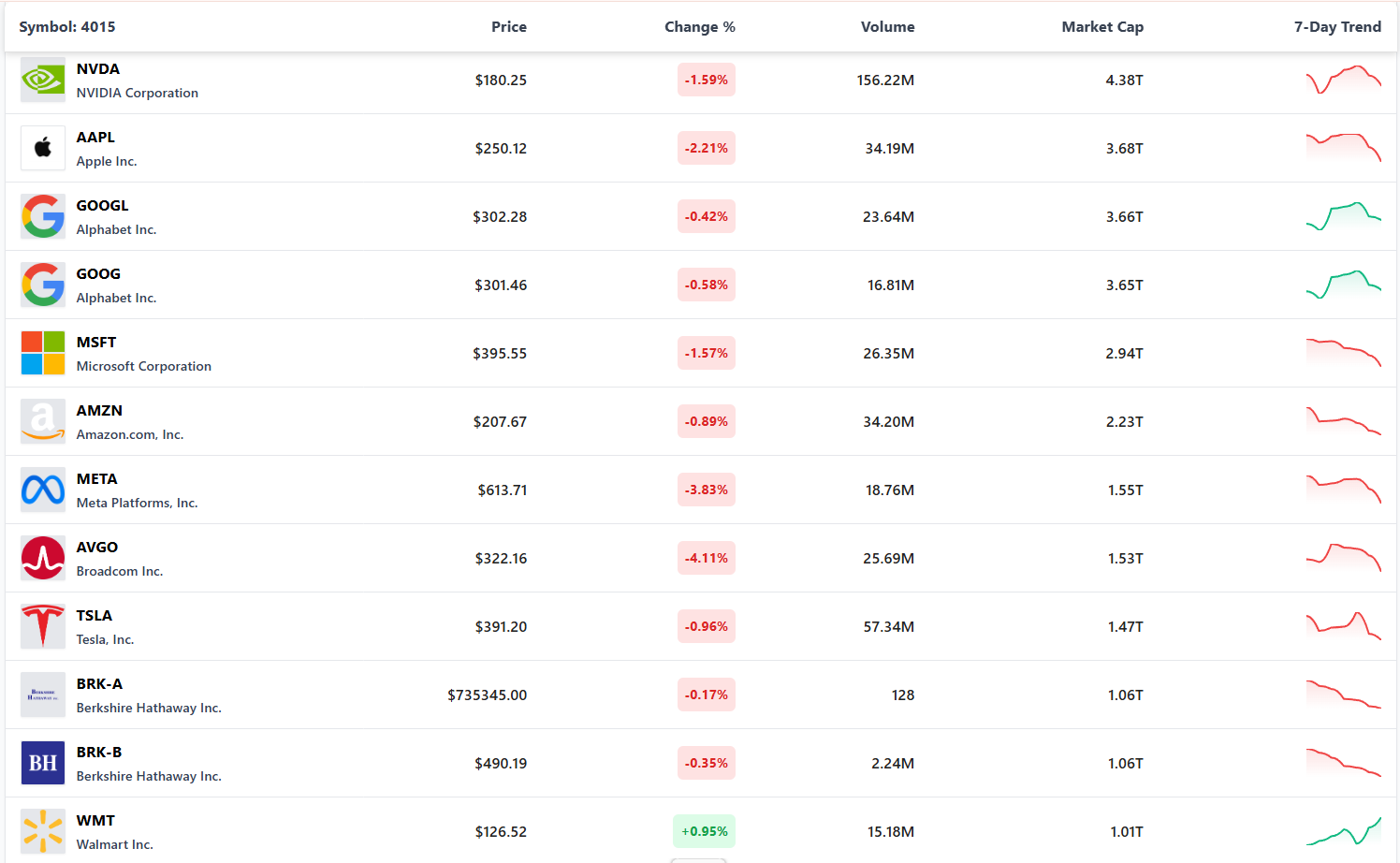
Use the powerful stock screener to filter equities by fundamental and technical criteria simultaneously. Run scenarios through the stock return calculator to model outcomes before you commit capital. And if you want to sharpen your analytical skills further, the investing education center offers structured resources aligned with the methods discussed here. Data-driven investing starts with having the right data at your fingertips.
Frequently asked questions
What types of market data are most important for investors?
Price, volume, financial statements, and economic indicators are the most critical types, as they collectively inform valuation, timing, and risk management decisions.
How do individual investors access quality market data?
Platforms like Yahoo Finance and Fidelity offer accessible starting points, while specialized tools like Tickerplace provide multi-factor screening and analytics that go deeper.
Can using market data really improve investment returns?
Momentum strategies using price data have outperformed basic buy-and-hold approaches in documented studies, particularly in less efficient market conditions.
What are the risks of relying solely on market data?
Overfitting backtests, ignoring transaction costs, and noise in sentiment data are the most common risks when investors rely on a single data stream without proper validation.
Do data-driven strategies always beat the market?
No strategy guarantees outperformance; while momentum and trend strategies have shown edge in certain regimes, most active managers underperform benchmarks over a full market cycle.