

TL;DR:
- WDS is traded on both the ASX and NYSE, with prices denominated in AUD and USD, respectively, which can cause confusion without proper context.
- Investors should always verify the exchange, timestamp, and currency before comparing prices or making trading decisions, as venue-specific data can differ significantly.
When you search "WDS share price," the results can be surprisingly inconsistent. One quote shows an Australian dollar figure from the ASX; another displays a US dollar price from the NYSE. Neither is wrong, but without understanding the underlying context, these conflicting numbers can create costly confusion. This guide cuts through that noise, explaining exactly why WDS trades on two separate exchanges, how to find reliable real-time quotes, and how to use venue-specific price data to sharpen your trading decisions.
Key Takeaways
| Point | Details |
|---|---|
| Dual listing clarity | Understanding both ASX and NYSE WDS listings is crucial for accurate pricing. |
| Real-time quotes matter | Always use official sources and verify timestamps when checking WDS share prices. |
| Venue impact | Trading venue differences can affect price trends and trader strategies. |
| Avoid common mistakes | Check exchange, quote timing, and currency before making trading decisions. |
| Advanced analytics advantage | Combining cross-venue data gives traders a strategic edge. |
Understanding Woodside Energy's dual listing: ASX and NYSE
Having laid out the confusion, let's clarify what "WDS share price" actually means depending on where and how you look it up.
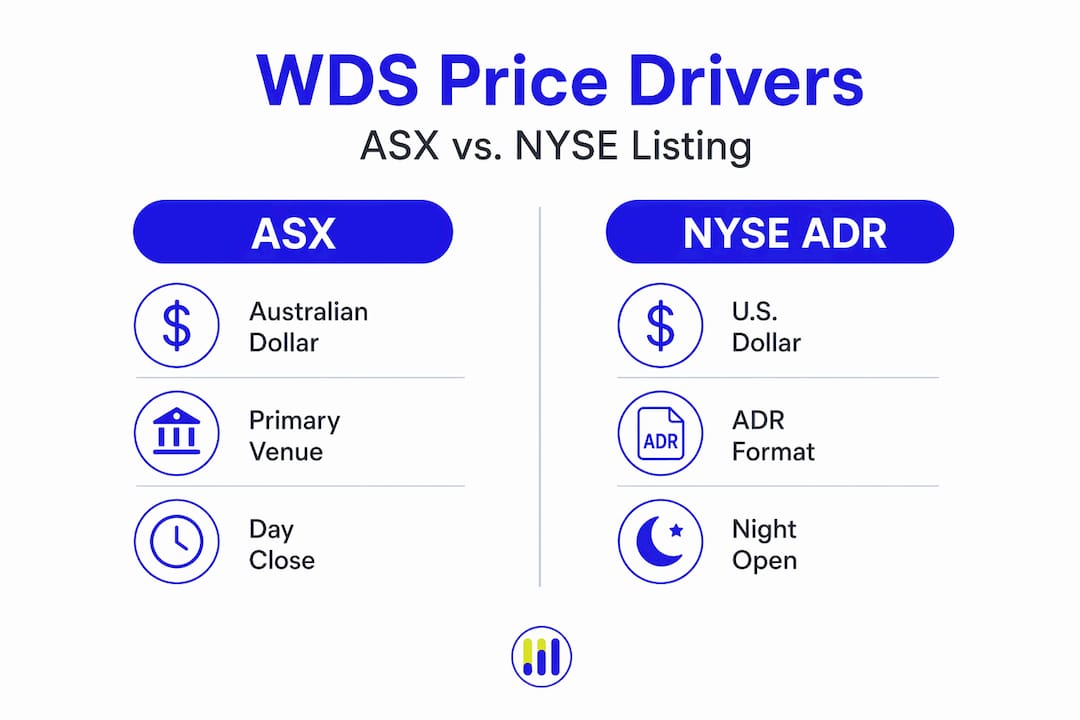
Woodside Energy Group is one of Australia's largest energy producers, and it is traded on two major exchanges. The primary listing is on the Australian Securities Exchange (ASX) under the ticker WDS, where shares are denominated in Australian dollars and trade during Sydney market hours. The secondary listing is on the New York Stock Exchange (NYSE), where Woodside is represented through American Depositary Shares (ADRs), also under the ticker WDS, priced in US dollars.
An ADR is a financial instrument issued by a US depositary bank that represents a set number of shares in a foreign company. For Woodside, each ADR corresponds to one ordinary ASX share. While the ratio simplifies the math, the price in US dollars will still differ from the ASX price due to prevailing exchange rates between the Australian dollar and the US dollar.
Here is a clear comparison of both listings:
| Attribute | ASX listing (WDS) | NYSE listing (WDS ADR) |
|---|---|---|
| Exchange | Australian Securities Exchange | New York Stock Exchange |
| Currency | Australian dollar (AUD) | US dollar (USD) |
| Trading hours | 10:00 AM to 4:00 PM AEST | 9:30 AM to 4:00 PM EDT |
| Instrument type | Ordinary shares | American Depositary Shares |
| ADR ratio | N/A | 1 ADR = 1 ordinary share |
| Primary regulator | ASIC (Australia) | SEC (United States) |
Key points every investor should note about these two instruments:
- Quote currency differs: AUD for ASX, USD for NYSE; never compare raw prices without converting.
- Trading hours do not overlap: This means price gaps can appear between sessions.
- Liquidity varies: ASX typically sees higher daily volume for WDS ordinary shares.
- Corporate actions apply equally: Dividends and splits affect both instruments.
For deeper context on Woodside's corporate fundamentals, the WDS financials and news page provides balance sheet data, earnings history, and analyst commentary that complements your price research. You can also review the full WDS stock price history to trace how the share has performed across market cycles. Additionally, browsing ASX listed companies can give you sector-level perspective on where Woodside fits within the Australian energy landscape.
Where to find real-time WDS share price quotes
Now that exchanges are clear, let's see where you can reliably find up-to-date prices for informed trading.
The official Woodside share price source is the most authoritative starting point. The page provides the latest ASX share price and the current ADR quote on the NYSE, making it easy to compare both in a single location. Importantly, it also displays the timestamp for each quote, which matters more than most traders realize.

For ASX quotes specifically, understanding ASX live price access is essential because ASX data feeds can vary between platforms. Some providers offer real-time quotes with a subscription; others default to a 20-minute delay. That delay can be the difference between entering a trade at your intended price or chasing a move that already happened.
Here is a practical checklist for sourcing WDS price data:
- Woodside investor relations page: Real-time ASX and ADR quotes with timestamps.
- ASX official market data: Authoritative source for Australian market prices.
- NYSE-listed data providers: Ensure the feed is real-time, not delayed by 15 minutes.
- Tickerplace company pages: Consolidated price, chart, and fundamental data for research.
- Brokerage platforms: Often provide streaming quotes as part of account access.
You can also look at finance chart examples on Tickerplace to understand how candlestick, line, and volume charts present price data visually. That context helps you read WDS charts more effectively. For quick ASX price lookup, the ASX price lookup tool offers a fast snapshot.
Pro Tip: Always check the timestamp displayed next to any WDS quote before acting. A real-time quote from 9:45 AM AEST and a delayed quote from 9:25 AM AEST can look identical on screen but represent meaningfully different market conditions, especially around earnings announcements or energy sector news.
How share price trends and venue differences impact trading strategy
Understanding where to get quotes, let's examine why venue matters for trend analysis and actionable trading insights.
Because ASX and NYSE operate in different time zones, WDS price movements can diverge before converging again. For example, a sharp move in crude oil prices during US trading hours will affect the NYSE ADR price well before the ASX market opens the following morning. This creates a preview effect: watching the NYSE ADR overnight can give ASX traders a directional signal for the next day's opening.
"WDS share price comparisons across ASX and NYSE require careful attention to venue, timestamp, and currency. Treating both quotes as interchangeable is a common source of analytical error." This principle underpins every effective cross-listed trading strategy.
Here is a simplified view of recent hypothetical trend behavior to illustrate venue differences:
| Date | ASX close (AUD) | NYSE ADR close (USD) | AUD/USD rate | Implied ASX price (USD) |
|---|---|---|---|---|
| Session 1 | 28.50 | 18.92 | 0.664 | 18.92 |
| Session 2 | 29.10 | 19.11 | 0.657 | 19.12 |
| Session 3 | 28.80 | 19.25 | 0.668 | 19.24 |
The data above shows that while the prices track closely after currency conversion, small deviations occur. These deviations reflect timing differences, exchange rate fluctuations, and venue-specific supply and demand.
A practical, numbered approach to incorporating venue data into your strategy:
- Set your primary reference exchange: Decide whether you are trading ASX ordinary shares or NYSE ADRs; base your analysis on the relevant venue.
- Monitor the overnight session: If trading ASX:WDS, track NYSE:WDS ADR movements to anticipate gap openings.
- Convert prices consistently: Always use the prevailing AUD/USD rate when comparing across venues.
- Review ASX financials alongside price data for a fuller picture of macro conditions affecting the stock.
- Account for liquidity: Lower liquidity in the NYSE ADR session can amplify short-term price swings that do not reflect fundamental value.
Common pitfalls when analyzing WDS share price
Having learned how venues affect price trends, it's crucial to avoid common mistakes in price interpretation.
Many investors inadvertently introduce errors into their analysis by overlooking the nuances of dual-listed stocks. Here are the most frequent and impactful mistakes:
- Mixing up exchanges without realizing it: Pulling an AUD price from the ASX and comparing it raw to a USD ADR quote overstates the apparent price difference and can trigger false valuation signals.
- Ignoring quote timestamps: As clarified by Woodside's price data, prices and timestamps differ by venue and by whether the quote is real-time versus delayed and/or local versus UTC/EDT. A stale quote dressed up as current data is worse than no data.
- Misinterpreting currency conversions: When Woodside pays dividends in AUD, ADR holders receive a USD equivalent that shifts with exchange rates. Failing to model this creates yield calculation errors.
- Treating ADR volume as equivalent to ASX volume: ADR trading volumes are often significantly lower; thin volume can distort technical signals like moving averages or breakout confirmations.
The WDS historical prices page is a valuable reference for understanding how these factors have played out over time, giving you a baseline for distinguishing genuine price moves from data artifacts.
Pro Tip: Before placing any trade in WDS, open two tabs side by side: one showing the ASX quote with its local AEST timestamp, and another showing the NYSE ADR quote with its EDT timestamp. Confirm both are current, then convert to the same currency. This 60-second check can prevent expensive misreads.
What most traders overlook about WDS cross-listings
Most discussions about dual-listed stocks stop at "check both prices and convert the currency." That is sound basic advice, but it leaves a significant analytical gap that experienced traders actively exploit.
The deeper insight is that timing gaps between venues are not random noise; they are structured. Because the ASX closes roughly 14 hours before the NYSE session ends, institutional traders with access to both markets have a window to observe how global sentiment develops before the next local session opens. This asymmetry means that the ASX opening gap on any given morning is partly predictable from the prior night's NYSE ADR performance.
Most retail traders glance at a generic price alert and assume the number they see is the whole story. It is not. The Woodside Energy financials and news feed, for example, includes earnings releases, production updates, and LNG contract announcements, all of which can move the ADR hours before the ASX responds. Traders who track only one venue consistently react to old information.
There is also a subtler point about price discovery authority. On most trading days, the ASX is the price-setting venue for WDS because that is where the bulk of trading volume concentrates. The NYSE ADR follows the ASX signal more than it leads it. But during high-volatility US market sessions driven by energy commodity moves, the ADR can temporarily take the lead. Knowing which venue is in control at any given time is a genuine edge.
Generic price checks flatten all of this nuance into a single number. Sophisticated investors use both venue timestamps and volume data together to determine which market is currently driving price formation for WDS.
Get deeper WDS price analytics on Tickerplace
To move from knowledge to informed action, here's how Tickerplace helps you put all of this into practice.
Tickerplace provides a centralized platform where you can access real-time WDS price data, historical charts, and fundamental analysis without switching between multiple sources. Whether you are monitoring the ASX ordinary shares or the NYSE ADR, the platform brings both datasets into a research-ready format.
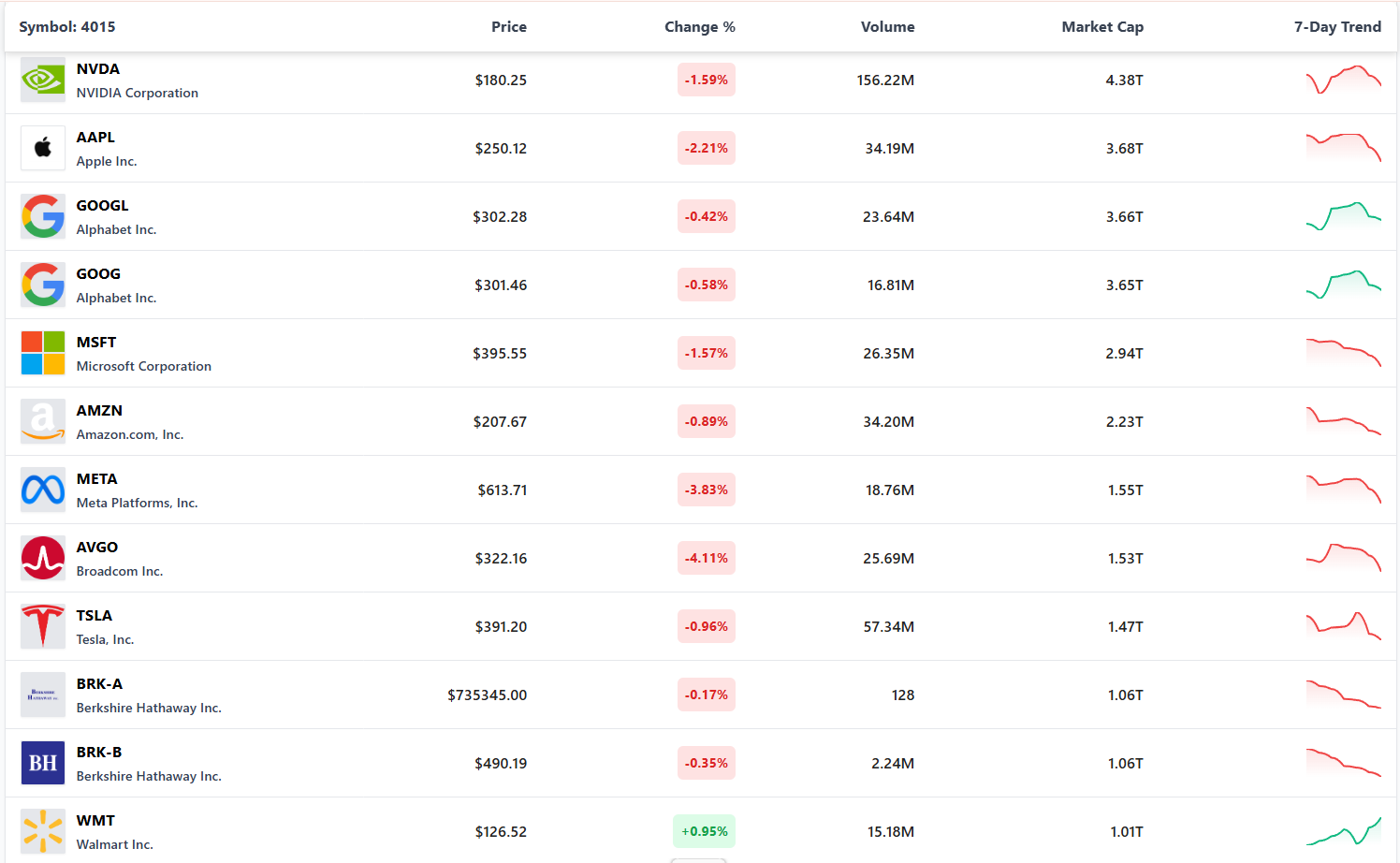
Use the stock screener to filter WDS against comparable energy producers by metrics such as price-to-earnings ratio, dividend yield, and market capitalization. The market research tools on Tickerplace support technical overlays, volume analysis, and sector comparison, giving you the analytical depth that serious trading decisions require. For investors who follow WDS across both exchanges, Tickerplace streamlines the workflow from research to execution.
Frequently asked questions
What is the difference between WDS shares on ASX and NYSE?
ASX WDS shares are ordinary shares denominated in Australian dollars, while NYSE shares are ADRs representing the same underlying stock priced in US dollars; quote differences reflect exchange rates, trading hours, and venue-specific liquidity.
Where can I find real-time WDS share prices?
Woodside's share-price page provides current quotes for both ASX and NYSE ADR listings, updated throughout each respective trading session with timestamps.
Why do share prices differ between ASX and NYSE listings?
Price differences arise from the AUD/USD exchange rate applied at the time of each quote, combined with the fact that prices differ by venue and trading hours, meaning each exchange prices WDS independently during its own session.
How can I avoid mistakes when interpreting WDS share price?
Always confirm which exchange the quote originates from and check the timestamp, because prices and timestamps differ by venue and by whether the quote is real-time or delayed; currency conversion is mandatory when comparing ASX and NYSE figures directly.