

TL;DR:
- Not all USD stocks move together; understanding sector and currency influences is crucial.
- Major indices like the S&P 500 track USD-denominated stocks, helping gauge market performance.
- Real-time data enhances trading precision by revealing volume, order flow, and news catalysts.
Not all USD stocks move together, and assuming they do is one of the most costly mistakes active investors make. The S&P 500 may be climbing while energy sector stocks slide, or a strong dollar may be quietly eroding the returns of a multinational you hold. Understanding what actually drives USD stock performance, from sector dynamics and index composition to currency mechanics and real-time data signals, is what separates reactive traders from genuinely informed investors. This article breaks down each of those layers in precise, actionable terms.
Key Takeaways
| Point | Details |
|---|---|
| Definition of USD stock | USD stocks are shares of companies traded and quoted in US dollars, usually on American exchanges. |
| Role of key indices | Major indices like the S&P 500 provide benchmarks for overall USD stock performance and market sentiment. |
| Global investor impact | Both US and international investors benefit from liquidity but must consider currency fluctuations when trading USD stocks. |
| Real-time data usage | Accessing and interpreting real-time data is crucial for making timely and informed trading decisions on USD stocks. |
| Comparing global equities | Diversifying between USD and international stocks can improve portfolios, but understanding risks is key. |
What is a USD stock and why does it matter?
A USD stock is any publicly traded equity whose shares are listed, quoted, and transacted in US dollars. This typically means the company is listed on a US-based exchange such as the New York Stock Exchange (NYSE), NASDAQ, or NYSE American. The distinction matters because the currency of denomination affects everything from pricing transparency to settlement risk and portfolio valuation.
The US dollar functions as the world's primary reserve currency, which means stocks on American exchanges are denominated in US dollars, providing a stable currency base for both local and global investors. This stability is a core reason institutional capital from Europe, Asia, and emerging markets flows heavily into US-listed equities.
For domestic investors, the USD denomination is largely invisible. You buy, hold, and sell in dollars without conversion friction. For international investors, however, the picture is more complex:
- Currency conversion costs: Every transaction involves converting local currency to USD and back, adding transaction costs and potential slippage.
- Exchange rate risk: A 10% gain in a USD stock can shrink to a 4% gain if the dollar weakens 6% against the investor's home currency during the same period.
- Hedging requirements: Sophisticated international investors often use currency forwards or options to neutralize dollar exposure, adding complexity and cost.
- Tax implications: Some jurisdictions tax currency gains separately from equity gains, creating an additional reporting burden.
Understanding these mechanics also informs portfolio allocation. A US-based investor holding only USD stocks carries implicit concentration in dollar-denominated assets. Blending in international equities, commodities priced in other currencies, or currency-hedged funds can reduce this concentration. Staying current on market movements overview helps you identify when dollar strength or weakness is becoming a meaningful factor in your returns.
Pro Tip: If you are a US investor with significant international exposure, monitor the DXY (US Dollar Index) alongside your equity positions. A rising DXY often signals headwinds for multinational earnings, which can weigh on USD stock prices even when domestic fundamentals look solid.
Major USD-denominated stock indices and benchmarks
Now that you've got a handle on what defines a USD stock, let's examine how these stocks are aggregated and tracked through major market indices. Indices serve as the primary barometers for USD stock sentiment, and reading them correctly is essential for any serious market participant.
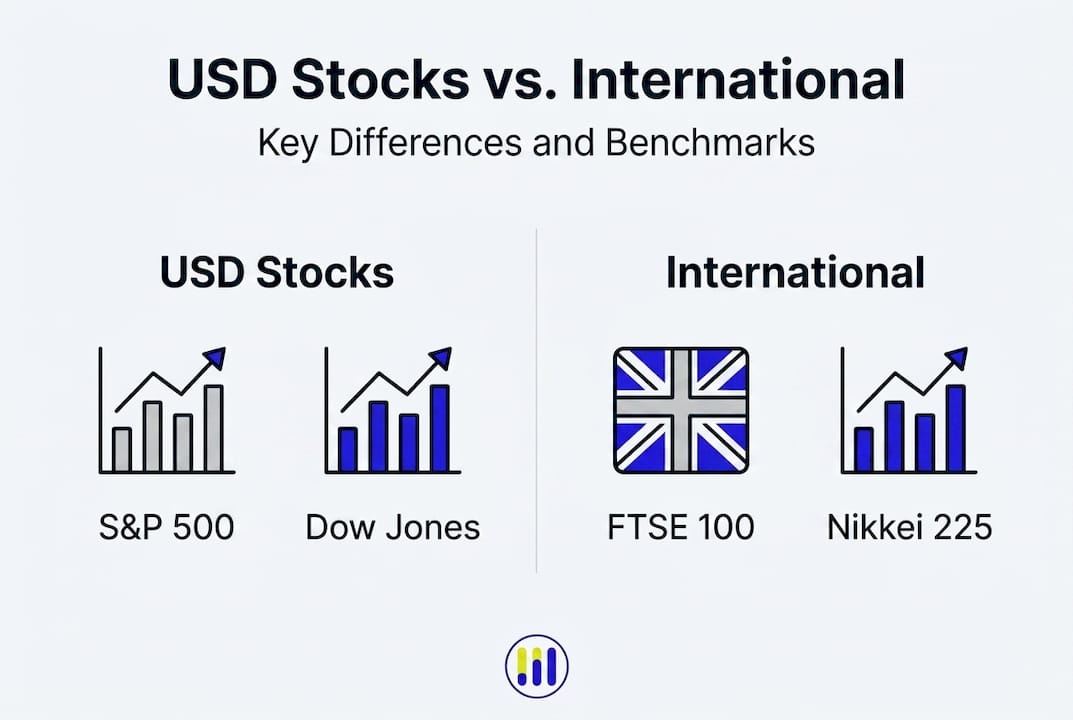
Indices like the S&P 500 and Dow Jones Industrial Average offer benchmarks for the health of US dollar-denominated equities, giving investors a standardized reference point for performance comparison.
Here is a quick comparison of the three major US indices:
| Index | Components | Weighting method | Primary focus |
|---|---|---|---|
| S&P 500 | 500 large-cap companies | Market capitalization | Broad US equity market |
| Dow Jones Industrial Average | 30 blue-chip companies | Price weighted | Industrial and consumer leaders |
| NASDAQ Composite | 3,000+ companies | Market capitalization | Technology and growth stocks |
Each index tells a different story. The S&P 500 is the most widely referenced because its market-cap weighting reflects the true economic footprint of each constituent. The Dow, being price-weighted, can be skewed by a single high-priced stock regardless of that company's actual market size. The NASDAQ skews heavily toward technology, making it a useful signal for growth sentiment specifically.
Here is how to use these indices effectively in your USD stock analysis:
- Track index divergence. When the S&P 500 rises but the NASDAQ falls, growth stocks are likely under pressure while value sectors hold up. This divergence signals a rotation worth investigating.
- Identify sector contribution. A handful of mega-cap stocks often drive index-level moves. Breaking down which sectors are contributing helps you avoid misreading broad index gains as uniform market strength.
- Use indices as a baseline, not a destination. Benchmark your portfolio against the relevant index to measure whether active selection is adding value or simply tracking beta.
- Watch index rebalancing dates. When stocks are added to or removed from major indices, institutional funds must buy or sell to track the benchmark, creating predictable short-term price pressure.
- Combine index signals with macro data. Index performance alone rarely tells the full story; pair it with interest rate expectations, earnings season trends, and indices explained resources to build a complete picture.
Understanding index construction is not academic. It directly shapes how you interpret daily market data and where you direct your research attention.
Comparing USD stocks with international equities
Having explored how major indices help you track USD stocks, comparing them with international equities sheds light on critical portfolio strategy questions. The decision to hold USD stocks versus international equities is not simply about geography; it involves liquidity, transparency, regulatory environment, and currency dynamics.

USD stocks offer global liquidity but can expose international investors to currency fluctuations, whereas local stocks may offer shelter from dollar volatility but limit global access. This trade-off is central to any multi-asset allocation strategy.
| Factor | USD stocks (US exchanges) | International equities |
|---|---|---|
| Liquidity | Very high; deep order books | Varies widely by market |
| Reporting standards | SEC-regulated, GAAP-based | IFRS or local standards |
| Currency exposure | USD denominated | Local currency denominated |
| Political/country risk | Lower for US-listed stocks | Higher in emerging markets |
| Dividend withholding tax | Varies by treaty | Often higher for foreign investors |
| Trading hours | 9:30 AM to 4:00 PM ET | Multiple time zones |
Key considerations when blending USD and international equities in your portfolio:
- Liquidity advantage: US markets consistently rank among the most liquid globally, meaning tighter bid-ask spreads and faster order execution, especially for large positions.
- Transparency edge: SEC disclosure requirements and GAAP accounting standards make financial statements more comparable and easier to audit than many international equivalents.
- Diversification rationale: Adding international equities can reduce correlation to the US business cycle, particularly when emerging market growth diverges from US GDP trends.
- Currency as a return driver: In periods when the dollar weakens significantly, unhedged international equity positions can deliver meaningful currency-driven outperformance on top of local market returns.
Pro Tip: When evaluating international equities, review DXS financials and similar non-US company filings to practice reading IFRS-based statements. The differences in how assets, liabilities, and earnings are reported can materially affect your valuation models.
Interpreting real-time data for USD stock trading decisions
With a broader perspective on global stocks, understanding how to use real-time data empowers you to act confidently in USD markets. The gap between real-time and delayed quotes may seem minor, but in fast-moving markets it can represent the difference between a well-timed entry and a costly miss.
Real-time data access allows investors to respond rapidly to market shifts, essential for active trading in USD stocks. Delayed quotes, which are typically 15 to 20 minutes behind, are adequate for long-term research but insufficient for active trading decisions.
"In active USD stock trading, the quality and timeliness of your data infrastructure is just as important as the quality of your investment thesis. A sound idea executed on stale data can still produce a poor outcome."
Here is a structured approach to interpreting real-time data effectively:
- Monitor volume surges first. Unusual volume, particularly volume that is two to three times the 30-day average, often precedes or confirms a significant price move. Volume validates price action; without it, moves are suspect.
- Read market depth (Level II data). The order book shows you where large buy and sell orders are clustered, revealing potential support and resistance levels that are invisible on a standard price chart.
- Track news catalysts in real time. Earnings releases, FDA approvals, merger announcements, and macro data prints can move individual USD stocks by 10% or more within minutes. Integrating a real-time news feed with your charting platform is not optional for active traders.
- Use stock screeners with live filters. Screening for stocks breaking above key moving averages or hitting 52-week highs in real time, using tools like the stock indices guide, helps you surface opportunities as they develop rather than after the fact.
- Set price alerts, not just watchlists. A static watchlist requires you to check manually. Price alerts push notifications when a stock crosses a threshold you've defined, allowing faster response without constant screen monitoring.
Pro Tip: Pair real-time price data with relative strength readings. A stock rising on strong volume while its sector is flat is demonstrating genuine buying interest, not just sector-level momentum. That distinction often signals a more durable move.
Why understanding USD stock nuances changes your investment game
Most investors look at an index chart and draw conclusions about the entire USD equity market. That is a significant analytical shortcut, and it costs returns. The index is an average; your portfolio is not. When you understand that a rising S&P 500 can mask deteriorating breadth, where fewer and fewer stocks are actually advancing, you start asking better questions.
The investors who consistently outperform do not just track advanced market index analysis; they interrogate it. They ask which sectors are leading, which currencies are strengthening, and whether the macro environment favors domestic or international exposure. Currency hedging, cross-market flow analysis, and real-time data interpretation are not advanced tactics reserved for institutional desks. They are practical tools available to any investor willing to look beyond the headline number.
Dive deeper with advanced stock tools
Ready to implement these insights and elevate your USD stock game? Tickerplace gives you everything you need to move from analysis to action. Use the stock screener to filter USD stocks by market cap, volume, sector, and technical signals in real time, so you can identify opportunities the moment they emerge.
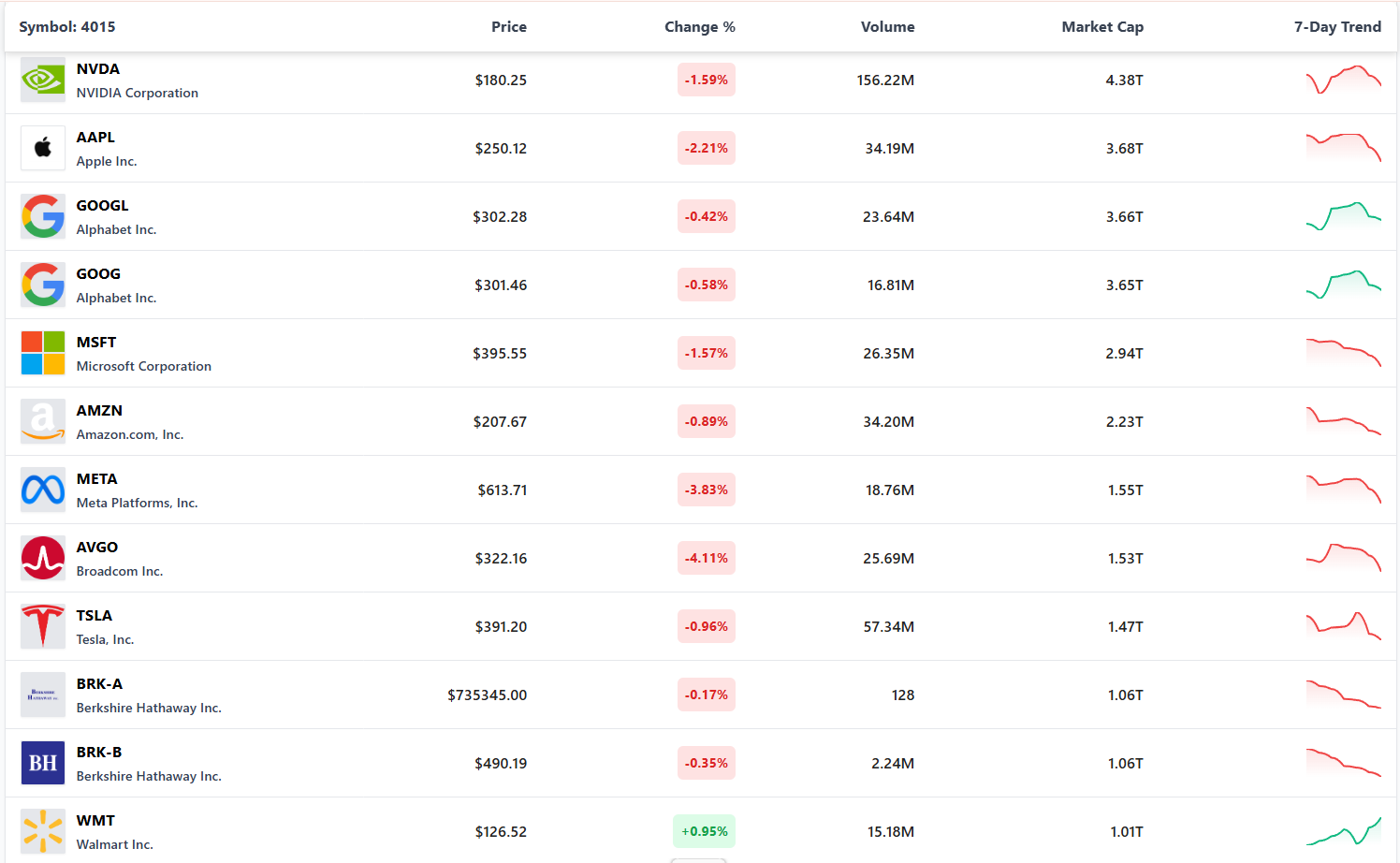
For investors who want to sharpen their analytical foundation, the investing education section covers indices, valuation methods, and portfolio strategy in depth. Whether you are building a new position or stress-testing an existing one, Tickerplace provides the data accuracy and research tools to support every step of your decision-making process.
Frequently asked questions
What qualifies as a USD stock?
A USD stock is any publicly traded company whose shares are listed and transacted in US dollars, usually on American exchanges. Stocks on American exchanges are denominated in US dollars, providing a stable currency base for both local and global investors.
Which indices track USD-denominated stocks?
Major indices include the S&P 500, NASDAQ, and Dow Jones Industrial Average, which all track leading US dollar stocks. These indices offer benchmarks for the health of US dollar-denominated equities and serve as the primary reference points for institutional and retail investors alike.
How does currency risk affect non-US investors in USD stocks?
Non-US investors in USD stocks are exposed to currency fluctuations, which can impact returns when converting back to their local currencies. USD stocks offer global liquidity but can expose international investors to currency fluctuations, whereas local stocks may offer shelter from dollar volatility but limit global access.
Why use real-time data for USD stock investing?
Real-time data helps investors react quickly to market changes, improve timing, and make more informed trading decisions. Real-time data access allows investors to respond rapidly to market shifts, which is essential for active trading in USD stocks where price moves can be swift and significant.