
TL;DR:
Different index methodologies (market cap, price, equal weight) affect performance and interpretation.
Major U.S. indices serve distinct purposes; S&P 500 is broad, DJIA is blue-chip, NASDAQ-100 is tech-heavy.
International benchmarks reflect regional economies; their performance and sector focus differ significantly from U.S. indices.
Navigating the world of stock indices can feel overwhelming when dozens of benchmarks compete for your attention. Yet the index you choose to follow or benchmark against shapes every performance comparison you make. Major indices like the S&P 500, Dow Jones Industrial Average, and NASDAQ-100 each measure the market differently, and that distinction matters enormously. This article breaks down how indices are built, compares the most important U.S. and international benchmarks, and helps you select the right one for your analysis.
Key Takeaways
| Point | Details |
|---|---|
| Index weighting matters | Different weighting methods change how an index measures market performance. |
| Know the big benchmarks | S&P 500, DJIA, NASDAQ-100, FTSE 100, DAX 40, and MSCI World are key indices every investor should understand. |
| Performance isn’t equal | Return rates and volatility vary widely between indices, so benchmark with purpose. |
| Use indices wisely | Pick indices that fit your investing goals and use comparison tools for deeper insight. |
How stock indices are constructed
Before we look at specific examples, let’s clarify how these indices are built and maintained. The methodology behind an index determines which stocks it includes, how much weight each stock carries, and how it responds to market events. Getting this right is foundational to using any index effectively.
Index methodologies fall into four main categories:
-
Market capitalization weighted: Larger companies carry more weight. The S&P 500 follows this approach, meaning Apple or Microsoft can move the entire index significantly.
-
Price weighted: Stocks with higher share prices carry more influence, regardless of company size. The DJIA uses this method.
-
Equal weighted: Every stock in the index carries the same weight, giving smaller companies equal influence.
-
Capped variants: A modified cap-weighted approach that limits how much any single stock can dominate, reducing concentration risk.
Maintaining an index requires ongoing adjustments. When a company executes a stock split, the index divisor is recalculated to prevent an artificial change in the index level. Bankruptcies and delistings are handled by setting the affected stock’s price to zero before removing it from the index, preserving historical continuity.
One underappreciated risk in cap-weighted indices is mega-cap concentration. When a handful of companies represent 20% or more of an index, the benchmark’s movement reflects those companies more than the broader market. Reviewing an indices construction guide before selecting a benchmark helps you understand exactly what you’re measuring.

Pro Tip: Always check an index’s top 10 holdings and their combined weight before using it as a portfolio benchmark. High concentration can create misleading performance comparisons.
Major U.S. stock indices: S&P 500, DJIA, and NASDAQ-100
With the basic methods defined, let’s examine the major U.S. indices and what sets them apart. Each serves a different analytical purpose, and treating them as interchangeable is a common mistake.
Three dominant U.S. indices define how most investors measure American equity performance:
-
S&P 500: Tracks 500 large-cap U.S. companies using float-adjusted market cap weighting. It represents roughly 80% of total U.S. market capitalization, making it the broadest large-cap benchmark available. Learn more about S&P 500 methodology to understand its selection criteria.
-
DJIA: Covers 30 blue-chip U.S. companies and uses price weighting. Because it’s price-weighted, a $500 stock influences the index five times more than a $100 stock, regardless of market cap. You can explore individual DJIA company profiles to see current constituents.
-
NASDAQ-100: Tracks the 100 largest non-financial companies listed on the Nasdaq exchange, with heavy technology sector representation. It uses market cap weighting and includes global giants like Apple, Microsoft, and Nvidia. Browse NASDAQ-100 components for a full breakdown.
| Index | Weighting method | Number of stocks | Sector focus |
|---|---|---|---|
| S&P 500 | Float-adjusted market cap | 500 | Broad large-cap |
| DJIA | Price weighted | 30 | Blue-chip |
| NASDAQ-100 | Market cap | 100 | Technology heavy |
Pro Tip: If your portfolio leans toward technology, benchmark against the NASDAQ-100. If you hold a diversified large-cap mix, the S&P 500 is a more honest comparison.
Top international and global stock indices
Beyond U.S. markets, investors often benchmark with international and global indices. These benchmarks capture economic conditions, currency dynamics, and sector compositions that U.S.-only indices simply cannot reflect.
Five major international benchmarks cover the most important markets outside the U.S.:
-
FTSE 100: Tracks the 100 largest companies listed on the London Stock Exchange, weighted by market cap. It skews heavily toward energy, financials, and mining sectors.
-
DAX 40: Germany’s primary index, covering 40 major Frankfurt-listed companies using market cap weighting. It reflects the health of Europe’s largest economy.
-
Nikkei 225: Japan’s flagship index tracks 225 Tokyo Stock Exchange companies using price weighting, making it structurally similar to the DJIA.
-
MSCI World Index: Covers over 1,500 large and mid-cap stocks across 23 developed markets, offering broad global diversification.
-
S&P World Index: Provides comparable global coverage with a focus on developed market equities.
| Index | Region | Weighting | Key sectors |
|---|---|---|---|
| FTSE 100 | United Kingdom | Market cap | Energy, financials |
| DAX 40 | Germany | Market cap | Industrials, autos |
| Nikkei 225 | Japan | Price weighted | Technology, industrials |
| MSCI World | Global developed | Market cap | Broad diversified |
For investors seeking global index coverage or exploring alternative international benchmarks, understanding these regional distinctions is essential before allocating capital across borders. International index data shows that each region’s index reflects its own economic structure, not a universal market truth.
Performance comparisons and practical takeaways
Now, let’s see how these indices stack up in terms of returns and how to use them in practice. Raw return numbers rarely tell the full story; risk-adjusted metrics reveal which benchmarks truly reward investors for the volatility they absorb.
“The S&P 500 achieved a CAGR of approximately 14% from 2010 to 2025, compared to roughly 4% for the MSCI China Index over the same period. The dynamic DJIA demonstrated higher Sharpe ratios and lower volatility than its static counterpart, while the NASDAQ-100 delivered higher long-term returns paired with significantly greater volatility.”
The S&P 500 Sharpe ratio of 0.73 versus China’s 0.19 from 2010 to 2025 illustrates how dramatically risk-adjusted performance can diverge across regions. Higher returns abroad often come with substantially higher volatility, which erodes real portfolio outcomes for many investors.
Here’s a practical framework for selecting and using indices effectively:
-
Match the index to your portfolio composition. A tech-heavy portfolio benchmarked against the S&P 500 will look artificially strong during tech rallies and artificially weak during corrections.
-
Evaluate Sharpe ratios, not just returns. An index with a 12% return and low volatility outperforms one with a 15% return and extreme swings for most risk-conscious investors.
-
Watch for rebalancing and concentration drift. Cap-weighted indices naturally concentrate in winners over time, which may not align with your target allocation.
-
Use multiple indices for context. Comparing your portfolio against both the S&P 500 and an international benchmark gives a more complete picture of relative performance.
Using index-based stock filters can help you identify securities that consistently outperform specific benchmarks, adding precision to your stock selection process.
Our view: Picking the right index for smarter investing
Let’s be direct about something most index discussions avoid. Cap-weighted indices like the S&P 500 are often treated as neutral market mirrors, but they are not. When the five largest companies represent nearly 25% of the index, you are effectively making a concentrated sector bet disguised as broad diversification. That’s not a flaw to avoid; it’s a reality to understand and account for.
Price-weighted indices like the DJIA appear simpler but can be equally misleading. A high-priced stock with modest market impact can move the index more than a company ten times its size. The solution is not to dismiss any single index but to use a combination of benchmarks deliberately. Explore strategy tips for outperforming indices to build a more nuanced, informed approach to benchmarking.
Explore indices and analysis tools with Tickerplace
Ready to put your knowledge into action? Here’s where you can dig deeper.
Tickerplace gives you the tools to move from theory to practice. Use the stock screener to filter equities by index membership, sector, and performance metrics, so your benchmarking is grounded in real data. The stock return calculator lets you compare historical returns across different time periods and indices with precision. For broader context and foundational knowledge, the investing education section covers everything from index construction to portfolio strategy.
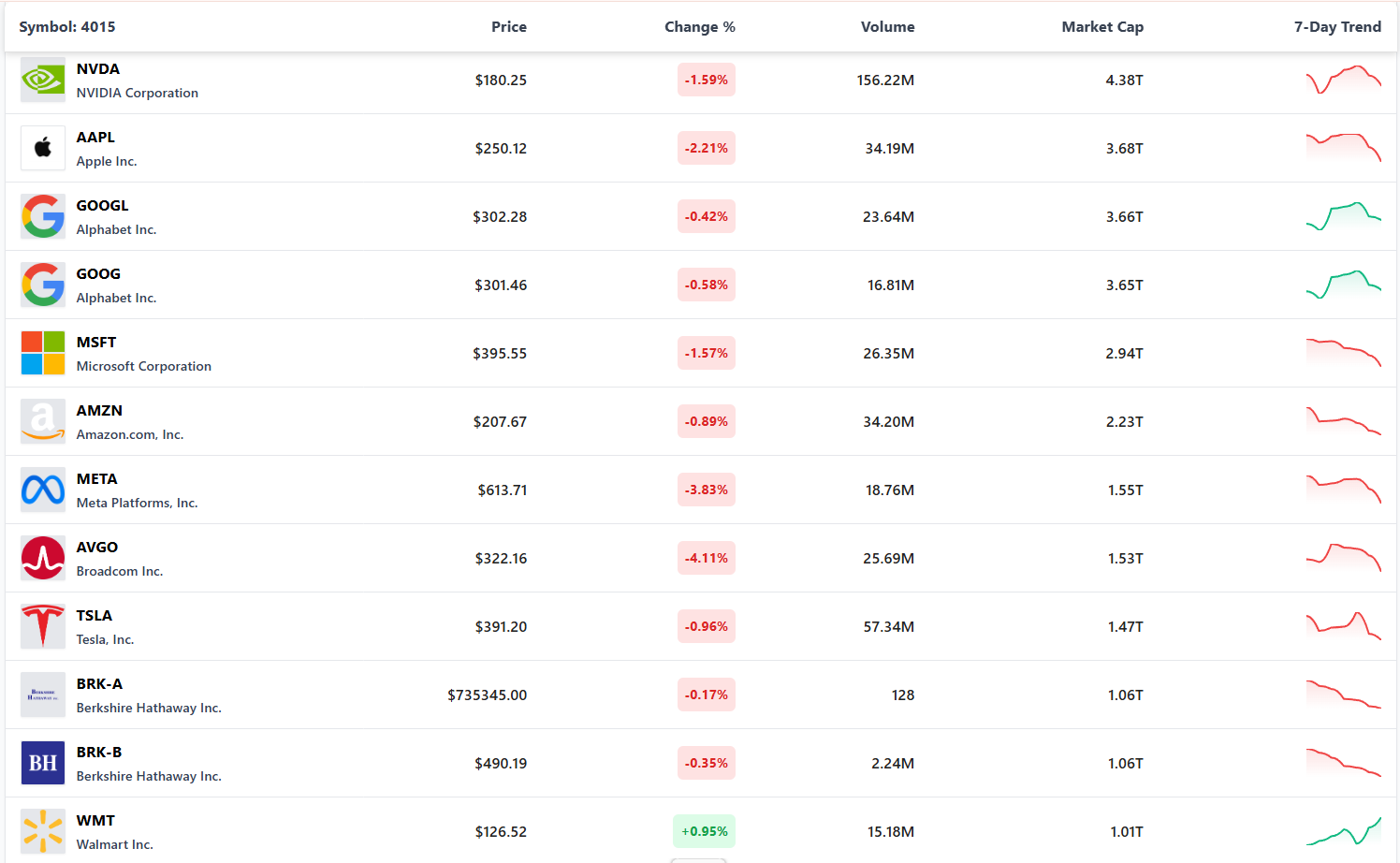
Tickerplace is built for investors who take analysis seriously. Start exploring today.
Frequently asked questions
What is the main difference between market cap-weighted and price-weighted indices?
Cap-weighted indices reflect company size, giving larger companies more influence, while price-weighted indices like the DJIA give more weight to stocks with higher absolute share prices regardless of overall company size.
Why do investors monitor global indices like MSCI World?
MSCI World and S&P World provide broad international exposure across dozens of developed markets, helping investors benchmark performance beyond U.S. or single-region portfolios.
How are corporate actions like stock splits or bankruptcies handled in indices?
For stock splits, the index divisor is adjusted to maintain continuity; for bankruptcies or delistings, the affected stock’s price is set to zero before removal, preserving the index’s historical integrity.
Which index has historically outperformed: S&P 500, DJIA, or NASDAQ-100?
The NASDAQ-100 delivered higher returns over long periods but with greater volatility, while the dynamic DJIA showed stronger risk-adjusted performance; the S&P 500 achieved a CAGR of approximately 14% from 2010 to 2025.