

TL;DR:
- Tracking Lyc's share price is complicated by its dual listings on the ASX and OTC Markets, with differences driven mainly by currency fluctuations. The stock's value is mainly influenced by demand for rare earths in clean energy sectors, earnings growth forecasts, and geopolitical supply chain factors. Investors should monitor both listings, commodity prices, and financial data systematically to develop a comprehensive view of Lyc's market performance.
Tracking the lyc share price accurately is harder than most investors expect. Lynas Rare Earths Ltd (ASX: LYC) trades under two different symbols across two continents, quoted in different currencies, and influenced by a complex web of rare earth demand cycles, earnings forecasts, and geopolitical supply chain dynamics. Investors who rely on a single price feed or misread the ticker symbol often end up with incomplete or misleading data. This article clarifies where and how Lyc shares trade, what genuinely moves Lycopodium stock price sentiment, and how to build a more informed view of current Lyc share price performance.
Key Takeaways
| Point | Details |
|---|---|
| Dual market listings | Lyc shares trade on both the Australian Securities Exchange and US OTC Markets, affecting price visibility. |
| Earnings growth drives price | Strong projected earnings and revenue growth underpin Lyc’s share price trends. |
| Industry demand impact | Demand for rare earths in green technology significantly influences investor outlook. |
| Use comprehensive tools | Leveraging real-time data and financial analysis platforms improves investment decisions. |
| Look beyond price moves | Focus on fundamentals and market context rather than daily price fluctuations for clearer insight. |
Understanding Lyc share price: listings, symbols, and markets
Confusion about the Lyc share price often starts before investors even check a chart. Lynas Rare Earths Ltd is dual-listed, which means it appears under different names and prices depending on where you look.
As confirmed by recent market reporting, shares of the Australian-listed rare earths miner trade on the OTC Markets in the United States under the symbol LYSCF, with the underlying security listed on the Australian Securities Exchange as LYC. That distinction matters more than it might seem.
Here is what each venue means for price interpretation:
- ASX (LYC): The primary listing. Shares are priced in Australian dollars (AUD), trade during Sydney market hours, and reflect the most direct liquidity for institutional and domestic Australian investors.
- OTC Markets (LYSCF): The US-accessible version. Shares are priced in US dollars (USD) and trade during American market hours. The price difference between ASX and OTC is largely a function of AUD/USD exchange rates, not a divergence in underlying value.
- Currency conversion risk: A move in Lyc share value on the OTC market may reflect a shift in exchange rates as much as a change in the company's fortunes. Always confirm which venue you are reading when interpreting price data.
You can review LYC historical prices on Tickerplace to compare how the stock has moved across time, giving you a baseline for interpreting current Lyc share price data accurately.
Pro Tip: When tracking Lycopodium market trends or comparing Lyc's price across platforms, confirm whether the figure is quoted in AUD or USD before drawing conclusions. A price that looks lower on one platform may simply reflect the currency difference, not a weaker market position.
Key factors influencing Lyc's share price movements
With Lyc's listing venues clear, let's explore what business fundamentals and market trends actually move its share price.
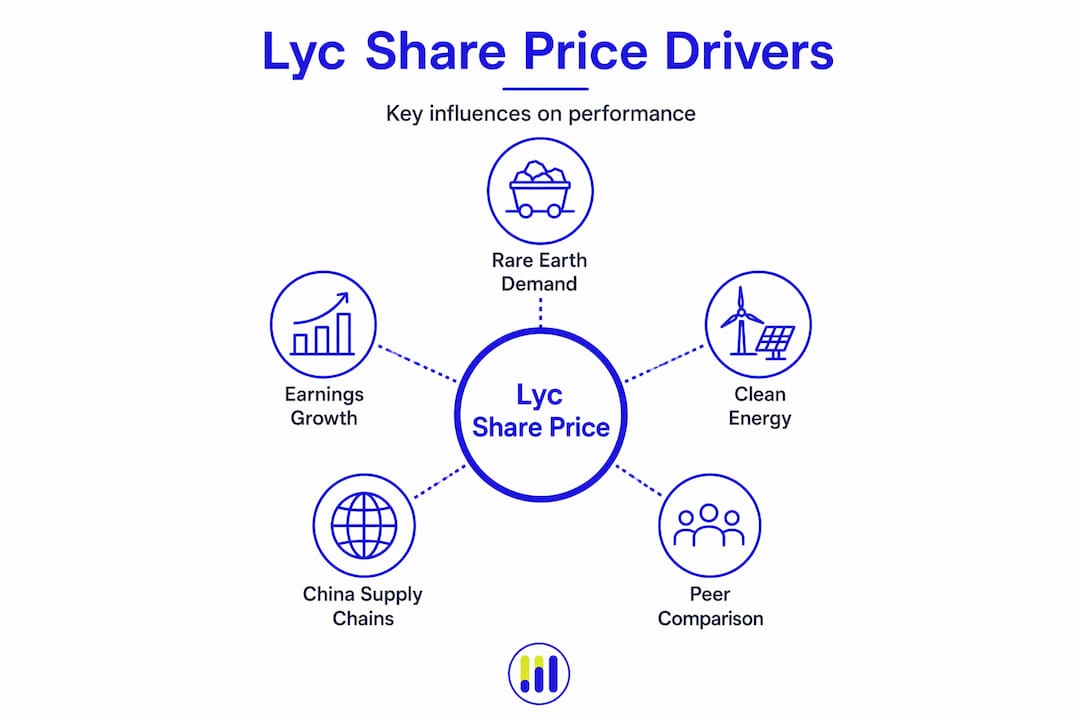
The lyc share price does not move in isolation. Several interconnected forces shape how the market values Lynas Rare Earths at any given moment.

Demand from clean energy industries
Rare earth elements (REEs) are essential inputs for permanent magnets used in electric vehicle (EV) motors and wind turbine generators. As global demand for clean energy infrastructure grows, so does the case for higher REE prices and, consequently, stronger Lycopodium financial news coverage. Lynas benefits directly from this structural demand trend. The stock has gained as investors weigh the company's role in the global rare earths supply chain and its improving earnings outlook.
Earnings and revenue growth forecasts
Forward-looking investor sentiment is heavily shaped by analyst projections. Analysts have highlighted strong projected growth in earnings and revenue over the next several years, with forecasts pointing to annual earnings growth of around 40% and revenue growth of roughly 30%. Numbers at that scale attract growth-oriented investors, which tends to support Lyc share performance even during periods of broader market weakness.
Key business factors affecting Lyc's share price include:
- REE pricing cycles: Spot prices for neodymium and praseodymium (NdPr), the core rare earth products Lynas sells, directly affect revenue per ton.
- Processing capacity: Lynas operates one of the few rare earth processing facilities outside China, giving it a structural advantage that the market increasingly values.
- Regulatory environment: Permitting decisions in Australia and Malaysia can affect production timelines and, by extension, earnings estimates.
You can review the LYC financial reports on Tickerplace for a detailed breakdown of earnings, revenue trends, and margin performance.
Pro Tip: Do not wait until quarterly earnings are published to reassess your position. REE spot price moves, which are reported frequently through commodity data services, often preview earnings surprises well in advance.
Analyzing recent Lyc share price trends and performance
Understanding the underlying business helps explain Lyc's share price, so next, we look at the recent price action investors should know.
As of May 8, 2026, Lynas Rare Earths traded at approximately 14.05 USD per share on OTC Markets, down slightly intraday but still above levels seen earlier in the year. That positioning reflects a stock that has absorbed some near-term volatility while maintaining a constructive longer-term trajectory.
| Metric | Value (approx., OTC / USD) |
|---|---|
| Recent share price | ~$14.05 USD |
| Market capitalization | Mid-single-digit billion USD |
| 12-month trend | Modestly positive |
| Primary currency (ASX) | AUD |
| OTC symbol | LYSCF |
Key observations from recent Lyc share performance:
- Intraday swings in LYSCF are common and often amplified by lower OTC liquidity compared to the primary ASX listing.
- Year-to-date gains reflect growing institutional confidence in REE demand, not just speculative momentum.
- Market capitalization in the mid-single-digit billion USD range positions Lynas as a mid-to-large cap player in its sector, which generally attracts more stable institutional ownership.
Review LYC stock price history to see how these recent movements fit into the longer multi-year arc of Lyc share value.
Comparing Lyc's market performance to rare earth industry peers
To fully grasp Lyc's potential, it is useful to see how it stacks up against competitors in the rare earth mining space.
Lynas Rare Earths Ltd is one of the larger pure-play rare earth producers globally, which sets it apart from most mining companies that treat REEs as a secondary product. That purity of exposure makes it a more direct bet on rare earth market trends, for better or worse.
| Company | Market focus | Growth outlook | Liquidity |
|---|---|---|---|
| Lynas Rare Earths (LYC) | Pure-play REE producer | High (~40% earnings growth est.) | Strong (ASX primary) |
| Pilbara Minerals (PLS) | Lithium (adjacent sector) | Moderate | Strong (ASX) |
| Liontown Resources (LTR) | Lithium development | Variable (pre-revenue phase) | Moderate (ASX) |
A few important comparisons to frame Lyc stock analysis:
- Lynas earns revenue today, unlike many smaller rare earth developers that remain in exploration or early production. This is a material distinction when assessing risk.
- Its earnings growth forecast of around 40% annually outpaces most peers in the broader critical minerals space, making it stand out on a growth-adjusted basis.
- Investors looking at PLS rare earth financials or the LTR financial overview will find useful contrast points when evaluating sector allocation.
Pro Tip: When comparing Lyc to peers, prioritize production-stage companies with actual revenue over developers. Earnings growth forecasts for pre-revenue companies are inherently less reliable, and sector volatility can punish speculative positions quickly.
Practical tips for tracking and investing in Lyc shares
After comparing Lyc to peers, here are practical steps to track and invest wisely in Lyc shares.
The stock has seen modest gains over the past month, reflecting sustained optimism around rare earth demand in EVs and wind energy. Sustaining that optimism in your own analysis requires a disciplined monitoring approach.
- Track both ASX and OTC prices. Check the ASX-listed LYC price in AUD and LYSCF in USD regularly. Divergences between the two, after accounting for exchange rates, can signal arbitrage activity or data lag on one platform.
- Monitor earnings calendars. Lynas reports earnings on a half-year cycle. Mark reporting dates and watch for analyst estimate revisions in the weeks leading up to results.
- Follow NdPr spot prices. These commodity prices are published through specialized rare earth pricing services and are a leading indicator of Lynas revenue potential.
- Use stock screeners to set alerts. Set price and volume alerts on tools like stock screening tools so you are notified when significant movements occur without having to check daily.
- Review quarterly financial statements. The LYC financial statements on Tickerplace give you a structured view of revenue, margins, and balance sheet health that headlines rarely capture.
Why typical Lyc share price guidance falls short — and what investors should focus on
Most Lyc share price coverage makes the same mistake: it treats the current price as the story. It is not. The price is the output of forces that most short-form guides barely mention.
Daily price fluctuations in a commodity-linked mining stock like Lynas are genuinely noisy. Obsessing over intraday LYSCF moves while ignoring the forward earnings trajectory is one of the most common and costly habits in retail mining investment. A 2% dip on a slow OTC trading day means almost nothing in a stock with 40% projected earnings growth.
What actually matters is whether the fundamental thesis is intact. Is NdPr demand growing in line with EV adoption forecasts? Is Lynas maintaining its processing advantage outside China? Are revenue growth estimates holding steady or being revised downward? Those questions, answered through in-depth LYC financials, tell you far more than any candlestick chart.
The rare earth sector also has a supply chain dimension that most investors underestimate. China controls the majority of global rare earth processing capacity. Lynas exists, in part, because governments and manufacturers want an alternative. That geopolitical role is not always priced in accurately, and it creates asymmetric upside when supply chain policy shifts accelerate. Investors who understand this dynamic position themselves to recognize value when the market is still catching up.
Explore Lyc stock insights and tools on Tickerplace
Keeping up with Lynas Rare Earths means having the right data infrastructure behind your research. Checking a quoted price once a day is not a strategy.
Tickerplace gives you real-time price data for both the ASX-listed LYC and the OTC-traded LYSCF, along with technical and fundamental analysis tools built for active investors. You can access detailed earnings data, revenue trends, and balance sheet metrics through the LYC financials page, or use the stock screener tool to identify similar opportunities in the critical minerals space. Whether you are monitoring an existing position or evaluating Lynas for the first time, Tickerplace organizes the data you need to make decisions with confidence, not guesswork.
Frequently asked questions
What exchanges list the Lyc share and how do prices differ?
Lyc shares trade on the Australian Securities Exchange as LYC (priced in AUD) and on OTC Markets in the US as LYSCF (priced in USD), with price differences between the two largely reflecting currency and market differences rather than any divergence in underlying value.
What are the main drivers of Lyc's share price growth?
The share price is primarily driven by rare earth demand from clean energy sectors like EVs and wind turbines, supported by analyst forecasts projecting annual earnings growth of around 40% over the next several years.
How can investors track Lyc share price effectively?
Investors should monitor both ASX and OTC listings for real-time prices, track NdPr spot prices as a leading revenue indicator, and use financial tools like stock screeners to stay ahead of demand for rare earths shifts and earnings revisions.