

TL;DR:
- Lovisa is a fast-growing jewelry retailer with over 1,000 stores in more than 50 countries, driven by rapid product updates and strategic acquisitions. Its valuation remains sensitive to expansion pace and labor risks, which can cause sharp stock movements. The launch of the premium Jewells brand signals diversification but introduces new operational challenges for investors.
Lovisa Holdings Limited is a publicly traded fast-fashion jewelry retailer listed on the Australian Securities Exchange under ticker symbol LOV, founded in 2010) by Brett Blundy. The company has grown from a single-country operation into a global retail force with over 1,000 stores across more than 50 countries. For investors researching the jewelry retail sector, Lovisa represents a rare combination of rapid international expansion, a lean operating model, and a product category that holds up well across economic cycles. This article breaks down the business drivers, financial metrics, and key risks that define the LOV investment case.
What drives Lovisa's business growth and competitive advantage?
Lovisa's growth engine runs on speed and scale. The company introduces hundreds of new styles weekly, drawing inspiration from global runway trends and street fashion. That constant product refresh keeps foot traffic high and encourages repeat visits, which is the core mechanic of the fast-fashion model applied to jewelry and accessories.
The operational model is deliberately lean. Rapid inventory turnover keeps working capital requirements low and reduces the risk of holding outdated stock. Lovisa targets a wide demographic by pairing affordable pricing with trend-forward designs, which gives it broad market reach without requiring heavy marketing spend.
Key competitive advantages include:
- Trend velocity. New Lovisa jewelry styles arrive in stores weekly, matching the pace of fast-fashion apparel brands.
- In-store piercing services. Lovisa offers free ear and nose piercing in select stores globally, driving foot traffic that pure product retailers cannot replicate.
- Acquisition-led market entry. Rather than building store networks from scratch in new markets, Lovisa uses acquisitions to accelerate entry and reach profitability faster.
- Scalable store format. The small-footprint store model keeps occupancy costs manageable across diverse retail environments.
Pro Tip: When evaluating Lovisa as an investment, pay close attention to same-store sales growth alongside total store count. A rising store count with flat same-store sales signals expansion without underlying demand growth, which compresses margins over time.
How is Lovisa performing financially and on the stock market?
Lovisa trades on the ASX under the ticker LOV, with its IPO completed in december 2014. The stock has experienced meaningful volatility tied directly to the pace of its international expansion and the broader pressures facing fast-fashion retail. Investors tracking LOV need to understand that the share price is highly sensitive to store rollout updates and any guidance changes around international markets.

From a valuation standpoint, Lovisa has historically traded at a premium price-to-earnings ratio relative to general retail peers. That premium reflects the market's expectation of continued high growth. When expansion slows or misses guidance, the P/E multiple contracts quickly, which amplifies downside moves in the share price.
The table below summarizes key financial and operational metrics investors should monitor:
| Metric | What to watch |
|---|---|
| ASX ticker | LOV |
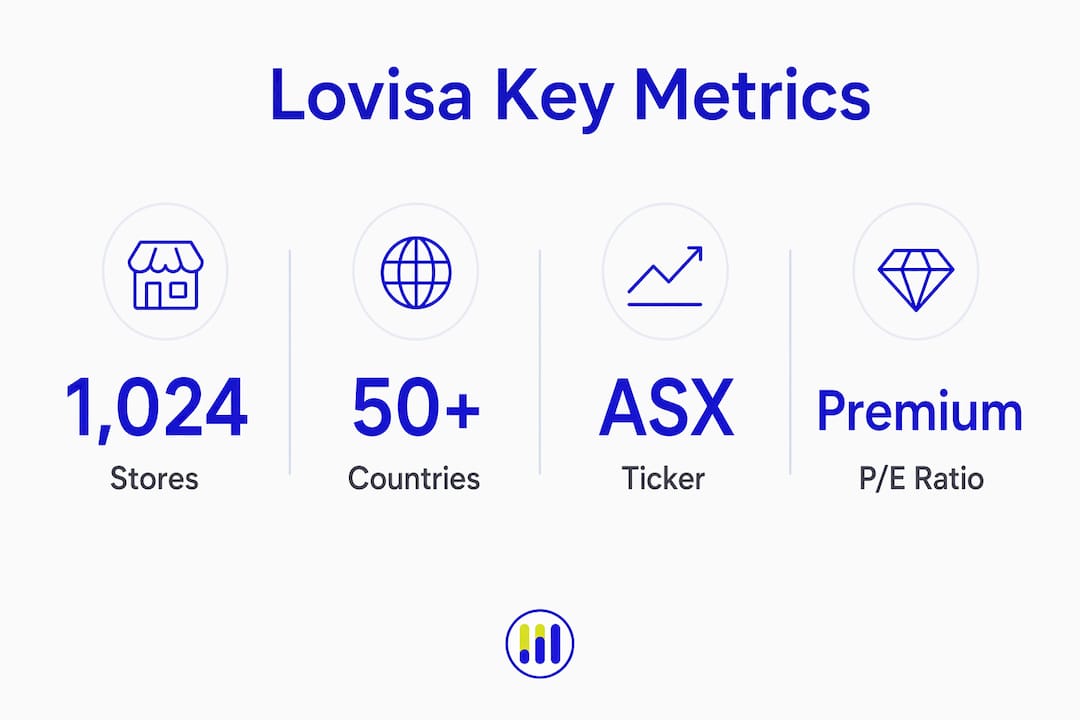
| Store count (mid-2025) | 1,024 stores across 50+ countries |
| IPO date | December 2014 |
| Valuation approach | P/E ratio, enterprise value relative to EBITDA |
| Key growth driver | International store rollout pace |
| Risk factor | Labor disputes and wage compliance |
Lovisa's LOV financial statements on Tickerplace provide updated earnings data, revenue trends, and key ratios for investors who want to track the numbers in real time. The enterprise value context matters here because Lovisa carries debt from its acquisition activity, which affects the true cost of ownership relative to market capitalization alone.
Statistic callout: 1,024 stores across 50+ countries) as of mid-2025. That scale puts Lovisa among the largest specialty jewelry retailers by store count globally, which is a meaningful moat against smaller regional players.
What are Lovisa's recent market expansions and brand diversification efforts?
Lovisa's international footprint is the clearest signal of its long-term ambitions. The company has moved well beyond its Australian origins to establish a presence across North America, Europe, Asia, and the Middle East. Three developments stand out for investors assessing the growth runway.
-
Beeline GmbH acquisition (2020). Lovisa acquired the Beeline GmbH store network, adding over 100 stores in European markets), including 74 stores in Germany and surrounding countries plus 30 stores in France. All stores were rebranded as Lovisa. This single deal compressed years of organic growth into one transaction and gave the company immediate scale in Western Europe.
-
Jewells brand launch (2025). Lovisa launched an upmarket jewelry brand called Jewells in the UK in 2025, operating 7 stores) as of july 2025. This signals a deliberate move into the premium segment, which carries higher margins and a different customer profile than the core Lovisa accessories range.
-
Continued US and Asian expansion. The United States remains a high-priority growth market. Lovisa's store count in North America has grown steadily, and the US market's size means even modest penetration translates into material revenue.
The Beeline acquisition is a textbook example of how Lovisa uses strategic acquisitions) to bypass the slow build of brand awareness in unfamiliar markets. For investors, the Jewells brand is worth monitoring closely. Premium jewelry carries different inventory risk and customer acquisition costs, and its success or failure will reveal whether Lovisa can execute outside its core fast-fashion model.
What challenges and risks could impact Lovisa's stock outlook?
Lovisa's growth story carries real risks that investors should not discount. The most documented operational risk involves labor compliance. In 2021 and 2022, the company faced wage arrears of NZ$153,190) and employee strikes in New Zealand, Belgium, and the Netherlands. These disputes attracted regulatory attention and damaged the company's employer reputation in key markets.
Key risks for investors to track:
- Labor and wage compliance. Ongoing disputes in multiple countries create legal liability and reputational costs. Any recurrence in new markets could slow expansion timelines.
- Fast-fashion consumer sentiment. Younger consumers increasingly scrutinize the environmental and labor practices of fast-fashion brands. A shift in sentiment could pressure both traffic and pricing power.
- Online competition. Digital-only jewelry retailers operate with lower overhead and can undercut Lovisa on price for non-differentiated products. Lovisa's in-store piercing services and physical experience provide some defense, but the threat is real.
- Currency exposure. With stores across 50+ countries, Lovisa's reported earnings in Australian dollars are subject to significant foreign exchange movements.
Pro Tip: Before taking a position in LOV, use a stock valuation checker to compare Lovisa's current P/E against its five-year average. A premium above historical norms requires confidence in the expansion pipeline to justify the price.
Key takeaways
Lovisa's investment case rests on its ability to sustain rapid international store growth while managing labor compliance, currency risk, and the premium valuation the market assigns to its shares.
| Point | Details |
|---|---|
| ASX ticker and scale | Lovisa trades as LOV with 1,024 stores across 50+ countries as of mid-2025. |
| Growth model | Weekly new product introductions and strategic acquisitions drive store count and revenue growth. |
| Valuation sensitivity | LOV trades at a premium P/E; any slowdown in expansion guidance triggers sharp share price moves. |
| Brand diversification | The Jewells launch in the UK signals a push into premium segments beyond core fast-fashion jewelry. |
| Key risk | Labor disputes in multiple markets create legal and reputational exposure that investors must monitor. |
Tickerplace's view on Lovisa as an investment
Lovisa is one of the more interesting retail growth stories on the ASX, and the operational model genuinely earns respect. The weekly product cadence is not just a marketing tactic. It is a supply chain discipline that most retailers cannot replicate at scale. The Beeline acquisition showed real strategic intelligence, buying market position in Europe rather than spending years on organic brand building.
That said, the valuation demands caution. LOV has historically priced in a great deal of future growth, which means the margin of safety is thin when expansion hits a speed bump. The labor disputes of 2021 and 2022 were not isolated incidents. They reflect the pressure that comes with rapid cross-border hiring at scale, and investors should treat them as a structural risk rather than a one-time event.
The Jewells brand is the most intriguing wildcard. If Lovisa can prove it can operate a premium jewelry concept profitably, the total addressable market expands meaningfully. If Jewells underperforms, it becomes a distraction from the core business. Tickerplace recommends tracking Jewells store count and any margin data that surfaces in Lovisa's half-year and full-year results.
— Tickerplace
Analyze Lovisa stock with Tickerplace tools
Tickerplace gives individual investors access to institutional-grade valuation tools at no cost, covering ASX-listed stocks including LOV.
Use the stock valuation calculator to model Lovisa's intrinsic value using P/E and discounted cash flow inputs. If you are averaging into a position across multiple purchases, the stock average price calculator keeps your cost basis accurate. For tracking realized and unrealized gains on your LOV position, the profit and loss calculator delivers a clear picture of where you stand. All tools are free and updated daily across 10,000+ US and ASX equities.
FAQ
What ASX ticker does Lovisa trade under?
Lovisa Holdings Limited trades on the Australian Securities Exchange under the ticker symbol LOV, with its IPO completed in december 2014.
How many stores does Lovisa operate globally?
Lovisa operates 1,024 stores across more than 50 countries as of mid-2025, making it one of the largest specialty jewelry retailers by store count worldwide.
What is the Jewells brand that Lovisa launched?
Jewells is an upmarket jewelry brand launched by Lovisa in the UK in 2025, operating 7 stores as of july 2025 and targeting a premium customer segment above the core Lovisa price point.
What labor risks has Lovisa faced?
In 2021 and 2022, Lovisa faced wage arrears payments and employee strikes in New Zealand, Belgium, and the Netherlands, resulting in documented wage arrears of NZ$153,190 and regulatory scrutiny.
How can investors assess whether Lovisa stock is fairly valued?
Investors can use a P/E ratio model or discounted cash flow analysis to estimate Lovisa's intrinsic value. Tickerplace provides a free intrinsic value calculator that runs these models for LOV and thousands of other ASX-listed stocks.