

TL;DR:
- Investors often confuse short-term volatility in TLS stock with long-term weakness, risking misinterpretation.
- Valuations are supported by steady government contract revenue, share buybacks, and sector trends, indicating potential upside.
Tracking the share price TLS presents a genuine challenge for individual investors who mistake short-term volatility for long-term weakness. Telos Corporation trades on NASDAQ under the ticker TLS, operating in the government cybersecurity and information assurance space, where contract cycles and program visibility drive equity performance more than quarterly noise. This guide cuts through common misconceptions about TLS stock value, unpacks the real drivers behind price movement, and equips you with practical frameworks to evaluate whether TLS belongs in your portfolio today.
Key takeaways
| Point | Details |
|---|---|
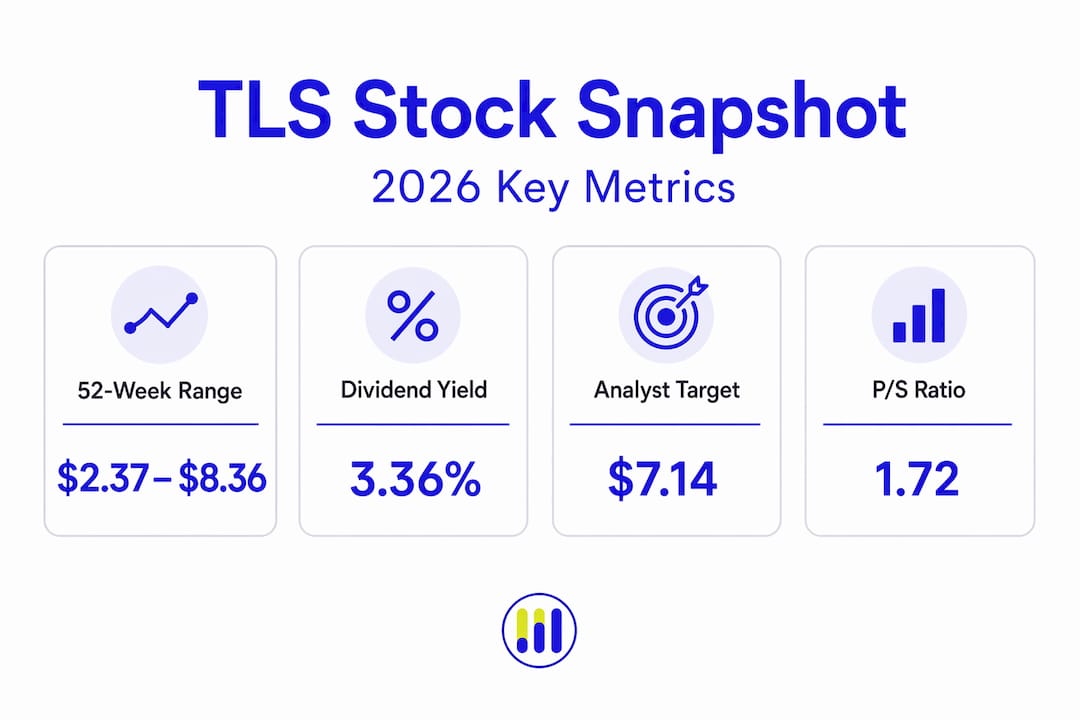
| Price volatility is context-dependent | TLS has a 52-week range of $2.37 to $8.36, meaning short-term swings carry little signal value on their own. |
| Revenue visibility reduces risk | Most 2026 forecast revenue comes from existing programs, giving investors clearer predictability than typical small-cap tech stocks. |
| Buybacks signal management confidence | Telos repurchased $2.2M in shares in Q1 2026, a concrete signal of undervaluation belief from those closest to the business. |
| Analyst targets vary widely | The consensus 1-year price target sits near $7.14, with a range from $4.04 to $9.45, reflecting genuine uncertainty alongside upside potential. |
| Valuation metrics offer useful anchors | A price-to-sales ratio of 1.72 at approximately $4.20 per share gives income and growth investors a concrete starting point for analysis. |
What drives the share price TLS investors watch most
Understanding TLS equity performance starts with the company's underlying business model. Telos generates revenue primarily through long-term government contracts in cybersecurity, identity management, and secure communications. These contracts provide a degree of revenue predictability that typical technology small-caps lack, but they also introduce their own risks. Contract renewals, government budget cycles, and program delays can all create sharp price reactions that feel irrational without that context.
The key financial and market factors that shape TLS stock value include:
- Revenue growth and EBITDA trajectory. Investors track top-line growth alongside adjusted EBITDA margins closely because Telos has historically operated near breakeven. Any expansion in profitability carries outsized significance for the share price.
- Management guidance clarity. When leadership provides specific forward guidance with program-level detail, it reduces the uncertainty premium the market prices in. Vague or cautious guidance tends to pressure the stock even when underlying fundamentals are stable.
- Sector sentiment. Government IT and cybersecurity spending trends directly affect how the market values TLS shares relative to peers. Shifts in federal budget priorities ripple through to valuation multiples quickly.
- Capital allocation decisions. Share repurchase programs, debt management, and investment in growth capabilities all communicate management's view of intrinsic value. The active repurchase program Telos has maintained creates upward pressure by shrinking the share float.
Pro Tip: Watch management commentary on program pipeline and contract backlog, not just headline revenue figures. In government IT businesses like Telos, backlog growth often predicts share price momentum six to twelve months out better than any single quarter's results.
Valuation metrics for analyzing TLS stock
Applying the right analytical frameworks to TLS helps you avoid the trap of buying or selling on price movement alone. The current TLS stock price near $4.20 with a market capitalization of $312.74M places it firmly in small-cap territory, which means valuation spreads and analyst disagreement are structurally wider than for large-cap peers.
The table below summarizes key valuation indicators worth monitoring:
| Metric | TLS Current Value | What It Signals |
|---|---|---|
| Price-to-sales ratio | 1.72 | Relatively low for a cybersecurity firm; suggests potential undervaluation if margins expand |
| Dividend yield | ~3.36% | Slightly below the 5-year average of 3.62%, modestly attractive for income investors |
| 52-week price range | $2.37 to $8.36 | Wide range indicates meaningful price recovery potential from trough levels |
| Analyst consensus target | $7.14 | Implies roughly 70% upside from May 2026 price levels if the bull case materializes |
Dividend discount models and discounted cash flow analysis are both applicable to TLS, though each requires assumptions about terminal growth rates that carry real uncertainty at this company's stage. A more grounded approach is comparing dividend yield trends and price-to-book ratios against sector peers to determine whether TLS is priced attractively relative to historical norms.
The analyst forecast range from $4.04 to $9.45 is itself revealing. A spread that wide tells you analysts are working with materially different assumptions about contract wins, margin expansion, and federal spending. That is not a reason to avoid the stock. It is a reason to form your own view on the most critical variables rather than anchoring to consensus.
Pro Tip: When analyst price targets show a wide range, identify which specific assumptions drive the bull and bear cases. For TLS, the key variables are contract award timing and EBITDA margin expansion. Track those two metrics quarter by quarter instead of waiting for price movement to tell you which scenario is playing out.
TLS share market trends and the 2026 outlook
The most recent quarterly results provide concrete data points for investors monitoring TLS share market trends. Management projected 22% to 28% revenue growth in Q2 2026, paired with adjusted EBITDA of $5M to $6M and a gross margin of approximately 39%. Those figures represent a meaningful step up from prior periods and reflect genuine operational progress, not financial engineering.
What strengthens confidence in those projections is the revenue composition behind them. Most forecast revenue comes from existing programs rather than new contract wins still pending award. For a government IT firm, that distinction matters enormously. Revenue tied to active programs with funded budgets carries far less execution risk than pipeline-dependent forecasts. That visibility reduces the uncertainty investors typically discount into small-cap government tech names.
Telos also repurchased $2.2 million worth of shares in Q1 2026, representing approximately 0.5 million shares. Management does not authorize buybacks when they believe the stock is fairly valued. That activity, combined with strong cash flow generation and disciplined working capital management, tells you something about how leadership views the current price relative to intrinsic value.

Risks remain real, though. Government contract delays, budget continuing resolutions, and competitive pressure in the federal cybersecurity sector could slow revenue recognition. Any guidance revision downward would likely pressure the share price sharply given the stock's sensitivity to management credibility.
How to invest in TLS shares effectively
Putting this analysis into practice requires a structured approach rather than reactive position changes. Here is a practical framework for monitoring and acting on TLS stock developments:
- Set up real-time price alerts. Track the current TLS stock price using financial platforms that provide intraday data, news feeds, and earnings calendars simultaneously. Reacting to price moves without understanding the catalyst behind them is one of the most common and costly mistakes in small-cap investing.
- Define your investment thesis clearly. Decide whether you are approaching TLS as an income investment (dividend yield, capital return program) or a growth play (margin expansion, revenue acceleration). Each framing leads to different entry price thresholds and holding periods.
- Review earnings transcripts directly. Management commentary on program pipeline, contract awards, and cost structure provides context that earnings summaries frequently omit. The Q1 2026 earnings call contains specific language on backlog composition worth reading in full.
- Compare TLS against sector peers. You can review TLS financial statements and stack them against comparable government technology firms to evaluate relative pricing on revenue multiples and margin profiles.
- Size positions relative to risk. Given the 52-week price range and analyst forecast spread, TLS carries above-average price variance. Position sizing should reflect that reality, especially for investors with shorter time horizons.
Pro Tip: Avoid anchoring your investment decision to where TLS was trading at its 52-week high. Price history is context, not a target. What matters is whether today's share price accurately reflects forward cash flow potential given current program visibility and margin trajectory.
My perspective on TLS investing
What I have learned watching TLS price behavior over time is that the market consistently over-punishes this stock for short-term guidance uncertainty and under-rewards it when program momentum builds quietly. Most investors fixate on headline revenue misses without reading into why revenue recognition shifted. In government contracting, timing differences are often administrative, not fundamental.
The share repurchase activity catches my attention more than most investors seem to realize. When management consistently repurchases shares at these price levels, that is not a trivial signal. It reflects a direct bet using company capital that the stock is underpriced. That kind of conviction from insiders, backed by actual capital deployment rather than words, changes how I weight the downside risk in my own analysis.
My honest take is that TLS rewards patient investors who understand the government IT contract cycle and resist the urge to trade quarterly noise. The fundamentals in 2026 look more constructive than the share price currently reflects.
— Tickerplace
Analyze TLS shares with Tickerplace
Tickerplace gives investors and analysts the tools to move beyond surface-level price tracking and into real financial analysis. Whether you are evaluating TLS stock value against sector peers, modeling return scenarios using the stock return calculator, or screening for comparable government technology equities with the stock screener, Tickerplace puts the data where you need it. Access TLS financial statements, technical indicators, and market context in one place at Tickerplace. Stop making investment decisions with incomplete information when a platform built specifically for serious market participants is available to you right now.
FAQ
What is the current TLS stock price?
TLS shares closed near $4.20 on May 15, 2026, with a market cap of $312.74M. Prices update continuously during market hours, so check a real-time data source for the latest figure.
What is the analyst price target for TLS shares?
The consensus analyst target for TLS sits near $7.14, with individual estimates ranging from $4.04 to $9.45, reflecting meaningful disagreement about future revenue and margin outcomes.
Does TLS pay a dividend?
TLS carries a dividend yield of approximately 3.36%, which is slightly below its 5-year historical average of 3.62% and may appeal to income-focused investors alongside the company's capital return program.
What drove TLS share price movement in 2026?
Management's guidance for 22% to 28% revenue growth in Q2 2026, combined with active share repurchases and strong existing program revenue, were the primary catalysts supporting price stability and potential appreciation.
How volatile has TLS been over the past year?
TLS has traded across a 52-week range from $2.37 to $8.36, indicating above-average price variance that investors should factor into position sizing and entry point decisions.