

TL;DR:
- IAG's share price is highly volatile due to fluctuating fuel costs, geopolitical risks, and market sentiment. Quarterly profits and financial maneuvers cause short-term swings, while long-term prospects depend on fuel hedging and route stability. Investors should carefully analyze operational fundamentals and market cues before making decisions.
The IAG share price has been anything but predictable in 2026, and that gap between expectation and reality is costing some investors real money. International Consolidated Airlines Group, the parent of British Airways, Iberia, Aer Lingus, and Vueling, sits at the center of a tug-of-war between strong quarterly profits and mounting fuel cost headwinds. This guide breaks down where IAG shares stand today, what is moving the price, how IAG compares to its peers, and how you can use that knowledge to make sharper investment decisions.
Key takeaways
| Point | Details |
|---|---|
| Significant price swings | IAG shares have traded in a wide range; understanding the triggers helps avoid reactive decisions. |
| Fuel costs are the main risk | CFO warnings point to fuel cost pressures intensifying in later 2026 quarters. |
| Q1 2026 profits were strong | Operating profit jumped 77.3%, but this may not be repeated at the same scale. |
| Multi-market listing adds complexity | IAG trades in GBX on the London Stock Exchange and EUR on Spanish exchanges simultaneously. |
| Bond buybacks create short-term rallies | Market reactions to financial maneuvers often fade quickly as operational realities return. |
IAG share price: current data and market position
Understanding where the IAG share price sits today requires looking at both the numbers and the context behind them. IAG shares trade on multiple exchanges, including the Madrid, Barcelona, Bilbao, and Valencia stock exchanges in Spain, as well as the London Stock Exchange under the ticker IAG.L. Depending on the venue, the price is quoted in different currencies, which matters when you are comparing data across platforms.
On the London Stock Exchange, the IAG stock price is quoted in GBX, or pence sterling, while Spanish exchange listings reflect EUR valuations. A recent reference point sits around 396.90 GBX on the London market, though this figure shifts with daily trading activity.
Here is a snapshot of key market metrics for context:
| Metric | Value |
|---|---|
| Market capitalization | Approximately £17.7 billion |
| Shares outstanding | ~4.46 billion |
| Recent London price range | ~396.90 GBX to 416.90 GBX in a single session |
| Primary ticker | IAG.L (London Stock Exchange) |
| Currency variations | GBX (London), EUR (Spanish exchanges) |
Some key characteristics of IAG's current market position:
- IAG market cap stands at roughly £17.711 billion, placing it firmly among the larger European airline groups by market value.
- Trading volumes are consistently high, reflecting strong institutional and retail interest.
- The 52-week range has shown notable spread, which signals above-average volatility relative to broader market indices.
Pro Tip: When tracking IAG shares today across platforms, always confirm whether the price is in GBX or EUR before making comparisons. A direct numeric comparison without accounting for currency will produce misleading results.
What drives IAG share price fluctuations
Airline stocks are sensitive to a wider range of variables than most sectors, and IAG is no exception. Several factors have shaped recent price movements in ways that deserve close attention.

Fuel costs represent the single largest operational expense for any major carrier. IAG's CFO Nicholas Cadbury warned that while Q1 2026 saw a relatively mild impact from rising fuel prices, the pressure is expected to intensify in subsequent quarters. That forward-looking signal alone is enough to suppress investor confidence even when current results look encouraging.
Geopolitical events add another layer of uncertainty. In recent periods, Middle East conflict risk has directly threatened IAG's full-year profit guidance, given that route disruptions and passenger demand shifts affect revenue across its airline brands. Operational breadth matters here: IAG owns British Airways, Iberia, Aer Lingus, and Vueling, which means exposure to multiple conflict-sensitive flight corridors simultaneously.
Financial engineering moves, such as bond buybacks, create their own market dynamic. Following positive announcements of this kind, IAG shares show a pattern of jumping sharply and then retreating as traders refocus on underlying operational metrics. In one recent session, the stock reached as high as 416.9p before pulling back roughly 3% to hover around 397.5p, a clear illustration of sentiment moving faster than fundamentals.
Quarterly profit results also move the market. IAG posted a Q1 2026 operating profit of €351 million, representing a 77.3% year-over-year increase. That figure impressed the market briefly, but forward guidance tempered enthusiasm. Investor sentiment in the airline sector tends to price future risk faster than it celebrates present gains.
IAG versus industry peers
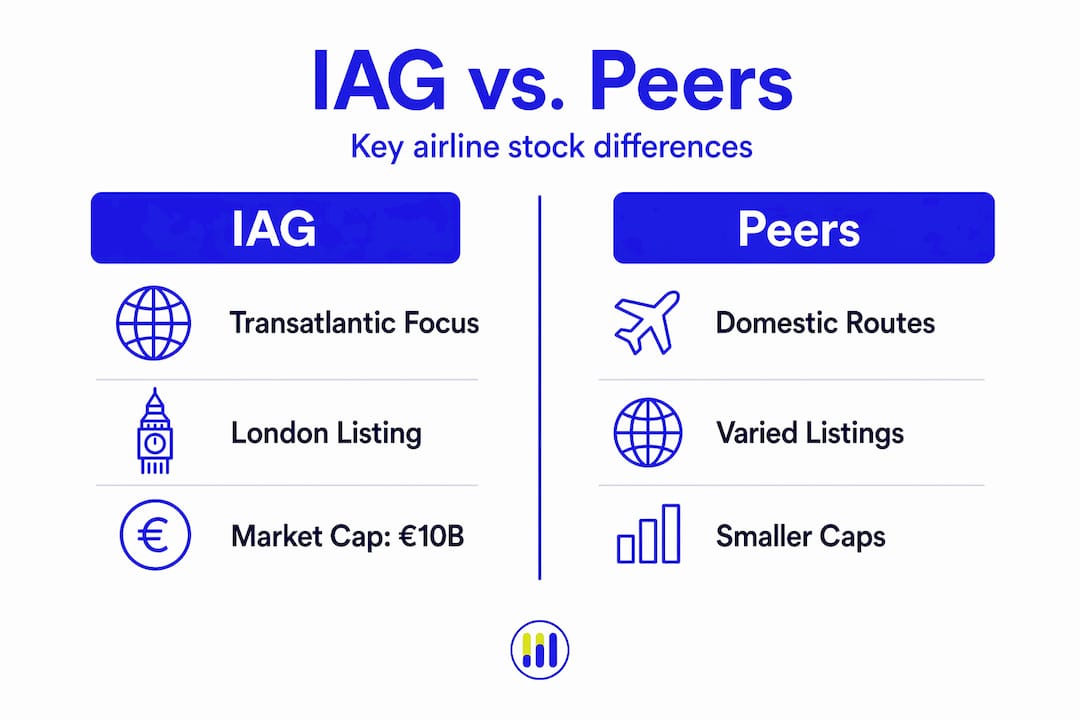
Putting the IAG market price in context requires comparing it to comparable airline groups. While exact peer figures fluctuate, the table below reflects approximate relative positions based on recent data.
| Company | Primary Exchange | Approx. Market Cap | Key Characteristics |
|---|---|---|---|
| IAG (IAG.L) | London / Spanish exchanges | ~£17.7 billion | Multi-brand, transatlantic exposure |
| Ryanair | Euronext Dublin / Nasdaq | ~£17 billion+ | Low-cost, high-volume model |
| Lufthansa Group | Frankfurt Stock Exchange | ~£8 billion+ | Full-service, European hub model |
| easyJet | London Stock Exchange | ~£4 billion | Short-haul, leisure-focused |
IAG's share performance has generally tracked the broader European airline recovery since 2022, but it has consistently shown more volatility than budget carriers like easyJet, partly because of its higher exposure to premium long-haul routes and currency complexity. When benchmarked against the FTSE 100 and IBEX 35, IAG's IAG share performance tends to amplify broad market moves rather than dampen them.
Risks unique to IAG relative to peers include its greater reliance on transatlantic routes, where geopolitical and currency shifts carry outsized weight. The opportunity side is equally distinct: premium demand on long-haul routes has remained resilient, and IAG's scale gives it negotiating power on fuel contracts that smaller carriers lack.
How to interpret IAG shares for investment decisions
Translating price data into sound investment thinking requires a structured approach. Here is a practical framework for evaluating the IAG share value at any given moment.
-
Read the earnings reports carefully. The difference between headline profit numbers and forward guidance is where the real signal lives. IAG's Q1 2026 results looked excellent in isolation, but the CFO's comments about fuel cost timing changed the picture significantly. Always read the management discussion section, not just the summary figures. You can review IAG financial statements to track these signals across reporting periods.
-
Track fuel price indexes alongside the share price. Jet fuel costs move with crude oil markets. Plotting Brent crude movements against IAG's stock price over rolling 90-day periods will reveal correlation patterns that help you anticipate directional pressure before it shows up in results.
-
Separate financial engineering from operational momentum. Bond buyback reactions create temporary price lifts that often reverse within days. If you are a long-term investor, reacting to these moves adds transaction costs without adding returns.
-
Monitor geopolitical developments affecting route networks. IAG's revenue depends on routes that cross conflict-sensitive regions. A single disruption can shift full-year guidance materially, which explains why the stock sometimes drops sharply on news that seems distant.
-
Establish a price thesis before you invest. Decide in advance what price range reflects fair value based on your analysis, and define the conditions under which you would revise that view. Investors who chase the IAG share price without a thesis tend to buy after rallies and sell into pullbacks.
Pro Tip: Avoid anchoring too heavily on 52-week highs or lows when assessing IAG share value. Airline stocks frequently reset their trading ranges on macro events, making historical levels less predictive than sector-specific indicators like load factor data and fuel hedging coverage.
My take on IAG's investment outlook
I've tracked a lot of airline stocks over the years, and what I find consistently underappreciated about IAG is how quickly the market cycles between two very different stories on the same company. The bond buyback rally followed by a 3% retreat is not surprising to me at all. It is the same pattern repeating: financial engineering optimism runs ahead of operational reality, and then the market corrects.
What individual investors often miss is that Q1's strong numbers do not distribute evenly across the year. Summer and holiday quarter strength can mask Q2 and Q3 cost pressures in the headline annual figures. When fuel costs hit margins in the back half of 2026, I expect the IAG stock price to test the patience of investors who bought on the Q1 momentum.
My view is that IAG is a fundamentally sound business with real brand strength across its portfolio. But sound does not mean immune to cycle risk. If you are considering how to invest in IAG, the timing matters as much as the thesis. Watch the fuel hedging disclosures in the next quarterly report. That single data point will tell you more about near-term share price direction than almost anything else.
— Tickerplace
Track IAG shares with Tickerplace
Tickerplace gives you the tools to monitor the IAG share price without guesswork. From real-time IAG stock data to historical price lookups and financial statement analysis, the platform puts institutional-grade research within reach of individual investors. Use the stock screener to compare IAG against peers on metrics like market cap, price-to-earnings ratio, and volume. Whether you are tracking IAG shares today or building a longer-term position, Tickerplace gives you the market data and research tools to invest with confidence.
FAQ
What is the current IAG share price?
The IAG share price fluctuates daily; recent London Stock Exchange data placed it around 396.90 GBX, though you should check a live market feed for the most current figure.
Why did IAG shares drop after a bond buyback announcement?
IAG shares initially rallied to 416.9p following positive financial news, then pulled back roughly 3% as investor focus shifted back to rising fuel costs and margin concerns.
What exchanges does IAG trade on?
IAG trades on the London Stock Exchange under the ticker IAG.L, as well as on the Madrid, Barcelona, Bilbao, and Valencia stock exchanges, with prices quoted in GBX and EUR respectively.
How do fuel costs affect the IAG stock price?
Fuel costs are IAG's largest variable expense; when prices rise, margins compress and forward guidance weakens, which typically puts downward pressure on the IAG share price in subsequent quarters.
Is IAG a good long-term investment?
IAG has strong brand assets and transatlantic scale, but the stock carries above-average volatility driven by fuel price cycles, geopolitical route exposure, and currency complexity across its multi-market listing structure.