

TL;DR:
- Woodside's share price experienced extreme volatility in 2026, with strong gains followed by sharp corrections driven by geopolitical factors. Its low or negative beta offers a unique diversification benefit, especially for risk-conscious investors, while fundamentals support long-term value when oil prices stay above $60-70 per barrel. Monitoring technical levels, geopolitical developments, and project progress is essential for making informed trading and investment decisions.
Few energy stocks have delivered the kind of whipsaw trading experience that the share price Woodside investors faced in the first half of 2026. A 29% year-to-date gain, followed by a sharp single-week correction driven not by earnings but by geopolitical peace talks, captures exactly why this stock demands more than a casual watch. Whether you are looking to buy Woodside shares, assess current Woodside shares for your portfolio, or simply understand what is moving the price, this article gives you the factual grounding and practical framework to make that call with confidence.
Key Takeaways
| Point | Details |
|---|---|
| Strong YTD performance | Woodside shares gained approximately 29% year-to-date before a sharp May 2026 correction. |
| Geopolitical premium at work | Peace deal developments directly unwind oil price premiums, causing fast and significant share price drops. |
| Unusual beta reading | Woodside's low or negative beta of -0.26 signals weak correlation with the broader market, affecting portfolio risk calculations. |
| Dividend appeal is real | A 60-80% payout ratio policy makes Woodside attractive for income-focused investors even through price volatility. |
| Fundamentals provide a floor | Long-term models suggest Woodside's share value holds up when oil stabilizes above the $60-70 per barrel range. |
Share price Woodside: 2026 performance snapshot
Woodside's price story in 2026 is not a smooth upward trend. It has been a series of sharp moves in both directions, shaped by factors well outside the company's direct control. Understanding where the stock has been helps you contextualize where it may go.
The most striking data point: shares declined 9.8% in early May 2026 in response to geopolitical developments, yet the stock still held a roughly 29% year-to-date gain as of mid-May. That kind of arithmetic tells you the underlying momentum was strong before the correction hit.
Here is a snapshot of the key data points from mid-2026:
| Metric | Value |
|---|---|
| Share price (mid-May 2026) | A$30.05 |
| Market capitalization | ~A$57.1 billion |
| Recent closing price | A$30.49 (after a 4.24% single-day drop) |
| Price vs. 50-day moving average | -7.06% |
| Price vs. 200-day moving average | +12.57% |
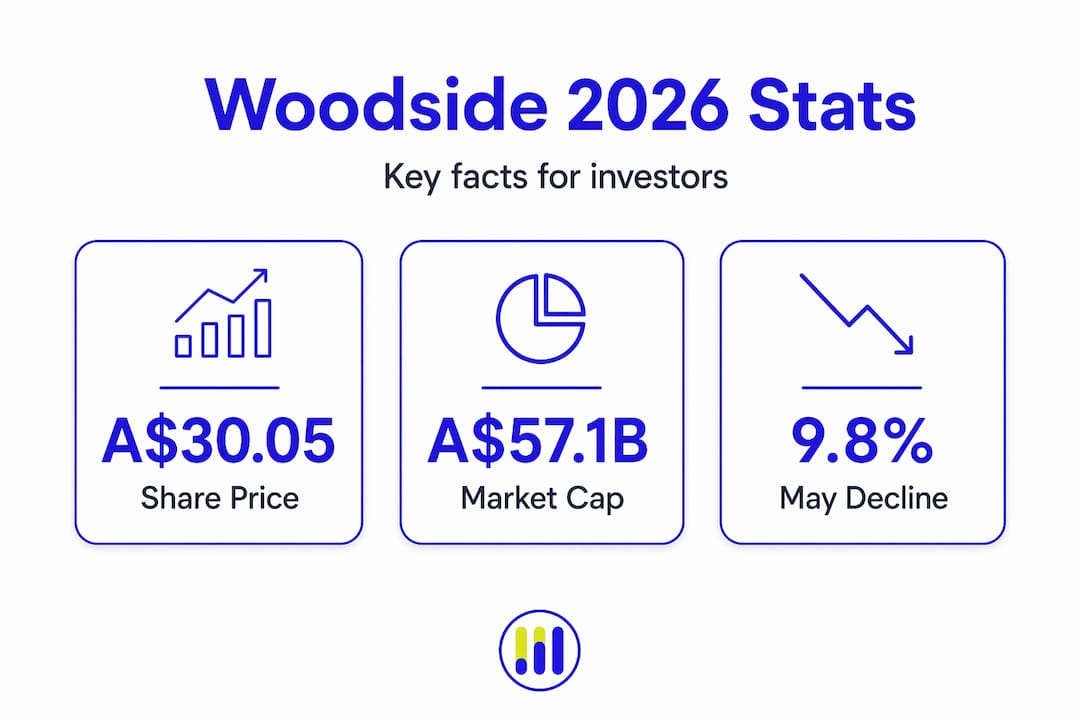
The A$57.1 billion market cap places Woodside firmly among the largest companies listed on the ASX, giving it significant weight within the Australian energy index. Traders watching the Woodside stock price closely would have noticed the A$30 psychological level acting as both a support and a focal point for short-term sentiment. The split between being below the 50-day moving average yet well above the 200-day average is a classic signal of a stock in a short-term correction within a longer-term uptrend.

Key factors driving Woodside's share price
The Woodside share price does not move in isolation. Several layers of influence interact to set the price on any given day, and understanding each layer gives you a real edge.
Geopolitical risk premium. Energy stocks frequently carry a premium during periods of conflict, reflecting the market's expectation that supply disruptions will push oil prices higher. For Woodside, Iran peace talks directly removed this premium in May 2026, unwinding months of built-in value almost overnight. This is not a new phenomenon, but the speed of the repricing surprised many retail investors.
Oil and LNG price sensitivity. Woodside's revenues are closely tied to both crude oil and liquefied natural gas prices. When commodity benchmarks pull back, earnings forecasts follow, and the share price adjusts accordingly. The company's Scarborough LNG project represents one of the most significant capital expenditure commitments in Australia's energy sector, and investor expectations around its delivery directly shape how the Woodside share value is priced at any given time.
Here are the primary factors worth tracking if you hold or plan to hold this stock:
- Brent crude oil price movements and forward curves
- LNG spot and contract pricing in Asian markets
- Progress updates on the Scarborough project
- U.S. dollar versus Australian dollar exchange rate fluctuations
- Regulatory changes in Australia's offshore energy sector
- OPEC production decisions and their downstream effects
The beta anomaly. Most energy producers carry a positive beta, meaning they move broadly in sync with the market. Woodside is different. Its stock carries a beta of -0.26, which means it historically moves with weak or even inverse correlation to the broader market. For portfolio construction purposes, this matters. Adding Woodside does not simply add more market risk. It adds a commodity-driven, geopolitically sensitive exposure that sits largely outside the normal index movement patterns.
Pro Tip: If you are using Woodside as a hedge against broader market downturns, the low beta reading supports that approach, but always check whether current oil price dynamics are aligned before assuming the historical pattern holds.
Technical analysis and trading Woodside shares
Technical analysis does not predict the future. What it does is give you a structured way to read crowd behavior and identify price levels where buyers and sellers have historically concentrated. For Woodside, several indicators are worth understanding.
-
The 50-day and 200-day moving averages. As noted, Woodside's price sits 7.06% below its 50-day average while remaining 12.57% above its 200-day average. This divergence tells a specific story: the recent drop is a short-term pullback, not a fundamental trend reversal. Experienced traders often treat the 200-day moving average as a long-term health indicator, and holding above it is generally a constructive sign.
-
Support and resistance at round numbers. The A$30 level has repeatedly attracted attention. Round numbers function as psychological anchors in trading; market participants remember them and react around them.
-
Volume behavior during news events. When Woodside dropped on the geopolitical news in May, volume spiked significantly. High-volume drops on news-driven catalysts often see partial recovery once the initial panic selling is absorbed, particularly when the fundamental picture has not materially changed.
-
Positioning data. Monitoring the ratio of long to short positions in Woodside gives insight into how the broader trader community is leaning. Heavy short positioning heading into a positive earnings update, for example, can amplify upside moves through short covering.
Pro Tip: Do not interpret a single-day price drop of 4% or more as a signal to sell Woodside shares without first checking whether the trigger was company-specific or macro-driven. Geopolitical re-pricings frequently overshoot in both directions.
Woodside's fundamentals and long-term investment case
Volatility is noise without context. For investors focused on the Woodside investment analysis beyond the next trading session, the fundamental picture provides a more grounded view.
Woodside maintains a dividend payout ratio target of 60 to 80%, fully franked, which is a meaningful draw for income-focused investors in a low-yield environment. Fully franked dividends carry a tax credit for Australian investors, making the effective yield considerably higher than the headline number suggests.
The comparison below shows how two investor profiles would view the same stock:
| Investor type | Primary concern | How Woodside addresses it |
|---|---|---|
| Income investor | Consistent dividend yield | 60-80% payout ratio, fully franked |
| Growth investor | Capital appreciation | Scarborough LNG project growth potential |
| Risk-conscious investor | Downside protection | Low or negative beta, diversified commodity exposure |
| Short-term trader | Price momentum | Strong YTD trend with clear technical levels |
The Scarborough LNG project offshore Western Australia represents the company's most significant growth catalyst. Its progress milestones generate headline risk in both directions: positive delivery news pushes the share price higher, while cost overruns or regulatory delays create selling pressure. Monitoring project updates through official company releases is not optional for anyone holding a material position.
Long-term models support Woodside's valuation when oil stabilizes above $60 to $70 per barrel. Below that range, earnings projections compress and dividend sustainability comes under scrutiny. The key risk to watch is a sustained oil price normalization driven by demand weakness or coordinated OPEC output increases, not short-term geopolitical re-pricing.
My take on trading Woodside through volatility
I've watched energy stocks get misread repeatedly by individual investors who confuse short-term geopolitical repricing with a change in fundamental value. Woodside is one of the clearest examples of this pattern. When peace talks removed the Middle East risk premium in May 2026, the market treated it as a signal to exit. In my view, that was a significant overreaction.
What I've found consistently is that the investors who do best with stocks like Woodside are the ones who separate the two timeframes deliberately. They know what they own and why. If you bought for the dividend and the LNG growth story, a 4% correction on peace news is not a reason to sell Woodside stock. It is, in fact, the kind of noise that long-term positions are built to absorb.
The contrarian angle that most commentators miss: Woodside's low beta is often presented as a weakness or an anomaly. I think it is actually a structural advantage for sophisticated portfolio builders. You get commodity exposure, strong franked dividends, and a price that does not follow the market off a cliff during broad selloffs. That combination is genuinely uncommon among ASX-listed stocks.
My consistent advice: watch the fundamentals quarterly, check the technical levels monthly, and resist reacting to geopolitical headlines daily.
— Tickerplace
Track Woodside smarter with Tickerplace
Knowing what moves the Woodside share price is the first step. Having real-time tools to act on that knowledge is where the difference is made.
Tickerplace provides investors with live stock data, advanced stock screening, and detailed fundamental and technical analysis, including full coverage of Woodside (WDS) on the ASX. You can track the current Woodside shares price, review Woodside price history through historical charts, compare valuation metrics, and set up research workflows that match your investment style. Whether you are assessing when to buy Woodside shares or monitoring an existing position, Tickerplace's research platform gives you the data depth to make that decision with confidence rather than guesswork.
FAQ
What is the current Woodside share price?
As of mid-May 2026, Woodside's share price was approximately A$30.05, with a market capitalization near A$57.1 billion. Prices change daily, so checking a live data source like Tickerplace gives you the most accurate reading.
Why did Woodside shares drop sharply in May 2026?
The May 2026 drop of approximately 9.8% was driven by Iran peace talk developments that removed the geopolitical risk premium previously priced into the stock. This kind of repricing is typical for energy producers with oil price sensitivity.
Is Woodside a good stock for dividend income?
Woodside targets a 60 to 80% payout ratio with fully franked dividends, making it one of the stronger income options on the ASX for Australian investors who benefit from dividend franking credits.
What does Woodside's beta of -0.26 mean for investors?
A beta of -0.26 means Woodside has a weak or inverse correlation with broader market movements. This makes it useful for portfolio diversification, though it also means the stock follows its own commodity and geopolitical drivers more than index trends.
What is the key long-term risk for Woodside's share value?
The primary long-term risk is a sustained decline in oil prices below the $60 to $70 per barrel range, which would compress earnings forecasts and put dividend sustainability under pressure. Regulatory changes in Australian offshore energy policy represent a secondary but meaningful risk.