

TL;DR:
- The AUD to INR exchange rate is currently about 67.07, influenced by monetary policies, commodity prices, and market interventions. Central banks' actions, especially RBA rate hikes and RBI's forward selling, significantly affect currency movements over different timeframes. Effective trading requires monitoring policy signals, execution costs, and timing to accurately anticipate currency fluctuations.
The AUD to INR exchange rate defines how many Indian rupees one Australian dollar buys at any given moment, and as of june 7, 2026, that figure sits at approximately 67.07 INR per AUD. For investors and traders working this currency pair, that number is only the starting point. The Reserve Bank of Australia (RBA) and the Reserve Bank of India (RBI) are both actively shaping the rate through monetary policy and direct market intervention, creating a pair with more moving parts than most. Understanding those forces is what separates a well-timed trade from an expensive mistake.
What drives the aussie dollar vs indian rupee rate?
Two central banks with very different mandates sit on opposite ends of this currency pair. Their policy decisions, and the lag between announcement and real-world impact, explain most of the volatility traders see in AUD/INR.

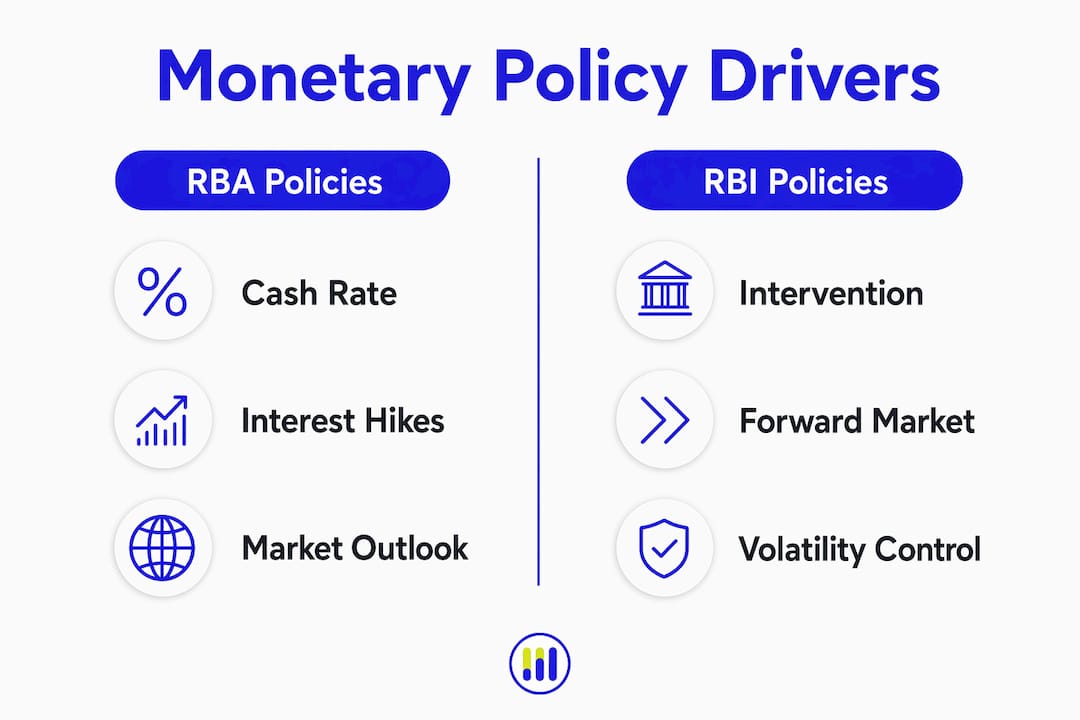
Monetary policy divergence is the primary structural driver. The RBA raised its cash rate to 4.35% in mid-2026 to contain inflation. Higher rates attract capital flows into Australian dollar assets, which supports AUD strength. The catch is that the full economic effect of rate changes takes 1–2 years to transmit through the economy, so the market reprices AUD faster than the underlying fundamentals shift.
On the Indian side, the RBI operates a managed float regime, also called a dirty float. The RBI does not target a fixed exchange rate but actively intervenes to smooth volatility. That makes the INR less responsive to pure market forces than a freely floating currency would be.
Additional factors shaping the rate include:
- Commodity prices: Australia exports iron ore, coal, and liquefied natural gas. Rising commodity prices lift export revenues and strengthen AUD. Falling prices do the opposite.
- India's trade balance: India runs a persistent current account deficit. A wider deficit increases demand for foreign currency to pay for imports, which pressures INR lower.
- Global risk sentiment: AUD is a risk-on currency. When global equity markets sell off or credit spreads widen, investors rotate out of AUD into safe-haven currencies like USD and JPY, which weakens AUD against INR indirectly.
Pro Tip: Watch the RBA's quarterly Statement on Monetary Policy alongside iron ore futures prices. Together, they give you the two most reliable leading signals for AUD direction.
How do provider markups affect AUD to INR conversions?
The mid-market rate is the midpoint between the buy and sell prices in the interbank market. It is the fairest benchmark for any AUD to INR conversion, but it is not the rate you receive when you execute a transfer or trade.
Mid-market rates are useful for fair-value comparisons, but realized rates depend entirely on your execution provider. The gap between benchmark and execution rate is where real money is lost, especially on larger transfers.
| Provider Type | Typical Markup | Flat Fee Range | Best For |
|---|---|---|---|
| Specialist FX providers | 0.2%–0.8% | Low or zero | Regular transfers, mid-size amounts |
| Retail banks | 2%–5% | Moderate to high | Convenience only |
| Online brokers | 0.1%–0.5% | Variable | Active traders |
Specialist providers charge 0.2%–0.8% versus the 2%–5% markup banks typically apply. On a $50,000 AUD transfer, that difference can amount to $1,000–$2,250 AUD in additional cost. Flat fees compound this further on smaller transfers, where a $15 fixed fee on a $500 transfer represents 3% of the transaction before the spread is even counted.
Pro Tip: Always calculate the all-in cost: multiply the transfer amount by the markup percentage, then add any flat fee. Compare this total across at least three providers before executing, particularly for amounts above $10,000 AUD.
How does RBI intervention shape the aud/inr forward market?
The RBI's intervention strategy in FY26 reached a scale that traders cannot afford to ignore. Understanding the difference between spot and forward market actions gives you a clearer read on the RBI's intent and the likely direction of INR volatility.
In FY26, the RBI executed record $53.13 billion in spot market sales to defend the rupee. Simultaneously, the RBI's net forward position expanded to $103.06 billion in net forward sales. These are the largest interventions in a decade, and they signal a deliberate policy of volatility suppression rather than rate targeting.
Here is how traders should interpret each intervention type:
- Spot sales inject immediate USD liquidity into the market, directly capping INR depreciation in real time. Large spot sales signal the RBI is defending a near-term level.
- Forward sales affect future liquidity and carry a signaling function. A large net forward position tells the market the RBI expects continued pressure on INR and is committing reserves to manage it over a longer horizon.
- Managed float signals mean prolonged directional trends in INR are less likely. The RBI's managed float approach produces range-bound volatility smoothing, which makes sustained INR depreciation or appreciation less predictable.
Key insight: Forward market interventions by the RBI allow reserve management flexibility and send market signals that affect investor sentiment well beyond immediate spot liquidity effects. Traders who only watch spot rates miss half the picture.
For AUD/INR traders, the practical implication is clear. When RBI forward positions expand sharply, FX risk premia on INR tend to shift. Watch the RBI's weekly reserve data and forward position disclosures alongside spot intervention announcements for a complete picture.
How does RBA policy timing affect aud/inr trades?
Timing is the most underappreciated variable in AUD/INR trading. The RBA's rate decisions reprice AUD almost instantly in currency markets, but the economic outcomes that justify those prices take far longer to materialize.
Here is the sequence every AUD/INR trader should understand:
- Policy announcement: The RBA announces a rate change. AUD reprices within hours as yield differentials shift and capital flows adjust.
- Market pricing phase (weeks to months): Currency markets price in the expected path of future rate moves. AUD strength or weakness reflects forward expectations, not current economic reality.
- Economic transmission (1–2 years): The actual impact on inflation and growth takes 12–24 months to work through the Australian economy via mortgage rates, business lending, and consumer spending.
- Commodity price overlay: Australia's export revenues from iron ore and energy remain a parallel driver. A rate hike that coincides with rising commodity prices amplifies AUD strength. A rate hike during a commodity downturn can be partially offset.
- Trade execution window: Markets price in RBA changes well in advance, but realized currency strength unfolds gradually. Traders who enter AUD long positions immediately after a rate announcement often buy at the peak of the initial repricing, not at the start of a sustained move.
The practical takeaway is that short-term AUD/INR trades around RBA meetings carry high repricing risk. Medium-term positions held over 3–6 months better capture the gradual transmission of policy into currency strength. You can also review ANZ Bank share price insights for additional context on how Australian monetary policy flows through major financial institutions.
Key takeaways
The AUD to INR exchange rate is shaped by RBA monetary policy, RBI intervention strategy, commodity prices, and provider execution costs, all of which require active monitoring to trade or invest effectively.
| Point | Details |
|---|---|
| Current benchmark rate | 1 AUD equals approximately 67.07 INR as of june 7, 2026, per XE mid-market data. |
| Provider cost gap | Specialist FX providers charge 0.2%–0.8% markup versus 2%–5% at retail banks. |
| RBI intervention scale | RBI sold a record $53.13 billion in spot markets in FY26 to defend INR stability. |
| RBA policy lag | RBA rate hikes reprice AUD quickly, but full economic effects take 1–2 years to materialize. |
| Forward vs spot signals | RBI forward positions signal medium-term intent; spot sales address immediate INR pressure. |
Tickerplace's take on trading aud/inr in 2026
Most traders focus on the headline rate and miss the two variables that actually determine outcomes: the cost of execution and the timing gap between policy signals and economic reality.
At Tickerplace, we track both spot and forward RBI intervention data because the forward position tells you what the central bank expects, not just what it is doing today. A widening net forward position is a more durable signal than a single spot sale. Traders who conflate the two end up misreading the RBI's intent.
The execution cost problem is equally underappreciated. A 2% bank markup on a short-dated AUD/INR hedge can consume most of the expected gain from a modest rate move. Specialist providers and direct broker access are not optional for active traders. They are the difference between a profitable strategy and a break-even one.
Patience is the hardest discipline in this pair. The RBA's 4.35% cash rate is already priced into AUD. The real AUD strength, if it materializes, will come from the economic outcomes that rate produces over the next 12–18 months. Traders who understand that distinction position themselves ahead of the market rather than chasing moves that have already happened.
— Tickerplace
Track aud/inr data and market signals with Tickerplace
Staying ahead of AUD/INR movements requires more than a single data point. You need real-time rate data, central bank policy tracking, and the analytical tools to connect macro signals to trade decisions.
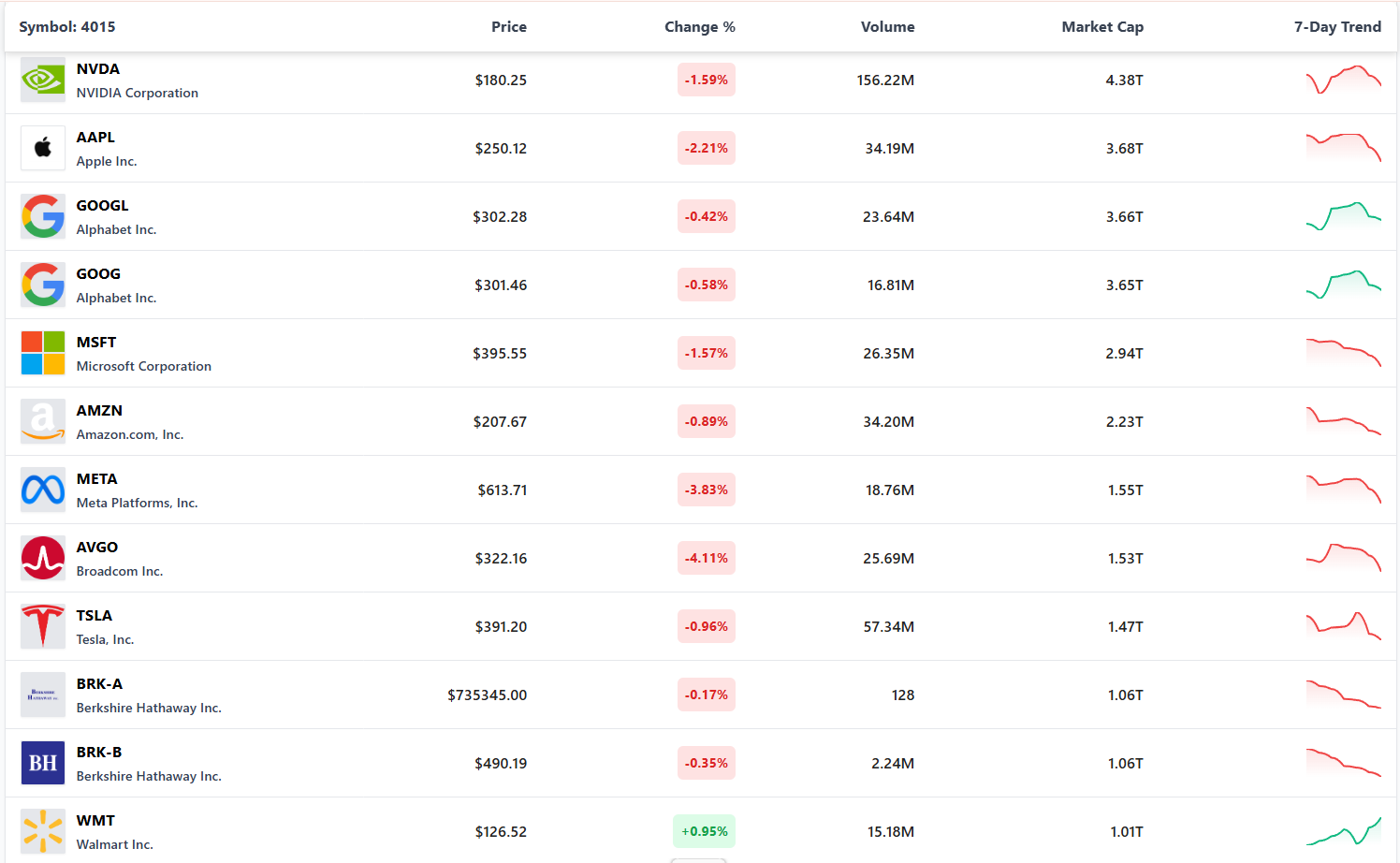
Tickerplace gives active traders and financial analysts access to real-time market data, currency-relevant stock screening, and a full suite of financial calculators designed to evaluate investment performance and hedge costs. Whether you are modeling the impact of RBA rate changes on AUD-exposed equities or comparing provider execution costs for a large transfer, Tickerplace provides the data infrastructure to support that analysis. The platform is built for market participants who treat currency exposure as a core part of portfolio management, not an afterthought.
FAQ
What is the current AUD to INR exchange rate?
The mid-market AUD to INR exchange rate is approximately 67.07 INR per 1 AUD as of june 7, 2026. This benchmark rate is published by XE and serves as the interbank reference point for fair-value comparisons.
Why does the INR not move freely against the AUD?
The RBI operates a managed float regime, intervening in both spot and forward markets to reduce volatility without targeting a fixed rate. This active management limits the extent of sustained directional moves in INR.
How do i convert australian dollar to rupee at the best rate?
Use a specialist FX provider rather than a retail bank. Specialists charge 0.2%–0.8% markup versus 2%–5% at banks, which produces meaningfully better realized rates on transfers above $5,000 AUD.
How should traders interpret RBI forward market interventions?
A large net forward position signals the RBI expects continued INR pressure and is committing to medium-term management. It affects investor sentiment and FX risk premia beyond what spot sales alone communicate.
Does the RBA cash rate directly strengthen AUD against INR?
The RBA cash rate at 4.35% supports AUD through yield differentials, but the full economic effect takes 1–2 years to transmit. Markets reprice AUD quickly after announcements, so the initial move often overstates near-term fundamentals.