

TL;DR:
- Suncorp's share price reflects its financial health, insurance earnings, and dividend prospects, trading near A$16.65 with upside potential. Its low beta of 0.224 indicates low volatility, making it attractive for income-focused investors seeking stable dividends. Key dates like ex-dividend days influence short-term price movements, while analysts project a 12-month target around A$18.73.
Suncorp shares price is the real-time market valuation of Suncorp Group Limited (ASX: SUN), reflecting the company's financial health, dividend reliability, and its position as Australia's leading pure-play insurer. With SUN last trading near A$16.65 and analyst consensus pointing higher, the stock sits at a meaningful decision point for individual investors weighing income generation against capital growth. Understanding what drives this price, and when to act on it, is the foundation of any sound Suncorp investment strategy.
What are the key factors influencing Suncorp's shares price?
Suncorp's stock price is shaped by a specific set of drivers that differ from general market equities. The company's shift to a pure-play insurance business, following the sale of its banking division, has concentrated investor attention on insurance earnings quality, claims experience, and capital management decisions. These three variables account for most of the meaningful price re-ratings you will observe in SUN.
The following factors carry the most weight in day-to-day and medium-term price movement:
- Earnings quality and claims experience: Strong underwriting results and controlled claims costs lift investor confidence and push the price upward. Adverse weather events, which drive elevated claims, tend to pressure the stock in the short term.
- Dividend announcements and ex-dividend dates: Suncorp is a reliable dividend payer, and dividend-related news moves the stock more than it does for growth-oriented peers.
- Sector trends in Australian financial services: Broader ASX financial sector sentiment, interest rate decisions by the Reserve Bank of Australia, and regulatory changes all feed into the Suncorp stock price.
- Market volatility and beta: With a beta of 0.224, SUN exhibits low sensitivity to overall market swings. This makes it a defensive holding, though it also means the stock rarely surges during broad market rallies.
- Capital management news: Share buybacks, special dividends, or capital returns following asset sales can trigger sharp short-term price moves.
Pro Tip: Track Suncorp's financial statements alongside earnings release dates. Price re-ratings most often occur within 48 hours of earnings or capital management announcements, not during quiet trading periods.
How has Suncorp's share price performed recently?

Suncorp's recent price history tells a story of measured recovery and sector-relative stability. The stock has traded within a 52-week range of A$13.80 to A$21.68, a spread that reflects both the post-banking-exit re-rating and broader ASX volatility during 2025. The current price near A$16.65 places SUN in the lower half of that range, which some analysts read as a value opportunity relative to the consensus 12-month target.
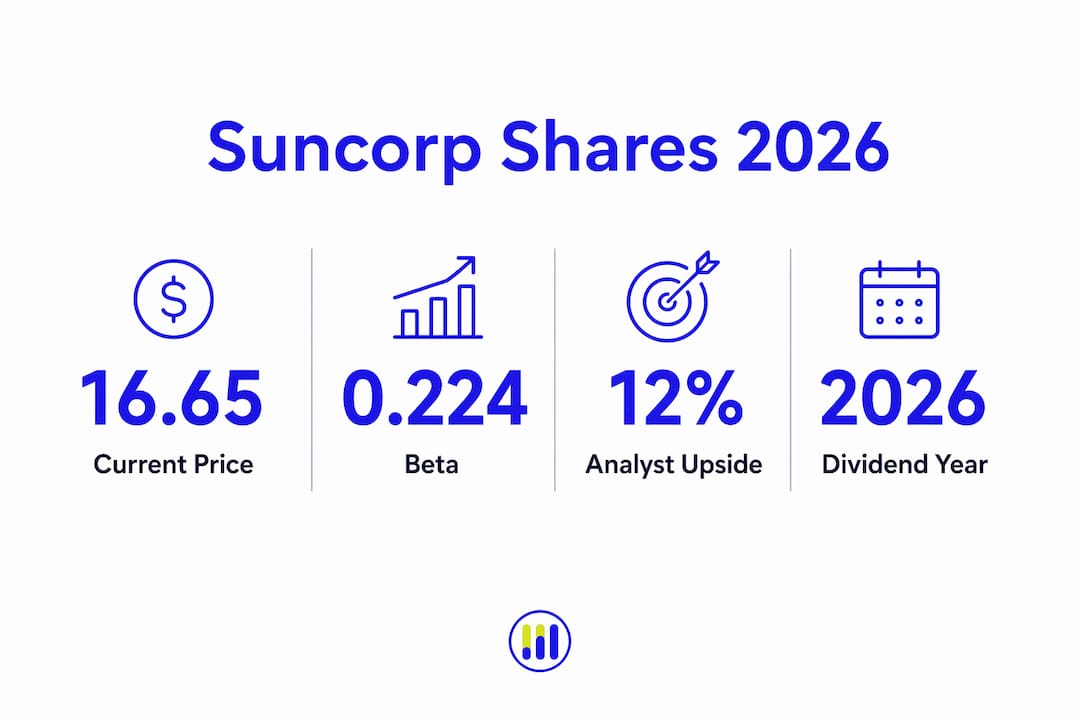
The table below summarizes the key price indicators and technical benchmarks relevant to your Suncorp share market analysis:
| Indicator | Value | What it means |
|---|---|---|
| Recent trading price | ~A$16.65 | Current market valuation per share |
| 52-week low | A$13.80 | Floor of recent price range |
| 52-week high | A$21.68 | Peak of recent price range |
| Beta | 0.224 | Low volatility relative to ASX market |
| Analyst consensus target | ~A$18.73 | Average 12-month price forecast from 12 analysts |
| Analyst target range | A$16 to A$21 | Spread of individual analyst forecasts |
The analyst consensus of A$18.73 across 12 analysts implies roughly 12% upside from the current price. That gap between market price and consensus target is meaningful. It suggests the market is pricing in some near-term uncertainty, likely around claims costs and the broader insurance cycle, while analysts maintain a more constructive medium-term view.
Volume and volatility context matters here too. SUN's low beta of 0.224 confirms that price movement is modest on most trading days, which suits income-focused investors who prioritize dividend yield over short-term capital gains. Traders seeking large price swings will find SUN less rewarding than higher-beta ASX names.
What is the 2026 dividend schedule for Suncorp?
Suncorp's 2026 dividend calendar is the single most important planning tool for income-focused investors. The company has published both ex-dividend and payment dates, giving you a clear framework to time your entry and exit decisions.
The 2026 dividend schedule breaks down as follows:
- Interim dividend ex-dividend date: February 23, 2026. Investors who hold shares before this date qualify for the interim dividend payment.
- Interim dividend payment date: March 31, 2026. The cash dividend is credited to eligible shareholders on this date.
- Final dividend ex-dividend date: August 17, 2026. This is the cutoff for the larger annual dividend entitlement.
- Final dividend payment date: September 22, 2026. Eligible shareholders receive the final dividend on this date.
Understanding the mechanics around these dates is critical. The share price typically drops by approximately the value of the dividend on the ex-dividend date itself. This is not a loss in the traditional sense. It is the market adjusting the stock price to reflect that the dividend has been separated from the share value. Short-term traders who buy just before the ex-dividend date and sell immediately after will often find the dividend gain offset by the price drop.
"Dividend-focused traders must carefully align purchase timing with ex-dividend dates to benefit from payouts without paying extra for dividends." — Motley Fool Australia
Pro Tip: Buying before the ex-dividend date captures the payout, but the real advantage comes from holding SUN through multiple dividend cycles, allowing compounding yield to offset short-term price fluctuations around ex-dividend dates.
How does Suncorp's share price compare to other ASX financial stocks?
Placing Suncorp's valuation in sector context helps you assess whether the current price represents fair value or a discount relative to peers. The comparison below uses ANZ Banking Group and Telstra as reference points, covering the metrics most relevant to income and value investors.
| Metric | Suncorp (SUN) | ANZ (ANZ) | Telstra (TLS) |
|---|---|---|---|
| Recent share price | ~A$16.65 | Higher price point | Mid-range price point |
| Beta | 0.224 (low) | Moderate | Low to moderate |
| Business focus | Pure-play insurance | Diversified banking | Telecommunications |
| Dividend reliability | High, post-banking exit | High | High |
| Analyst 12-month target | ~A$18.73 | Varies by analyst | Varies by analyst |
Suncorp's low beta of 0.224 positions it as one of the more defensive names on the ASX, comparable in stability to Telstra, which also attracts income-focused investors. You can review ANZ's financial data alongside Suncorp's to compare leverage ratios and payout structures directly. For Telstra context, the Telstra share price analysis provides a useful parallel on dividend timing and price behavior.
The key distinction is business model concentration. Suncorp's pure-play insurance focus means its earnings are more sensitive to weather events and reinsurance costs than a diversified bank like ANZ. That concentration creates specific risk, but it also means the dividend stream is more predictable in benign claims environments.
Key takeaways
Suncorp's share price is best understood through the lens of dividend yield, low volatility, and a 12-month analyst consensus target of A$18.73 that sits meaningfully above the current trading price near A$16.65.
| Point | Details |
|---|---|
| Current price context | SUN trades near A$16.65, below the analyst consensus target of A$18.73. |
| Low volatility profile | A beta of 0.224 makes SUN a defensive holding suited to income investors. |
| 2026 dividend dates | Ex-dividend dates fall on February 23 and August 17, 2026; plan entry accordingly. |
| Price behavior on ex-dividend day | The share price typically drops by the dividend amount on the ex-dividend date. |
| Sector comparison | SUN's pure-play insurance model creates specific claims risk but supports dividend reliability. |
Tickerplace's read on Suncorp's price signals
Suncorp is a stock that rewards patience more than it rewards timing. The low beta tells you something important: this is not a name where short-term traders have a structural edge. The price moves slowly, the dividend calendar is predictable, and the analyst target range of A$16 to A$21 gives you a clear picture of where the market sees fair value.
What concerns me about how most retail investors approach SUN is the fixation on dividend capture as a short-term trade. Buying before the ex-dividend date and selling after sounds logical, but the price drop on ex-dividend day routinely absorbs the dividend gain, leaving the trader with transaction costs and no net benefit. The investors who consistently extract value from Suncorp are those holding across multiple dividend cycles, benefiting from the compounding yield and the gradual price appreciation toward the analyst consensus.
The post-banking-exit Suncorp is a cleaner business than it was three years ago. The insurance focus sharpens earnings visibility, and the dividend commitment is credible. For cautious investors, the current price near A$16.65 with a consensus target of A$18.73 represents a reasonable entry point, provided you are comfortable with the claims cycle risk that comes with any insurer. For more aggressive investors, the upside to A$21 is real but requires a benign weather and reinsurance environment to materialize.
The common pitfall is treating ex-dividend dates as the primary investment signal. They are a planning tool, not a strategy in themselves.
— Tickerplace
Track Suncorp shares with Tickerplace
Tickerplace gives you the data infrastructure to monitor Suncorp's price movements, dividend calendar, and fundamental metrics without switching between multiple platforms. The Tickerplace stock screener lets you filter ASX stocks by dividend yield, beta, and price-to-earnings ratio, so you can benchmark SUN against peers in seconds. For deeper analysis, the real-time ASX data tools on Tickerplace give you live price feeds and technical charting to track price behavior around key dates like ex-dividend days. Whether you are building an income portfolio or evaluating a tactical trade, Tickerplace provides the market data and screening tools to make that decision with confidence. Visit Tickerplace to access Suncorp's full financial profile and live price data today.
FAQ
What is the current Suncorp share price?
Suncorp shares last traded near A$16.65, within a 52-week range of A$13.80 to A$21.68. Prices update in real time on trading days, so check a live data source for the most current figure.
What is the Suncorp shares forecast for 2026?
Twelve analysts set an average 12-month price target of approximately A$18.73 for SUN, with individual forecasts ranging from A$16 to A$21. The consensus implies meaningful upside from the current trading price.
When are Suncorp's ex-dividend dates in 2026?
Suncorp's interim dividend ex-dividend date is February 23, 2026, with payment on March 31. The final dividend ex-dividend date is August 17, 2026, with payment on September 22.
Is Suncorp a low-volatility stock?
Yes. Suncorp carries a beta of 0.224, which indicates significantly lower price volatility than the broader ASX market. This makes SUN a defensive choice for income-focused investors rather than a vehicle for short-term capital gains.
Should I buy Suncorp shares before the ex-dividend date?
Buying before the ex-dividend date qualifies you for the dividend, but the share price typically falls by approximately the dividend amount on that date. Long-term holders benefit most from Suncorp's dividend structure, while short-term traders often find the price adjustment offsets the payout.