

TL;DR:
- The AUD to INR exchange rate reflects the number of Indian Rupees one Australian Dollar can buy. It is driven by supply and demand in global currency markets, influenced by economic indicators and central bank policies. Using the mid-market rate as a benchmark helps evaluate conversion costs, which vary significantly between banks and digital transfer services.
The AUD to INR exchange rate is defined as the number of Indian Rupees one Australian Dollar purchases at any given moment in global forex markets. As of june 2026, the mid-market rate sits between 66.93 and 68.43 INR per 1 AUD. For investors and traders, this rate is not just a number. It directly shapes the cost of converting capital, the value of cross-border returns, and the timing of investment decisions between Australia and India.
What drives the AUD to INR exchange rate?
The AUD to INR forex rate is set by supply and demand across global currency markets, not by any single institution. When demand for Australian Dollars rises relative to the Indian Rupee, the rate moves up. When demand falls, the rate drops. This happens continuously throughout the trading day.

Economic indicators like interest rates, inflation, and GDP growth in both Australia and India are the primary drivers of these movements. The Reserve Bank of Australia (RBA) and the Reserve Bank of India (RBI) both influence the rate through monetary policy decisions. A rate hike by the RBA, for example, typically strengthens the Australian Dollar against the Rupee.
The mid-market rate is calculated as the midpoint between global buy and sell prices, aggregated from multiple sources to reduce outliers. This makes it the most reliable benchmark for evaluating what a fair conversion should cost. Geopolitical events, trade relations between Australia and India, and global commodity prices (Australia is a major commodity exporter) also shift the rate in ways that are difficult to predict in advance.
| Date (june 2026) | Mid-Market Rate (INR per AUD) |
|---|---|
| Early june | 66.93 |
| Mid june | 67.65 |
| Late june | 68.43 |
Pro Tip: Set a rate alert on XE or OFX so you receive a notification when the AUD to INR rate crosses your target threshold. This removes the need to monitor charts manually every day.
How much does it cost to convert AUD to INR?
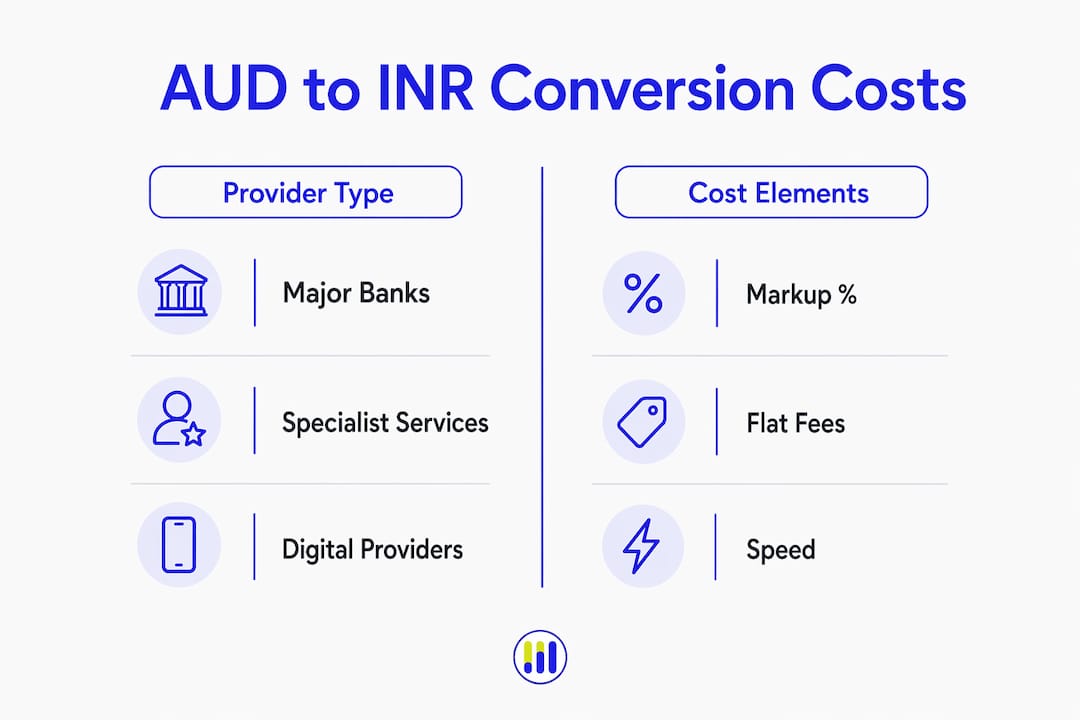
The cost of converting AUD to INR depends on the provider you use, and the difference between providers is significant. Banks typically add a 2–5% markup on the mid-market rate, while specialist digital transfer services add only 0.2–1% plus small flat fees. On a transfer of AUD 10,000, that gap translates to hundreds of dollars in lost value.
The mid-market rate is the fairest benchmark for evaluating any provider's quote. Subtract the provider's offered rate from the mid-market rate, then divide by the mid-market rate to calculate the effective markup percentage. Digital transfer services consistently offer better AUD to INR rates and lower fees than traditional banks, though banks remain the preferred choice for traders who prioritize institutional security.
| Provider Type | Typical Markup | Flat Fees | Speed | Best For |
|---|---|---|---|---|
| Major banks | 2–5% | Low to moderate | 1–3 days | Security-focused transfers |
| Digital specialists | 0.2–1% | Low | Same day to 2 days | Cost-conscious investors |
| Forex brokers | Variable | Variable | Same day | Active traders |
No single provider offers the best rate for every transfer size. The optimal choice depends on the transfer amount, the markup percentage, and the flat fee structure. A specialist may win on a AUD 5,000 transfer but lose on a AUD 500 transfer once flat fees are factored in.
Pro Tip: Always calculate the total cost of a transfer, not just the exchange rate. Add the flat fee to the markup cost to get the true effective rate before committing to any provider.
How to track today's AUD to INR rate for trading decisions
Tracking the live AUD to INR exchange rate accurately requires using sources that pull directly from interbank markets. The following tools give traders and investors reliable, real-time data:
- XE: Displays the live mid-market rate and historical charts for the AUD/INR currency pair. Free to use and widely trusted by forex professionals.
- OFX: Provides live rates alongside transfer cost comparisons. Useful for traders who also need to execute conversions.
- SendMoneyCompare: Aggregates rates from multiple providers and compares total transfer costs against the mid-market benchmark.
- Tickerplace: Offers live market data and financial analysis tools that help investors contextualize currency movements within broader portfolio decisions.
Rate charts reveal patterns that raw numbers hide. A trader watching the historical AUD to INR trend over 12 months can identify seasonal patterns tied to Australian commodity export cycles or Indian fiscal policy announcements. These patterns do not guarantee future movements, but they provide context for timing decisions.
Volatility matters as much as direction. A rate that moves 1.5 INR in a single week creates both risk and opportunity. Investors converting large sums should track intraday volatility and avoid executing transfers during periods of high market uncertainty, such as central bank announcement days.
What strategies help investors optimize AUD to INR conversions?
Currency risk management for AUD to INR conversions centers on three widely used approaches: lump-sum versus periodic conversions, forward contracts, and dollar-cost averaging. Each suits a different investor profile and risk tolerance.
Key strategies to apply:
- Dollar-cost averaging: Convert fixed amounts at regular intervals rather than all at once. This reduces exposure to a single unfavorable rate and smooths your average conversion cost over time.
- Forward contracts: Lock in today's rate for a future transfer date. This protects against adverse rate movements when you know you will need to convert funds at a specific time.
- Lump-sum conversion: Suitable when the rate is near a multi-month high and you have high confidence in the direction of the market. Requires careful timing and carries more risk.
- Provider rotation: Compare providers before every significant transfer. The best rate for a AUD 2,000 transfer may come from a different provider than the best rate for a AUD 20,000 transfer.
- Rate alert systems: Use tools like XE or OFX alerts to notify you when the rate reaches your target. This removes emotional decision-making from the process.
Common pitfalls include converting at airport kiosks or hotel desks, which apply markups of 5–10% or more. Traders also frequently overlook the impact of flat fees on smaller transfers, where a AUD 15 flat fee on a AUD 300 transfer represents a 5% cost before any markup is applied.
Pro Tip: Combine an investment return calculator with a live currency converter to model how exchange rate changes affect your actual returns in INR terms before executing any cross-border investment.
Key Takeaways
The mid-market rate is the only reliable benchmark for evaluating AUD to INR conversion costs, and specialist digital providers consistently deliver better rates than banks for most transfer sizes.
| Point | Details |
|---|---|
| Mid-market rate benchmark | Use the mid-market rate to calculate provider markups before committing to any conversion. |
| Bank vs. specialist cost gap | Banks add 2–5% markup; digital specialists add 0.2–1%, saving hundreds on large transfers. |
| Rate drivers | RBA and RBI policy decisions, commodity prices, and GDP data move the AUD/INR rate daily. |
| Conversion strategy | Dollar-cost averaging and forward contracts reduce exposure to unfavorable rate swings. |
| Provider selection | No single provider wins for all transfer sizes; compare total cost each time. |
Tickerplace's take on AUD to INR rate dynamics
The most common mistake investors make with AUD to INR conversions is focusing on the advertised exchange rate while ignoring the total cost. A provider quoting 68.00 INR per AUD with a AUD 20 flat fee may cost more than a provider quoting 67.80 with no flat fee, depending on the transfer size. The math is simple, but most traders skip it.
Rate forecasts deserve healthy skepticism. The AUD/INR pair is sensitive to commodity market swings, RBA policy shifts, and Indian macroeconomic data releases. All three can move simultaneously and in conflicting directions. Tickerplace recommends treating any AUD to INR prediction as a probability range, not a target price.
The practical edge comes from process, not prediction. Investors who set rate alerts, compare providers systematically, and use tools like the Tickerplace investing education hub to understand the macroeconomic context make better decisions than those chasing rate forecasts. Technology does the monitoring. Your job is to act on the data with a clear cost threshold in mind.
— Tickerplace
Tickerplace tools for AUD to INR investors and traders
Tracking the AUD to INR exchange rate is only one part of a complete investment decision. Tickerplace gives investors the broader market context needed to act on currency movements with confidence.
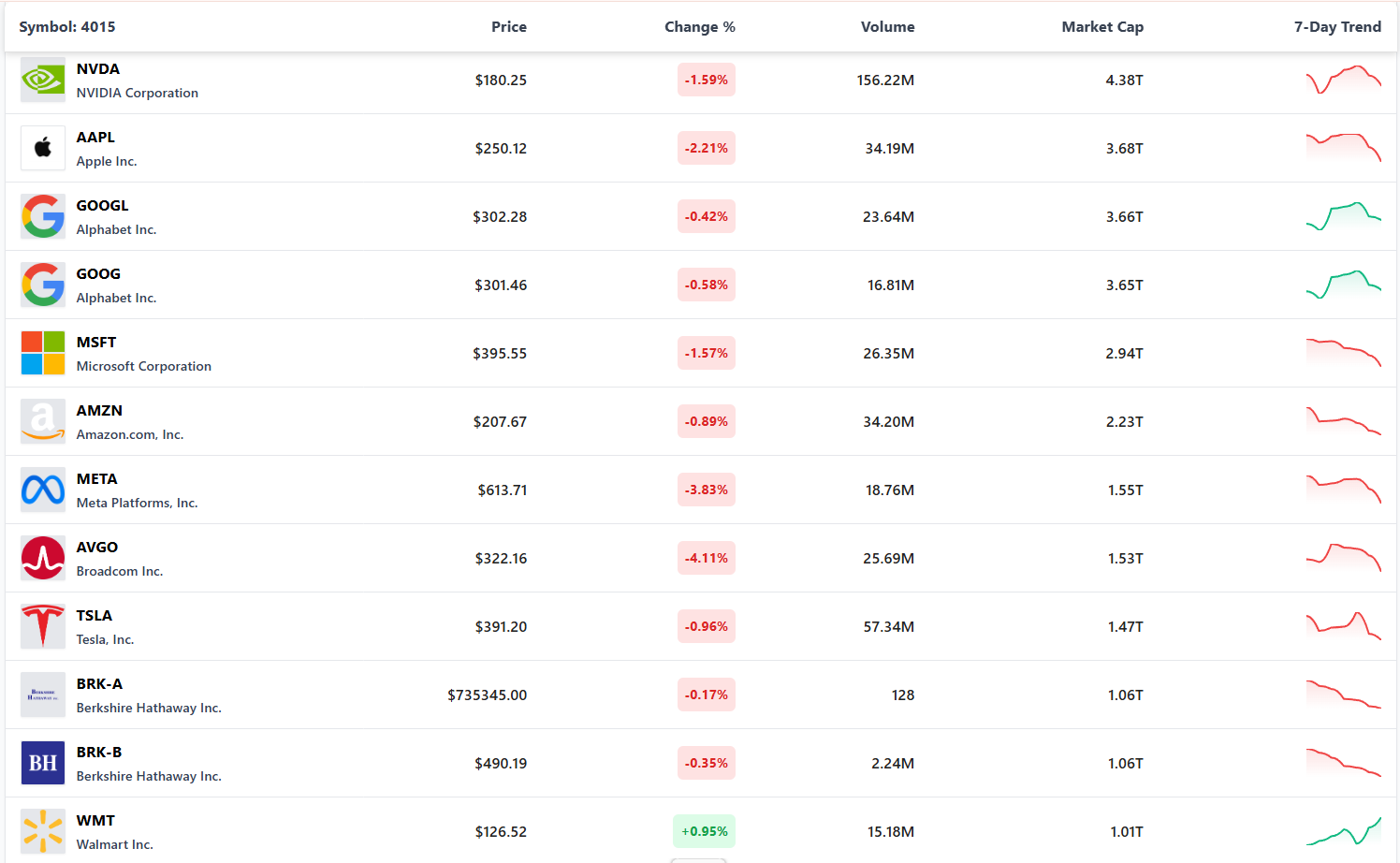
The Tickerplace platform provides live market data, stock screening tools, and financial calculators that help investors connect currency rate changes to real portfolio outcomes. The stock screener lets you filter Australian and Indian equities by key financial metrics, so you can identify which holdings are most exposed to AUD/INR fluctuations. For deeper return modeling, the investment return calculator factors in currency conversion costs alongside asset performance. Tickerplace is built for investors who want data and analysis in one place, not scattered across multiple tools.
FAQ
What is the current AUD to INR exchange rate?
The mid-market AUD to INR rate in june 2026 ranges between 66.93 and 68.43 INR per 1 AUD. The exact rate you receive depends on your provider and their markup.
Why does the AUD to INR rate change daily?
The rate changes because of continuous shifts in supply and demand across global forex markets, driven by RBA and RBI policy decisions, inflation data, GDP reports, and geopolitical developments.
Which provider gives the best AUD to INR rates?
No single provider offers the best rate for every transfer size. Digital specialist services typically add 0.2–1% markup versus 2–5% for banks, but total cost depends on the flat fee and transfer amount.
What is the mid-market rate and why does it matter?
The mid-market rate is the midpoint between global buy and sell prices for AUD/INR. It is the fairest benchmark for calculating how much markup any provider is charging you above the true market rate.
How can I reduce costs when converting AUD to INR?
Compare the total cost (markup plus flat fees) across multiple providers before each transfer, use rate alerts to time conversions at favorable levels, and consider dollar-cost averaging for large or recurring transfers.