

TL;DR:
Telstra’s share price reflects stable demand, dividend yield, and sector trends, closing at $4.79 in May 2026.
The ex-dividend date causes a mechanical drop in the share price, which does not indicate business deterioration but aligns with dividend payouts.
TLS shares price is the real-time market valuation of Telstra Group Limited (ASX: TLS), Australia’s largest telecommunications company by market capitalization. The current TLS share price reflects a combination of dividend policy, earnings performance, and broader ASX sector trends. As of late May 2026, TLS shares closed at $4.79, with the stock showing steady recovery after a modest dip. For income-focused investors, the TLS share market offers a compelling mix of dividend yield and capital stability that warrants careful, data-driven analysis.
What factors influence the current TLS shares price?
The TLS share market price moves in response to several distinct forces, and understanding each one helps you separate short-term noise from meaningful signals.
-
Dividend announcements and ex-dividend dates. Telstra distributes dividends twice yearly, and each announcement shifts investor demand. The forward dividend yield sits at approximately 4.03%, making TLS attractive to income investors who buy ahead of each record date.
-
Company financial performance. Quarterly and half-year earnings reports directly affect market sentiment. Revenue growth in Telstra’s mobile segment, for example, tends to support the share price, while margin compression in fixed-line services can weigh on it.
-
Broader ASX market trends. TLS trades on the Australian Securities Exchange and responds to macro conditions including interest rate decisions by the Reserve Bank of Australia. When rates rise, dividend-paying stocks like TLS face relative pressure as bonds become more competitive.
-
Supply and demand dynamics. Institutional rebalancing, index fund flows, and retail investor activity all contribute to daily price movement in TLS shares.
Pro Tip: Set price alerts around Telstra’s earnings release dates and dividend announcement windows. These are the periods when TLS share price volatility is highest and when mispriced entry points occasionally appear.
Monitoring these factors together, rather than reacting to any single data point, gives you a more accurate picture of where the current TLS share price stands relative to fair value.

How does the ex-dividend date affect TLS shares price?
The ex-dividend date is the cutoff date by which you must own TLS shares to receive the upcoming dividend payment. Understanding this date is one of the most practical skills for any TLS investor.
Here is how the sequence works for Telstra’s most recent dividend cycle:
-
Ex-dividend date: February 25, 2026. Investors who purchase TLS shares on or after this date do not qualify for the declared dividend.
-
Record date: February 26, 2026. Telstra confirms the list of eligible shareholders on this date.
-
Payment date: March 27, 2026. The dividend of 0.105 AUD per share is distributed to eligible shareholders.
On the ex-dividend date itself, the TLS share price typically drops by an amount roughly equal to the dividend paid. This is a mechanical adjustment, not a sign of deteriorating business fundamentals.
“Dividend-related price drops on ex-dividend dates are mechanical and not indicative of poor business performance. Using the ex-dividend date and dividend amount helps separate dividend effects from genuine price moves.” — Dividend-aware trading insights for TLS
This distinction matters enormously. An investor who sees TLS fall by $0.105 on February 25 and interprets it as a negative signal is misreading the data. The total return analysis for TLS must always combine price appreciation with dividend income to reflect true investment performance.
How does TLS shares performance compare historically and with peers?
Placing the current TLS share price in historical context reveals whether the stock is trading at a premium, a discount, or near fair value.
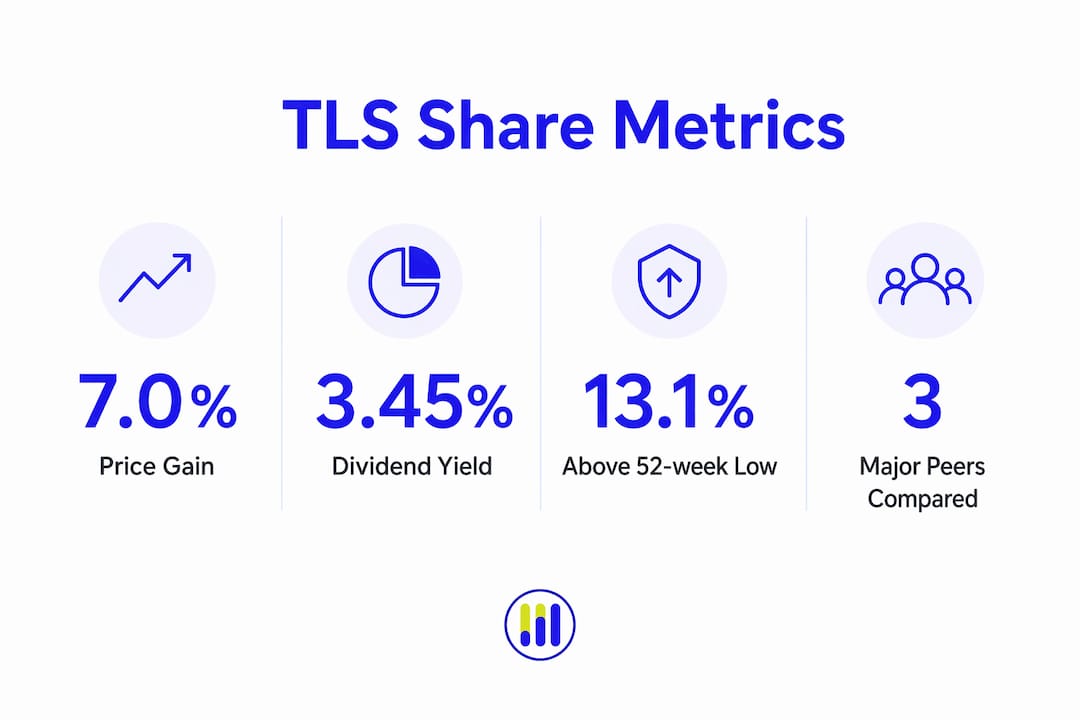
TLS shares have risen approximately 7.0% since the start of 2025, a moderate gain that reflects stable demand without speculative excess. The current dividend yield of approximately 3.45% sits slightly below the 5-year historical average of 3.62%. That gap is not a warning sign. It indicates that the share price has risen faster than the dividend, which is a positive signal for capital growth.
| Metric | TLS (Telstra) | TCL (Transurban Group) | MIN (Mineral Resources) |
|---|---|---|---|
| 52-week performance | ~7.0% gain since Jan 2025 | Infrastructure-driven stability | Higher volatility, commodity-linked |
| Dividend yield | ~3.45% (current) | Lower yield, growth-oriented | Variable, resource-cycle dependent |
| Valuation basis | Price-sales ratio, dividend yield | Asset-backed valuation | Earnings and commodity price driven |
| Investor profile | Income and moderate growth | Long-term infrastructure | High-risk, high-reward |
TLS trades approximately 13.1% above its 52-week low, which signals moderate recovery and price resilience. Compared to Transurban Group (TCL) and Mineral Resources (MIN), TLS occupies a middle ground: more yield than a pure growth stock, less volatility than a commodity-linked name.
Pro Tip: When comparing TLS with peers like TCL or MIN, use the historical price data on Tickerplace to normalize for dividend adjustments before drawing conclusions about relative performance.
Valuation ratios like price-to-sales and dividend yield relative to historical averages are the most reliable tools for gauging whether TLS shares are under- or over-valued at any given moment.
How can investors use TLS share price data to make informed decisions?
Interpreting TLS share price movements correctly requires integrating dividend data, historical price action, and sector comparisons rather than reading price changes in isolation.
-
Separate dividend effects from business changes. When TLS drops on an ex-dividend date, verify the amount matches the declared dividend before treating it as a negative signal. Genuine business deterioration shows up in earnings reports, not dividend date mechanics.
-
Track dividend yield trends over time. A growing dividend relative to the 3-year average is a strong indicator of financial health. Telstra’s dividend trajectory has been positive, which supports the case for TLS as an income holding.
-
Monitor the share price around key dates. The period between a dividend announcement and the ex-dividend date often sees buying pressure as income investors position themselves. Understanding this pattern helps you time entries more precisely.
-
Use comparative valuation metrics. Reviewing TLS’s financial statements alongside peers like TCL gives you a clearer sense of relative value. A stock that looks expensive in isolation may look fairly priced against its sector.
-
Account for total return, not just price. Dividend income is a material component of TLS’s investment case. Investors who focus only on price appreciation undercount the actual return Telstra delivers to shareholders.
Risk management also applies here. TLS is a large-cap, dividend-paying stock, but it is not immune to regulatory risk, competitive pressure from Optus and TPG Telecom, or macro headwinds. Diversified analysis across multiple data sources produces better decisions than relying on price alone.
Key takeaways
TLS shares price is best understood as a composite signal that combines dividend yield, historical price trends, and peer comparisons rather than a standalone number.
| Point | Details |
|---|---|
| Current TLS share price | TLS closed at $4.79 in late May 2026, up approximately 7.0% since January 2025. |
| Ex-dividend mechanics | The February 25, 2026 ex-dividend date caused a mechanical price drop equal to the 0.105 AUD dividend, not a business signal. |
| Dividend yield context | Current yield of ~3.45% is slightly below the 5-year average of 3.62%, reflecting share price growth rather than a dividend cut. |
| Peer comparison value | TLS trades 13.1% above its 52-week low and offers more yield stability than TCL or MIN in the current market. |
| Total return discipline | Combining dividend income with price appreciation gives a more accurate picture of TLS investment performance than price alone. |
Tickerplace’s take on reading TLS share price movements in 2026
At Tickerplace, we have tracked enough dividend-paying stocks to know that the most common mistake retail investors make with TLS is reacting to ex-dividend price drops as if they signal trouble. They do not. The mechanics are predictable, the amounts are declared in advance, and the price typically recovers within a few weeks as the market reprices around the next dividend cycle.
What we find more instructive is the yield trend. The fact that TLS’s current yield sits just below its 5-year average tells us the share price has outpaced dividend growth. That is not a red flag. It is a sign that the market has re-rated Telstra upward, likely in response to mobile segment performance and a more stable competitive environment. Income investors should not chase yield compression by selling. They should ask whether the underlying business justifies the higher price, and in Telstra’s case, the evidence leans toward yes.
Comparing TLS with peers like Transurban Group and Mineral Resources also sharpens your perspective. TLS is not a commodity play or a pure infrastructure bond proxy. It sits in a category of its own: a regulated, dividend-growing telecom with moderate capital appreciation potential. That profile suits investors who want income without the volatility of resource stocks. We recommend using sector comparison tools regularly rather than evaluating TLS in a vacuum.
— Tickerplace
Track TLS shares price with Tickerplace tools
Tickerplace gives individual investors and traders the data infrastructure to monitor TLS shares price with precision. The Tickerplace stock screener lets you filter ASX equities by dividend yield, price-to-sales ratio, and 52-week performance, making it straightforward to benchmark TLS against peers like TCL and MIN in seconds. The platform’s real-time quotes, financial statements, and technical analysis tools are built for investors who need more than a price ticker. Whether you are evaluating entry points around ex-dividend dates or tracking Telstra’s long-term yield trend, Tickerplace puts the right data in front of you without the noise.
FAQ
What is the current TLS share price?
TLS shares closed at $4.79 in late May 2026, reflecting a modest gain of approximately 7.0% since the start of 2025. Prices update in real time on platforms like Tickerplace and Yahoo Finance.
Why did TLS share price drop on February 25, 2026?
February 25, 2026 was Telstra’s ex-dividend date. The share price fell by approximately 0.105 AUD to reflect the dividend paid to eligible shareholders on March 27, 2026. This is a standard mechanical adjustment, not a sign of business weakness.
What is TLS’s current dividend yield?
TLS’s current dividend yield is approximately 3.45%, slightly below the 5-year historical average of 3.62%. The gap reflects share price appreciation rather than a reduction in dividend payments.
How does TLS compare to other ASX stocks like TCL and MIN?
TLS offers more dividend stability than Mineral Resources (MIN) and a higher yield than Transurban Group (TCL), making it a middle-ground option for investors seeking income with moderate growth potential.
How do I buy TLS shares?
TLS shares trade on the Australian Securities Exchange under the ticker TLS. You can purchase them through any ASX-registered broker or online trading platform that provides access to Australian equities.