

TL;DR:
- Telstra's share price reflects a mature, low-volatility business with strong dividend growth and ongoing buybacks.
- However, competitive pressures, rising spectrum costs, and interest rates limit its valuation upside beyond established income strategies.
The share price Telstra carries on the ASX tells only part of the story. Beneath the surface of steady dividends and a well-publicized buyback program lies a more complicated picture, one shaped by competitive threats, rising costs, and valuation multiples that leave little room for error. Whether you are managing a self-directed portfolio or evaluating Telstra as part of a broader income strategy, understanding what actually moves the Telstra stock price, and what constrains it, is the difference between a well-informed position and an expensive assumption.
Key Takeaways
| Point | Details |
|---|---|
| Strong dividend growth | Telstra declared a fully franked interim dividend of 10.5 cents per share in H1 FY26, a 10.5% year-over-year increase. |
| Significant buyback in progress | The A$1.25 billion buyback for FY26 had already repurchased approximately 130 million shares by February 2026. |
| Low volatility profile | Telstra's beta of approximately 0.16 makes it one of the lowest-volatility income stocks on the ASX. |
| Competitive and rate risks persist | Rival pricing pressure, spectrum fees, and rising interest rates all weigh on Telstra's growth outlook. |
| Valuation requires justification | A P/E ratio near 26.5 at 52-week highs means dividends and buybacks must continuously justify current price levels. |
Share price Telstra: current performance and key metrics
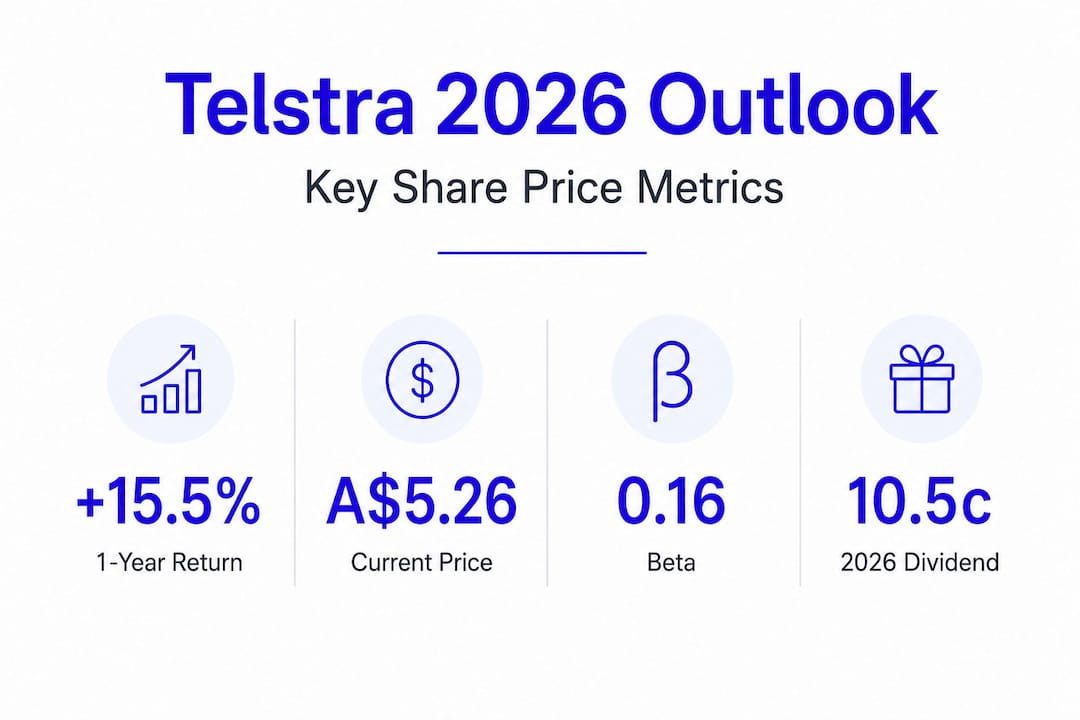
Telstra (ASX: TLS) has been trading near its 52-week highs, with shares closing around A$5.26 and intraday fluctuations between A$5.24 and A$5.31. That tight trading range reflects a market that is neither running toward Telstra with enthusiasm nor running away from it.
The metrics underpinning the current Telstra share price paint a picture of a mature, income-oriented business:
- Dividend yield: Approximately 3.8%, fully franked, offering tax-effective income for Australian resident investors.
- Full-year dividend projection: Around 21 cents per share for FY26, up more than 10% year-over-year, based on the 10.5-cent interim payment.
- Beta: Approximately 0.16, meaning the stock moves with very little correlation to broader market swings. This is unusually low even for a defensive sector.
- P/E ratio: Near 26.5 at peak pricing, which is elevated for a telecom and signals the market is paying a premium for predictability.
Over the prior 12 months, Telstra shares gained around 15.5%, meaningfully outperforming the ASX benchmark index. That performance was driven by a combination of dividend income, franking credits, and buyback-driven share price support rather than earnings expansion alone.
Pro Tip: When evaluating the share price of Telstra, always calculate total return, including franking credits. For Australian investors in higher tax brackets, the after-tax yield on fully franked dividends is materially higher than the headline number suggests.
How the buyback program supports the share price
Telstra's on-market share buyback is one of the most significant capital return programs on the ASX right now. For FY26, the buyback was expanded to A$1.25 billion, and by February 2026, the company had already completed A$637 million of that total, repurchasing approximately 130 million shares, or about 1.14% of total capital.
Here is why this matters for the Telstra share market valuation:
- Earnings per share improvement: Fewer shares outstanding means each remaining share represents a larger claim on earnings. Even without profit growth, EPS improves mechanically.
- Price floor effect: Consistent on-market buying at scale provides a technical demand signal that tends to limit downside during periods of weak sentiment.
- Capital discipline signal: Buybacks communicate that management believes the stock is not overvalued and that surplus cash is better returned to shareholders than deployed elsewhere.
That said, buybacks have real limitations as a standalone investment thesis. Markets still demand clearer growth catalysts for Telstra to trade convincingly above recent highs. A buyback can support a price floor, but it cannot manufacture revenue growth or expand addressable markets. Investors who buy current Telstra shares primarily on buyback momentum are relying on a mechanism that has a natural ceiling.
Key figure: A$637 million in buybacks completed by February 2026, representing 130 million shares retired from approximately 1.14% of total capital, a meaningful reduction in share count at scale.
Competitive and macro risks affecting the share price outlook
Telstra's position as Australia's dominant mobile network operator is real, but it is not without pressure. Several structural forces are working against a straightforward re-rating of the Telstra stock price above current levels.
-
Competitive pricing from rivals: TPG Telecom and Vodafone have been aggressive on price in the consumer mobile segment. Telstra's premium pricing strategy has held so far, but margin compression remains a credible risk if competitive intensity escalates further.
-
Spectrum licence fee increases: Regulatory costs tied to spectrum renewals are rising, and these are not discretionary expenses. They flow directly into operating costs and reduce the free cash flow available for dividends and buybacks.
-
Rising interest rates: Higher rates compress the valuation premium on dividend stocks. When a risk-free rate rises, the relative attractiveness of a 3.8% yield narrows. Competitive and macro risks including aggressive pricing, rising spectrum fees, and interest rate sensitivity all pressure Telstra's growth prospects despite stable income.
-
Technology investment uncertainty: Telstra has flagged potential overinvestment risks in artificial intelligence, signaling that rising tech costs could weigh on profit margins even as revenue grows.
These are not reasons to dismiss Telstra as an investment. They are reasons to price the stock correctly and avoid treating a high P/E, low-growth telecom as if it carries growth-stock upside.
Using the Telstra share price for investment decisions
Understanding Telstra's metrics is one thing. Translating them into a coherent investment position is another. The table below frames Telstra against the two most common investor profiles.
| Investor type | What Telstra offers | What it does not offer |
|---|---|---|
| Income-focused investor | Fully franked ~3.8% yield, low beta, consistent dividend growth | Capital appreciation potential above mid-single digits |
| Growth-focused investor | Buyback-driven EPS improvement, defensive revenue base | Meaningful top-line growth or sector re-rating catalysts |
| Portfolio diversifier | Very low correlation to market moves (beta ~0.16) | Inflation protection or high-return upside in bull markets |
For income investors, Telstra functions well as a core ASX-listed holding in a yield-oriented portfolio. The combination of franked dividends and buyback-supported share price makes total return reasonably predictable within a narrow band.

For growth investors, the Telstra share forecast is less compelling unless the company can articulate and execute a strategy that expands earnings beyond the current buyback cycle. At a P/E near 26.5, you are paying a meaningful premium for defensiveness, not for growth.
Pro Tip: Monitor Telstra's free cash flow conversion quarterly. Dividend sustainability and buyback capacity both depend on free cash flow remaining above the combined capital return commitment. If FCF narrows, something has to give.
Monitoring the share price of Telstra also means watching dividend payout announcements, buyback progress updates, and ACCC regulatory decisions on spectrum pricing, all of which can move the stock materially in either direction. Understanding how to read Telstra's financial statements gives you an edge in anticipating these shifts before the market fully prices them in.
My take on Telstra's share price outlook
I've watched Telstra's price action through multiple rate cycles and competitive shifts, and what I've learned is this: the stock tends to reward patience and punish impatience. Investors who buy expecting a quick re-rating consistently underestimate how long a mature telecom can trade in a tight range, even with strong capital returns.
What I find genuinely underappreciated is the compounding effect of franking credits for Australian investors. Over five to seven years, the tax-effective yield materially changes the total return math in ways that headline comparisons often miss.
My honest concern is the P/E multiple. At 26.5 near highs, Telstra is priced for perfection in its capital return program. Any stumble on free cash flow, whether from spectrum costs, competitive pricing response, or tech overinvestment, will reprice the stock faster than the dividend yield can cushion the fall.
Watch the FCF coverage ratio above all other metrics. If it stays above 1.2x the combined dividend and buyback commitment, the current valuation is defensible. If it drops, the Telstra share forecast changes quickly.
— Tickerplace
Track Telstra shares with Tickerplace
Staying current on the Telstra stock price requires more than checking a number once a week. Price floor dynamics, dividend announcements, and buyback progress all interact in real time, and missing a shift can cost you a better entry or exit point.
Tickerplace gives you real-time data, stock screening tools, and technical and fundamental analysis in one place so you can monitor current Telstra shares alongside their ASX peers with full context. From dividend yield comparisons to P/E tracking and financial statement access, the platform is built for investors who want to act on data, not guesswork. Start your research at Tickerplace and see exactly what the Telstra share market is telling you right now.
FAQ
What is the current Telstra share price?
Telstra shares have been trading near A$5.26, close to 52-week highs, with intraday price movement between A$5.24 and A$5.31 reflecting a market in a cautious holding pattern.
What dividend does Telstra pay in FY26?
Telstra declared a fully franked interim dividend of 10.5 cents per share in H1 FY26, with the projected full-year dividend around 21 cents per share, representing more than a 10% increase over the prior year.
How does the share buyback affect the Telstra stock price?
The A$1.25 billion buyback for FY26 reduces shares outstanding, supports earnings per share, and provides consistent on-market demand that creates a technical price floor, though it does not guarantee price appreciation on its own.
Is Telstra a low-volatility stock?
Yes. Telstra's beta of approximately 0.16 is among the lowest on the ASX, making it a strong candidate for investors prioritizing steady income and capital stability over aggressive growth.
How do I buy Telstra shares?
You can buy Telstra shares through any ASX-registered broker or online trading platform by searching for the ticker TLS. Review the current price, dividend yield, and buyback progress through a research platform before placing an order.