

TL;DR:
- The definition of "largest" varies between revenue and market capitalization, shaping different investment insights. The Fortune 500 ranks US companies primarily by revenue, highlighting operational scale, while market cap reflects investor expectations and future growth potential. Using both metrics together allows for a more comprehensive analysis of company size, strategy, and valuation opportunities.
When the definition of "largest" shifts, so does your entire investment thesis. Whether you're screening for revenue giants, market cap leaders, or sector champions, the criteria you apply to identify the biggest US companies will directly shape which names surface, which risks emerge, and which opportunities you capitalize on. This guide breaks down the key ranking frameworks, highlights the top companies by multiple metrics, and offers a strategic lens for using these lists more effectively in your analysis and portfolio management.
Key Takeaways
| Point | Details |
|---|---|
| Definitions shape rankings | Whether you use revenue or market cap fundamentally changes which firms appear as 'largest' and why it matters for investors. |
| Fortune 500 is a revenue benchmark | The Fortune 500 remains the go-to US list for revenue-based company size, driven by transparent public filings. |
| Market cap reveals investor sentiment | Market capitalization highlights public perception of value and future prospects, complementing revenue analytics. |
| Sector leadership evolves | Major companies in retail, tech, health, and energy frequently shift positions and influence investment opportunities. |
| Lists are a starting point | Expert analysis and custom screening tools help uncover deeper trends beyond simple rankings. |
Understanding what 'largest' means: Criteria that matter
Not all definitions of "largest" are created equal, and that distinction has real consequences for financial analysis. The two most commonly used criteria are revenue and market capitalization, and they can produce strikingly different rankings.
Revenue measures the total income a company generates from its business operations over a fiscal year. It reflects operational scale and market reach. Market capitalization, on the other hand, is calculated by multiplying a company's share price by its total outstanding shares. Market cap reflects what investors collectively believe a company is worth today and in the future, not just what it earned last year.
Here's why the difference matters in practice:
- A company with $500 billion in annual revenue could have a market cap of $400 billion, while a high-growth tech firm with $100 billion in revenue might carry a $2 trillion market cap.
- Revenue-based rankings favor mature industries with high throughput, such as retail, energy, and healthcare distribution.
- Market cap rankings favor companies with strong future earnings expectations, often concentrated in technology and pharmaceuticals.
The Fortune 500 ranks the largest U.S. companies by revenue, using fiscal-year data and focusing on companies that file publicly available financial statements. This is a critical eligibility requirement. Private companies that do not maintain full public financial transparency are routinely excluded. That means large private firms like Cargill or Koch Industries, despite their enormous operational scale, do not appear on the list.
Definitions of "largest" affect screening and analysis in ways that cascade through every layer of portfolio construction. When comparing US firms with largest global firms, analysts must align their metrics or risk drawing misleading conclusions.
Pro Tip: When building a screening strategy, decide upfront which metric aligns with your investment mandate. Growth-focused funds typically prioritize market cap; value and income-oriented funds often find more actionable signals in revenue-based lists.
The Fortune 500: The authoritative US revenue ranking
While definitions matter, let's turn to how these concepts translate into real rankings, starting with the Fortune 500. This list has been published annually since 1955 and remains the most widely recognized benchmark for corporate scale in the United States.
To qualify for the Fortune 500, a company must:
- Be incorporated in the United States
- Report full fiscal-year revenues that are publicly available
- File financial statements with a government agency or make them otherwise publicly accessible
The 2025 Fortune 500 top 10 by revenue includes the following companies:
| Rank | Company | Primary Sector |
|---|---|---|
| 1 | Walmart | Retail |
| 2 | Amazon | Technology/Retail |
| 3 | UnitedHealth Group | Healthcare |
| 4 | Apple | Technology |
| 5 | CVS Health | Healthcare |
| 6 | Berkshire Hathaway | Financials/Conglomerate |
| 7 | Alphabet | Technology |
| 8 | Exxon Mobil | Energy |
| 9 | McKesson | Healthcare Distribution |
| 10 | Cencora | Healthcare Distribution |
A few patterns stand out immediately. Healthcare distribution companies, namely McKesson and Cencora, appear in the top 10 primarily because of the sheer volume of pharmaceutical products they move through the supply chain. Their revenue figures are enormous, but their profit margins are relatively thin compared to a company like Apple. This distinction is vital for any analyst using the list as a starting point for valuation work.
Walmart's enduring dominance at number one reflects its status as the world's largest retailer by revenue, with annual sales exceeding $680 billion in its most recent fiscal year. Amazon's appearance at number two shows just how quickly e-commerce and cloud computing revenues have scaled. For investors, comparing these two companies on revenue alone misses the story that emerges when you layer in operating margins, return on equity, and free cash flow.
Pro Tip: Cross-reference the Fortune 500 revenue ranking with world market cap leaders to identify companies where market sentiment has significantly diverged from operational scale. That gap often signals either a valuation opportunity or an overextension worth investigating.
Market capitalization and the investor's lens
Revenue rankings matter, but for investors, understanding market capitalization is equally critical. Market cap tells a different story entirely. It captures collective investor expectations, pricing in anticipated earnings growth, competitive moats, brand value, and macroeconomic conditions.
Here is how the two metrics diverge in practice:
- Apple generates roughly $400 billion in annual revenue but carries a market cap exceeding $3 trillion, reflecting its extraordinary pricing power and ecosystem lock-in.
- Walmart leads in revenue but its market cap is substantially lower than Apple's, reflecting the thinner margins inherent in large-scale retail.
- Berkshire Hathaway ranks high on revenue because it consolidates the revenues of its wholly owned subsidiaries, yet its market cap is a more direct reflection of Warren Buffett's capital allocation track record.
Public market rankings like the Fortune Global 500 use market cap, and include top US names, but their methodologies differ meaningfully from revenue-based lists. Analysts who blend both types of rankings gain a more complete picture of a company's competitive position, financial health, and market valuation.
When analyzing market cap leaders alongside revenue figures, look for companies where market cap growth is outpacing revenue growth. That dynamic often indicates expanding margins, improving business mix, or investor recognition of a structural competitive advantage. Conversely, when revenue is growing faster than market cap, the market may be skeptical about sustainability or profitability.
| Metric | Best used for | Example |
|---|---|---|
| Revenue | Assessing operational scale | Walmart, Amazon |
| Market capitalization | Gauging investor expectations/value | Apple, Alphabet |
| Revenue + Market Cap | Full picture analysis | Berkshire Hathaway |
Comparing top US companies: Sector and strategy breakdown
Let's now see how sector distinctions and company strategies impact the rankings, and what that means for your portfolio. The Fortune 500 and Fortune Global 500 both include major US firms leading in retail, technology, healthcare, and energy. Each sector carries its own investment characteristics, risk profile, and growth trajectory.

Retail (Walmart, Amazon): These companies operate at massive scale with intense competition and thin net margins. Walmart's brick-and-mortar advantage continues to compete with Amazon's logistics network. For income investors, Walmart offers dividend stability; for growth investors, Amazon Web Services (AWS) is the real value driver buried inside the company's revenue report.
Technology (Apple, Alphabet): Both companies benefit from high switching costs and recurring revenue streams. Apple's services segment now contributes significantly to overall profitability. Alphabet's advertising dominance and investments in artificial intelligence position it as a long-term compounder.
Healthcare (UnitedHealth Group, CVS Health, McKesson, Cencora): Healthcare distribution firms like McKesson and Cencora show up on revenue lists due to volume, not margin. UnitedHealth Group, however, is a more complex business combining insurance underwriting with care delivery through Optum, making it a distinctive holding for healthcare-focused portfolios.
Energy (Exxon Mobil): Exxon's position in the top 10 reflects both the scale of oil and gas operations and the elevated commodity prices of recent years. Energy companies carry cyclical risk tied to global supply and demand dynamics.
Sector performance and company strategy inform investment evaluations in ways that raw revenue numbers alone cannot capture. For advisors evaluating company sectors, sector rotation analysis becomes particularly valuable when cross-referencing these top companies against macroeconomic cycle data.
"Revenue shows where a company has been; market cap shows where investors expect it to go. The most insightful analysis lives in the space between those two numbers."
A smarter way to use the 'largest companies' lists
Here is the candid reality: most investors treat these lists as a scoreboard rather than a research tool. That is where strategic value gets lost. The Fortune 500 and similar rankings are best understood as a dynamic starting point, not a destination.
Consider what the list reveals beyond rankings. When a new company cracks the top 50 by revenue for the first time, it often signals a sector undergoing rapid consolidation or expansion. When a longtime fixture drops out of the top 10, it may indicate structural disruption or margin compression worth monitoring. These are early signals, not just data points.
Conventional wisdom says "invest in the largest companies because they are the safest." That logic has merit but misses nuance. The largest companies by revenue often operate in sectors with commoditized competition and modest growth. The largest companies by market cap may carry elevated valuations that price in near-perfect execution. Neither list alone tells you whether a company is a good investment at today's price.
The smarter approach uses these rankings to frame research questions rather than answer them. Identify which companies have moved up or down significantly year over year. Cross-reference revenue growth with market cap trends to spot divergences. Look for emerging companies in the 100 to 200 range on the Fortune 500, those are often companies gaining scale faster than the market has fully recognized.
Reading beyond the top 10 is where the real strategic edge lies.
Dig deeper into US giants with advanced tools
Understanding the rankings is only part of the picture. Putting that knowledge to work in your investment process requires the right tools.
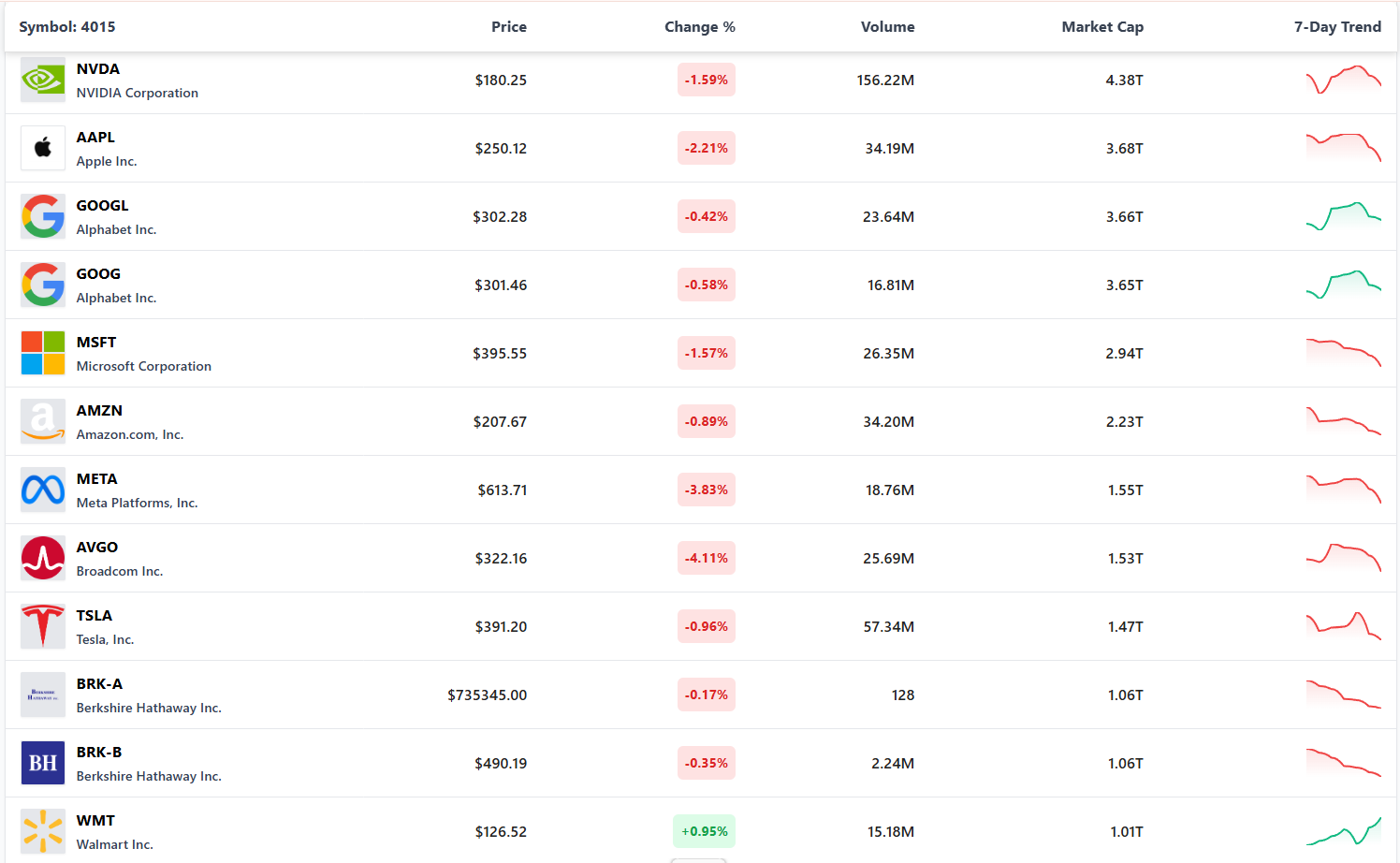
Tickerplace gives investors and financial professionals direct access to real-time market data, custom screening capabilities, and detailed financial breakdowns for US and global equities. Whether you're comparing revenue leaders to market cap leaders or conducting sector-level analysis across the Fortune 500, our stock screener lets you filter, rank, and compare companies against the metrics that matter most to your strategy. Pair that with our investing education resources to sharpen your analytical framework and apply these insights with greater precision across any market environment.
Frequently asked questions
How often does the Fortune 500 list update?
The Fortune 500 updates annually, with the 2025 edition released on June 2, 2025, based on each company's fiscal-year total revenues. Rankings can shift significantly from year to year as sector conditions and company performance evolve.
Can private US companies appear on the Fortune 500?
Generally, no. Private companies without full financial statements filed for enough quarters are excluded, which means large private firms are typically absent regardless of their true scale.
Is ranking by market cap or revenue better for investment decisions?
Both metrics serve different purposes. Global rankings use market cap to measure investor-assigned value, while revenue lists reflect operational size; combining both gives you a more complete analytical picture.
Which sectors dominate the US top 10 company rankings?
Retail, technology, healthcare, and energy are most represented. Walmart, Apple, UnitedHealth Group, and Exxon Mobil exemplify each sector's leading position on the 2025 Fortune 500.