

TL;DR:
- DroneShield's stock relies heavily on government contracts and geopolitical tensions rather than traditional valuation metrics. While a major US defense contract boosts revenue prospects, ongoing regulatory investigations introduce significant downside risks. The stock's extreme valuation and geopolitical sensitivity make it suitable only for high-risk, growth-focused investors with a long-term perspective.
DroneShield Limited (ASX: DRO) is defined as an Australian counter-drone technology company whose share price moves more on geopolitical headlines and government contract wins than on traditional valuation metrics. As of mid-2026, DRO ASX sits at a crossroads: a landmark US defense contract signals strong revenue growth, while an active ASIC investigation and a volatile stock profile create meaningful downside risk. This analysis covers the key factors every investor and analyst needs to assess before taking a position.
How has DRO ASX performed in 2026?
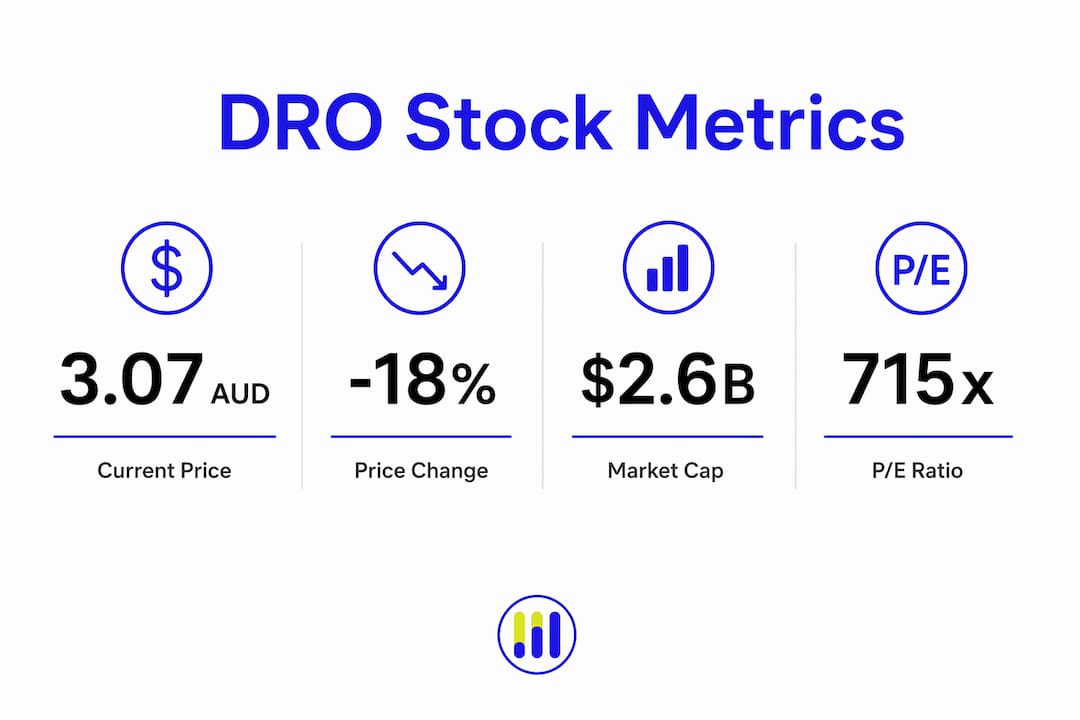
DroneShield shares have declined approximately 18% over the past month as of early june 2026, trading around $3.07 AUD. That drop reflects a combination of regulatory pressure and profit-taking after a strong run earlier in the year. The average analyst target price currently sits at $3.29, a figure that itself has contracted sharply from a prior consensus of $4.10.
Analyst sentiment has shifted from mostly positive to genuinely mixed. Ratings now span strong buy, hold, sell, and strong sell simultaneously. That spread signals real disagreement among professionals, not just routine caution.
Key 2026 performance metrics at a glance:
| Metric | Value |
|---|---|
| Recent share price (June 2026) | ~$3.07 AUD |
| One-month price decline | ~18% |
| Average analyst target price | $3.29 AUD |
| Prior average analyst target | $4.10 AUD |
| Market capitalization | ~$2.6 billion AUD |
Trading volumes have remained elevated despite the price decline, which suggests active repositioning rather than investor disengagement. High volume during a drawdown often indicates institutional rebalancing, not retail panic selling.
What impact has the US department of war contract had on DRO?
DroneShield secured a $24.9 million USD contract with the US Department of War's Joint Interagency Task Force 401 in mid-2026. The structure includes an initial $19.3 million USD award plus $5.6 million USD in five-year options, with deliveries scheduled across 2026 and 2027. At least $10 million USD is expected to be recognized in FY26 revenue.
This contract matters for several reasons beyond the headline dollar figure:
- It confirms DroneShield as a credible supplier to the US military, the world's largest defense buyer.
- It diversifies revenue away from Australian government contracts, reducing geographic concentration risk.
- It signals that counter-unmanned aerial systems (counter-UAS) technology is being procured at scale, not just evaluated.
- The multi-year option structure provides a revenue runway extending into FY27 and beyond.
The share price jumped on the announcement, demonstrating how contract wins function as the primary positive catalyst for DRO. This pattern is typical of defense tech companies at DroneShield's stage of development, where revenue is lumpy and investor confidence tracks contract flow closely.
Pro Tip: When analyzing defense tech stocks like DRO, treat large government contract announcements as forward revenue signals. The contract value, delivery timeline, and option structure together tell you more about near-term earnings visibility than any quarterly earnings report.

How does the ASIC investigation affect dro's risk profile?
The Australian Securities and Investments Commission (ASIC) disclosed an investigation in may 2026 focused on DroneShield's market announcements and share trading activity during november 2025. The company states it is cooperating fully, but the investigation itself creates a regulatory overhang that limits upward price momentum regardless of operational performance.
The market reaction has been direct and measurable. Governance concerns from the ASIC probe have kept institutional trust fragile, even as the US contract win provided a positive counterweight. Institutional investors, in particular, are constrained from adding exposure to companies under active regulatory scrutiny.
Key risk factors stemming from the investigation:
- Uncertainty over the outcome and timeline of the ASIC review.
- Potential for further share price volatility if new disclosures emerge.
- Reduced appetite from fund managers with strict governance mandates.
- Reputational risk that could affect future contract bids, particularly with government clients who conduct their own due diligence.
"Governance and transparency are the foundation of institutional confidence. An active regulatory investigation does not automatically mean wrongdoing, but it does mean uncertainty, and markets price uncertainty as risk."
The investigation relates specifically to november 2025 disclosures, which suggests the ASIC review is examining whether material information was released in a timely and compliant manner. Until the investigation concludes, this remains a live risk factor in any DRO ASX analysis.
How does dro's valuation compare to established defense stocks?
DroneShield carries a price-to-earnings ratio of approximately 715x and a market capitalization of roughly $2.6 billion AUD, with zero dividend yield. A P/E ratio at that level does not reflect current earnings power. It reflects market expectations for future earnings growth at a rate that justifies paying a large premium today.
Understanding DRO's beta and volatility is equally important. The stock moves sharply on news events, both positive and negative, in a pattern atypical of mature defense contractors like BAE Systems or Northrop Grumman, which trade at far lower multiples and pay consistent dividends.
| Metric | DRO (DroneShield) | Mature ASX Defense/Industrial |
|---|---|---|
| P/E ratio | ~715x | 15x–30x |
| Dividend yield | 0% | 2%–5% |
| Revenue profile | Lumpy, contract-driven | Recurring, diversified |
| Price sensitivity | High (geopolitical/news) | Low to moderate |
| Investor type | Growth-oriented | Income and value-oriented |
The absence of a dividend is not a flaw for growth investors. It signals that DroneShield is reinvesting all available capital into scaling its technology and winning contracts. Income investors, however, should recognize that DRO offers no yield cushion during drawdowns.
Pro Tip: A P/E ratio above 100x is not inherently a red flag in high-growth defense tech. The relevant question is whether the company's contract pipeline and addressable market justify the implied growth rate. For DRO, the US Department of War contract provides partial validation, but the full picture requires tracking contract wins over multiple quarters.
What geopolitical factors drive DRO stock movements?
DroneShield's share price is highly correlated with geopolitical conflict levels, particularly demand signals from active conflict zones and allied defense procurement cycles. This makes DRO a proxy for defense tech sentiment rather than a stock that can be analyzed purely on financial fundamentals.
The key external drivers include:
- Middle East conflict intensity: Easing tensions in the region have historically corresponded with DRO share price dips, as near-term demand expectations soften.
- NATO and allied defense spending: Increased commitments from NATO members to counter-UAS capability directly expand DroneShield's addressable market.
- US defense budget cycles: Congressional appropriations for counter-drone programs determine the size and frequency of contracts available to companies like DroneShield.
- Emerging threat environments: The proliferation of commercial drones in conflict zones has accelerated government procurement timelines globally.
DRO is best understood as a defense tech exposure vehicle rather than a traditional valuation play. Investors who treat it as the latter will consistently misread its price movements. The stock rewards those who track geopolitical developments and defense procurement news with the same rigor they apply to earnings reports.
You can compare DRO's positioning against all ASX-listed companies by market capitalization to contextualize its scale within the broader Australian equity market.
Key takeaways
DroneShield (ASX: DRO) is a high-growth, high-risk defense technology stock whose price is driven by government contracts and geopolitical trends, not conventional valuation metrics.
| Point | Details |
|---|---|
| US contract win | A $24.9M USD deal with the US Department of War confirms DroneShield as a credible military supplier with FY26 revenue visibility. |
| Share price under pressure | DRO has fallen ~18% in one month to ~$3.07 AUD, with analyst targets revised down from $4.10 to $3.29. |
| ASIC investigation risk | An active regulatory probe into november 2025 disclosures limits institutional confidence and creates ongoing price volatility. |
| Extreme valuation | A ~715x P/E ratio and zero dividend yield position DRO strictly as a growth stock, unsuitable for income-focused portfolios. |
| Geopolitical sensitivity | Share price movements track conflict levels and defense spending cycles more closely than quarterly earnings results. |
Tickerplace's view on DRO in the current climate
DRO is one of the most genuinely difficult stocks to hold with conviction right now. The US Department of War contract is a real milestone. It validates the technology and opens a much larger revenue channel. But the ASIC investigation is not a footnote. Regulatory uncertainty of this kind tends to linger, and the market will keep discounting the stock until there is resolution.
What concerns me most is the analyst target compression. Moving from $4.10 to $3.29 in a short period reflects a fundamental reassessment, not just short-term noise. That said, if the investigation concludes without material findings and contract wins continue, the re-rating potential is significant.
My view: DRO belongs in a growth-oriented portfolio with a defined risk tolerance and a multi-year time horizon. Position sizing matters here more than entry timing. Investors who treat it as a short-term trade will be whipsawed by every geopolitical headline. Those who understand that lumpy revenue recognition is the nature of defense tech, and who monitor contract flow and regulatory developments systematically, are best positioned to manage the risk.
— Tickerplace
Track DRO and ASX defense stocks with Tickerplace
Staying current on DRO ASX requires more than reading headlines. You need real-time share price data, historical charting, and fundamental metrics in one place to make informed decisions quickly.
Tickerplace delivers exactly that. The platform provides real-time ASX share prices, advanced charting tools, and detailed fundamental data including market capitalization, P/E ratios, and revenue breakdowns for companies like DroneShield. Use the Tickerplace stock screener to filter ASX-listed growth stocks by sector, market cap, and valuation metrics, so you can identify opportunities and monitor risk across your entire portfolio. For a full market overview and company-level research, visit Tickerplace and start analyzing DRO alongside the broader ASX defense and technology sector today.
FAQ
What does DRO stand for on the ASX?
DRO is the ASX ticker symbol for DroneShield Limited, an Australian company specializing in counter-drone and counter-UAS technology for military and government clients.
Why has the DRO share price dropped recently?
DRO shares have fallen approximately 18% over one month to around $3.07 AUD, driven by the ASIC investigation disclosed in may 2026 and a broader reassessment of analyst price targets from $4.10 to $3.29.
Is DRO a good investment in 2026?
DRO suits growth-oriented investors with a high risk tolerance and a multi-year horizon. The US Department of War contract provides revenue visibility, but the ASIC investigation and extreme P/E ratio of ~715x make it unsuitable for conservative or income-focused portfolios.
How does the US contract affect dro's revenue outlook?
The $24.9 million USD contract with the US Department of War's Joint Interagency Task Force 401 includes at least $10 million USD expected to be recognized in FY26, with additional deliveries planned for 2027 under a five-year option structure.
What drives dro's share price volatility?
DRO's price is highly sensitive to geopolitical conflict levels, defense spending announcements, and government contract wins, making it a proxy for defense tech sentiment rather than a stock driven by conventional earnings metrics.