

Equities, also called stocks, represent partial ownership in a company, giving shareholders voting rights and claims on its assets and earnings. The case for investing in equities rests on two core financial benefits: capital appreciation as the company grows, and dividend income distributed from profits. Historically, no major asset class has matched equities for long-term wealth building, and the data from authoritative sources like the U.S. Securities and Exchange Commission (SEC) and AllianceBernstein (AB) consistently supports that view.
Here is what equity ownership delivers:
- Capital appreciation: Stock prices rise when companies grow earnings, expand markets, or improve profitability.
- Dividend income: Many established companies distribute a portion of profits directly to shareholders on a regular schedule.
- Voting rights: Common stockholders can vote on major corporate decisions, including board elections and mergers.
- Liquidity: U.S.-listed equities trade on regulated exchanges, making it straightforward to buy or sell shares during market hours.
- Long-term outperformance: Large-cap stocks outperformed U.S. investment-grade bonds roughly 80% of rolling 10-year periods from 1990 to 2022, according to AllianceBernstein.
10 reasons to stay invested in equities
Staying invested through market cycles is one of the most consistently validated principles in long-term investing. The following ten reasons draw on data from AB, the SEC, and Vanguard to explain why equities belong in a long-term portfolio.
1. Equity markets have risen over time despite volatility
Stock markets have delivered positive returns across decades, even after absorbing recessions, geopolitical shocks, and financial crises. The trajectory is not smooth, but the direction over long horizons has been upward. Investors who remained invested through downturns captured the recoveries that followed.
2. Superior long-term capital growth vs. bonds
Equities outperformed bonds in roughly 80% of rolling 10-year periods between 1990 and 2022, according to AB. That gap widens further over 20-year horizons. For investors with a long time horizon, the compounding effect of equity returns is difficult for fixed-income assets to replicate.

3. The interest rate environment supports stock valuations
When interest rates fall or stabilize, the present value of future corporate earnings rises, which tends to lift stock prices. Rate environments directly affect how investors discount future cash flows, making the Federal Reserve's policy stance a meaningful input for equity valuations. Investors who understand this relationship can better contextualize market moves.
4. Corporate earnings have shown resilience amid inflation
Companies with pricing power can pass rising input costs on to customers, protecting profit margins even when inflation runs high. This earnings resilience is not universal, but it is pronounced among businesses with strong brands, essential products, or dominant market positions. Sectors like consumer staples and healthcare have historically demonstrated this quality.
5. Quality companies buffer inflation's impact
Higher-quality businesses, those with durable competitive advantages and low debt, tend to hold up better when inflation erodes purchasing power. Their ability to maintain margins and sustain dividends makes them particularly attractive during inflationary periods. Focusing on quality rather than chasing high-growth speculative names is a discipline that pays off when conditions tighten.
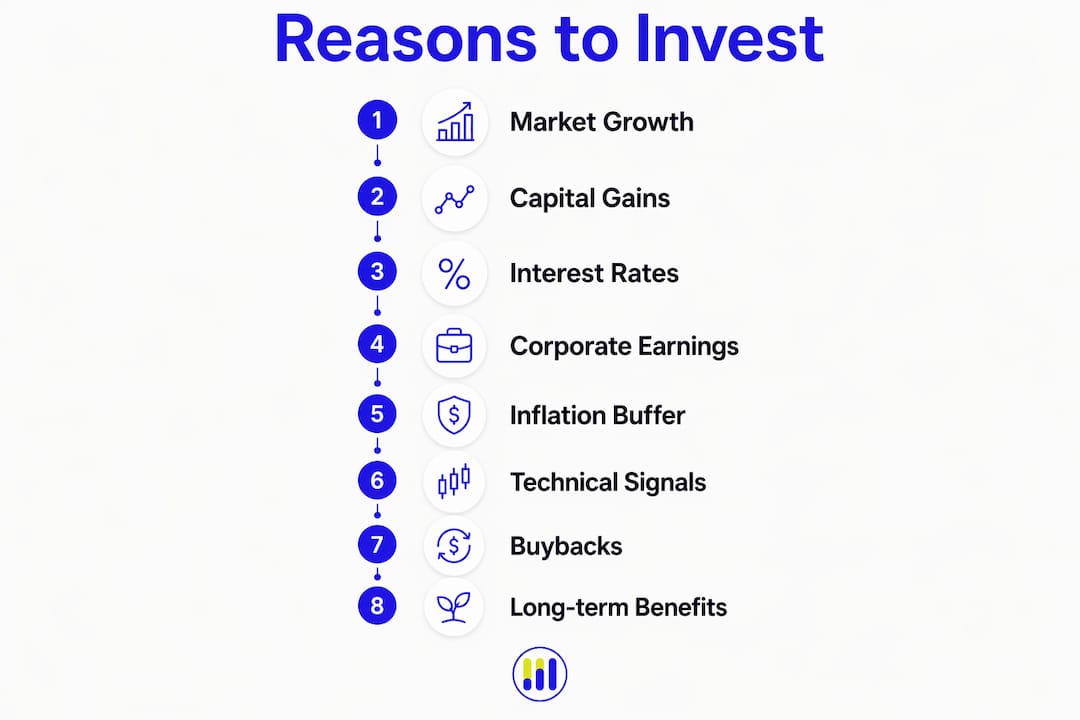
6. Equities perform well during moderate inflation
Stocks perform well when inflation remains below approximately 4%, according to AB. At that level, rising prices often reflect healthy economic demand, which supports corporate revenue growth. Bond yields, by contrast, tend to lag in real terms during the same periods, widening the performance gap between the two asset classes.
7. Market technicals can signal upside potential
Low equity allocations among institutional investors can act as a contrarian indicator, suggesting room for capital to rotate back into stocks. When sentiment is depressed and positioning is light, market technical factors often provide a floor for prices. Tracking these signals alongside fundamentals gives investors a more complete picture of near-term risk and opportunity.
8. Stock buybacks support valuations
When companies repurchase their own shares, they reduce the share count outstanding, which mechanically increases earnings per share. U.S. companies have repurchased record amounts in recent years, bolstering equity valuations and signaling management confidence in future prospects. Buybacks also provide price support during periods of broader market weakness.
9. Missing the best market days is costly
Trying to time the market is one of the most reliably damaging behaviors for long-term investors. AB analysis shows that missing the 5 best market days over a 20-year period cuts annualized returns by nearly 2%. Those recovery days frequently cluster around periods of peak fear, which is precisely when reactive investors are most likely to be sitting in cash.
10. Staying invested beats market timing
Consistent, long-term participation in equity markets outperforms the average investor who moves in and out based on sentiment or short-term forecasts. The math is straightforward: compounding requires time in the market, not timing the market. Investors who stay the course through volatility capture the full return sequence that drives long-term wealth accumulation.
What are the real benefits and risks of stocks?
Understanding both sides of equity investing is what separates informed investors from reactive ones. Stocks carry genuine advantages, but they also carry risks that deserve clear-eyed assessment.
Benefits of owning stocks
- Capital appreciation: Stock prices reflect the market's expectation of future earnings. As companies grow, their share prices tend to follow.
- Dividend income: Income stocks, such as established utility companies, pay dividends consistently, generating cash flow without requiring you to sell shares.
- Voting rights: As a common stockholder, you hold a voice in corporate governance decisions.
- Liquidity: U.S.-listed equities can be bought or sold during market hours, unlike real estate or private equity.
- Tax efficiency: Dividend income and long-term capital gains are often taxed at lower rates than ordinary income, according to Vanguard, which improves net returns meaningfully over time.
- Diversification through funds: Stock mutual funds and ETFs give you exposure to hundreds or thousands of companies, reducing single-stock concentration risk. Vanguard notes that suitability depends on each investor's comfort with price fluctuations.
Risks you need to understand
Equity investing involves real downside. The SEC notes that large-company stocks have historically posted negative returns roughly one in every three years. In a liquidation scenario, common stockholders are last in line, behind bondholders and preferred shareholders. Price volatility can also be driven by factors entirely outside a company's control, including political events, macroeconomic shifts, and changes in market sentiment.
Diversification reduces but does not eliminate these risks. Holding a mix of equities, bonds, and other asset classes is the most practical way to manage the inherent volatility of stock ownership. Investors nearing retirement, in particular, typically shift toward a higher bond allocation to protect capital they will need in the near term.
Key considerations before you invest in equities
Knowing why equities outperform is only part of the equation. How you invest matters just as much as whether you invest.
- Risk tolerance: Assess honestly how much portfolio drawdown you can absorb without making reactive decisions. Younger investors with decades ahead can typically accept more volatility than those within five years of retirement.
- Investment horizon: Stocks reward patience. Investors willing to hold for 15 years or more have historically been rewarded with strong positive returns, according to Investor.gov.
- Diversification: True diversification spans sectors, market capitalizations, and geographic regions. Spreading across these dimensions reduces volatility more effectively than simply owning many stocks in the same industry.
- Valuation and interest rates: Buying into an overvalued market amplifies downside risk. Monitoring the interest rate environment and current stock valuations helps you assess whether entry points are attractive.
- Tax efficiency: Holding equities for more than one year qualifies gains for long-term capital gains tax rates, which are lower than short-term rates. Dividend income from qualified dividends also receives preferential treatment. These advantages compound over time.
- Behavioral discipline: Emotional reactions to market swings are among the most common causes of underperformance. Having a written investment plan and sticking to it during downturns is more valuable than any single stock pick.
Pro Tip: For investors who want built-in diversification without selecting individual stocks, broad-market ETFs provide exposure to hundreds of companies across sectors and market caps in a single, low-cost vehicle.
How valuation tools help you assess equity opportunities
Knowing a stock is worth buying requires more than a positive outlook on the company. Valuation analysis tells you whether the current price reflects fair value or whether the market has already priced in the growth you are expecting.
The core valuation metrics every equity investor should understand include:
- Price-to-Earnings (P/E) ratio: Compares a stock's current price to its earnings per share. A high P/E relative to peers or historical averages may signal overvaluation; a low P/E may indicate opportunity or underlying problems worth investigating.
- Intrinsic value (DCF modeling): Discounted cash flow analysis estimates what a company is worth based on its projected future cash flows, discounted back to present value. This approach anchors valuation to fundamentals rather than market sentiment.
- Price-to-Sales (P/S) ratio: Useful for companies with low or negative earnings, the P/S ratio compares market capitalization to revenue, offering a relative sense of how the market values each dollar of sales.
- Dividend yield: For income-oriented investors, yield analysis reveals whether a stock's dividend is sustainable and whether the payout ratio leaves room for future growth.
Tickerplace provides institutional-grade valuation tools including DCF, P/E, and P/S analysis across 10,000+ U.S. and ASX-listed equities, updated daily. Combining these quantitative models with fundamental research, such as reviewing earnings trends, debt levels, and competitive positioning, gives investors a more complete basis for decision-making. You can also use the intrinsic value calculator to estimate a stock's fundamental worth independently of its current market price.
Evaluating stock performance through a structured, multi-model framework reduces the risk of anchoring to a single metric that may be distorted by short-term market conditions.
How behavioral biases affect your equity investing decisions
Even investors who understand the fundamentals of equities often underperform because of how they react to market conditions. Behavioral finance research consistently identifies a set of cognitive biases that lead to poor timing decisions and suboptimal portfolio outcomes.
Loss aversion is the tendency to feel the pain of losses more acutely than the pleasure of equivalent gains. This asymmetry causes investors to sell during downturns to stop the psychological discomfort, locking in losses at exactly the wrong moment. The AB data on missing the five best market days illustrates the direct cost of this behavior.
Recency bias leads investors to extrapolate recent market trends into the future. After a prolonged bull market, investors assume gains will continue indefinitely. After a sharp correction, they assume further declines are inevitable. Both assumptions distort portfolio decisions.
Overconfidence is particularly common among investors who have experienced a run of successful picks. It leads to concentrated positions, insufficient diversification, and underestimation of downside risk. The antidote is a disciplined risk management framework that enforces position sizing and diversification rules regardless of recent performance.
Herding occurs when investors follow the crowd into popular stocks or sectors, often near market peaks. Buying what everyone else is buying typically means paying a premium for assets that are already fully valued. Valuation discipline, grounded in metrics like P/E and intrinsic value, is the most direct counter to herd behavior.
Recognizing these biases does not make you immune to them. Building a rules-based investment process, one that specifies when to buy, when to hold, and when to rebalance, is the practical way to reduce their influence on your returns.
Key Takeaways
Equities remain the highest-returning major asset class over long horizons, and the case for owning them rests on both empirical data and sound portfolio theory.
| Point | Details |
|---|---|
| Long-term outperformance | Large-cap stocks outperformed U.S. investment-grade bonds in roughly 80% of rolling 10-year periods from 1990 to 2022. |
| Cost of market timing | Missing just the 5 best market days over 20 years cuts annualized returns by nearly 2%, according to AllianceBernstein. |
| Inflation resilience | Equities tend to perform well when inflation stays below approximately 4%, outpacing bonds in real terms. |
| Tax efficiency | Qualified dividends and long-term capital gains are taxed at lower rates than ordinary income, improving net returns over time. |
| Valuation discipline | Using P/E, DCF, and intrinsic value models helps identify whether a stock is fairly priced before you commit capital. |
FAQ
What is the difference between stocks and equities?
Stocks and equities are the same thing. The SEC and Investor.gov use both terms interchangeably to describe securities that represent partial ownership in a company.
Is it better to invest in equities or mutual funds?
These are not mutually exclusive choices. Stock mutual funds and ETFs invest in equities, so choosing a fund is one way to gain equity exposure with built-in diversification across many companies.
Is the S&P 500 considered equities?
Yes. The S&P 500 is an index of large-cap U.S. stocks, all of which are equities. Index funds and ETFs that track the S&P 500 give investors broad equity market exposure in a single vehicle.
Why are equities risky?
Equities carry risk because stock prices fluctuate with company performance and broader market conditions, and common stockholders are last in line during a liquidation. The SEC notes that large-company stocks have historically posted negative returns roughly one in every three years.
Should I invest in equities if I am close to retirement?
Investors nearing retirement typically reduce equity exposure and shift toward bonds to protect capital. However, maintaining some equity allocation can help preserve purchasing power over a retirement that may span two or more decades.