
TL;DR:
UPS stock price is driven by earnings reports, market sentiment, and macroeconomic factors.
Key influencers include quarterly results, labor negotiations, fuel costs, and industry competition.
Technical analysis tools and broader market signals improve investment decision accuracy.
United Parcel Service is one of the most recognized names in global logistics, yet many investors treat its stock as a predictable, slow-moving blue chip and stop there. That assumption can be costly. UPS stock has delivered sharp price swings tied to earnings surprises, labor negotiations, and shifting consumer demand cycles that catch even experienced analysts off guard. This guide breaks down exactly how UPS’s stock price is set, what forces move it most, how it stacks up against competitors, and which tools and signals you can use to make better, faster decisions.
Key Takeaways
| Point | Details |
|---|---|
| Stock price drivers | UPS stock price is shaped by earnings, news, market trends, and dividend policy. |
| Competitor comparison | Benchmark UPS against other logistics stocks for smart investment decisions. |
| Actionable analysis tools | Strong analysis requires both technical signals and practical calculators. |
| Avoid common pitfalls | Don’t rely solely on headlines—use both market data and context for UPS investing. |
How UPS stock price is determined: The market mechanics
Before you can interpret UPS price movements, you need a clear picture of what actually sets the price each day. Stock prices for large publicly traded companies like UPS move based on supply and demand, earnings reports, analyst forecasts, and macroeconomic signals. When more investors want to buy than sell, the price rises. When sellers dominate, it falls. Simple in theory, complex in practice.
Several core factors shape UPS’s daily price action:
-
Market capitalization: UPS’s total market value, calculated by multiplying share price by shares outstanding, signals its relative size and stability to institutional investors.
-
Earnings per share (EPS): This measures profitability on a per-share basis. A positive EPS surprise almost always pushes the price up.
-
Price-to-earnings (P/E) ratio: Investors use this to judge whether UPS is overvalued or undervalued relative to its earnings and peers.
-
Trading volume: High volume on a price move confirms conviction; low volume suggests the move may not hold.
-
Analyst forecasts: Upgrades or downgrades from major Wall Street firms can shift UPS’s price by several percentage points in a single session.
Institutional investors, including mutual funds and pension funds, control large blocks of UPS shares and can move the price significantly when they rebalance. Retail investors, by contrast, tend to react to news headlines rather than drive the initial move. Understanding analyzing stock fundamentals helps you separate noise from signal.
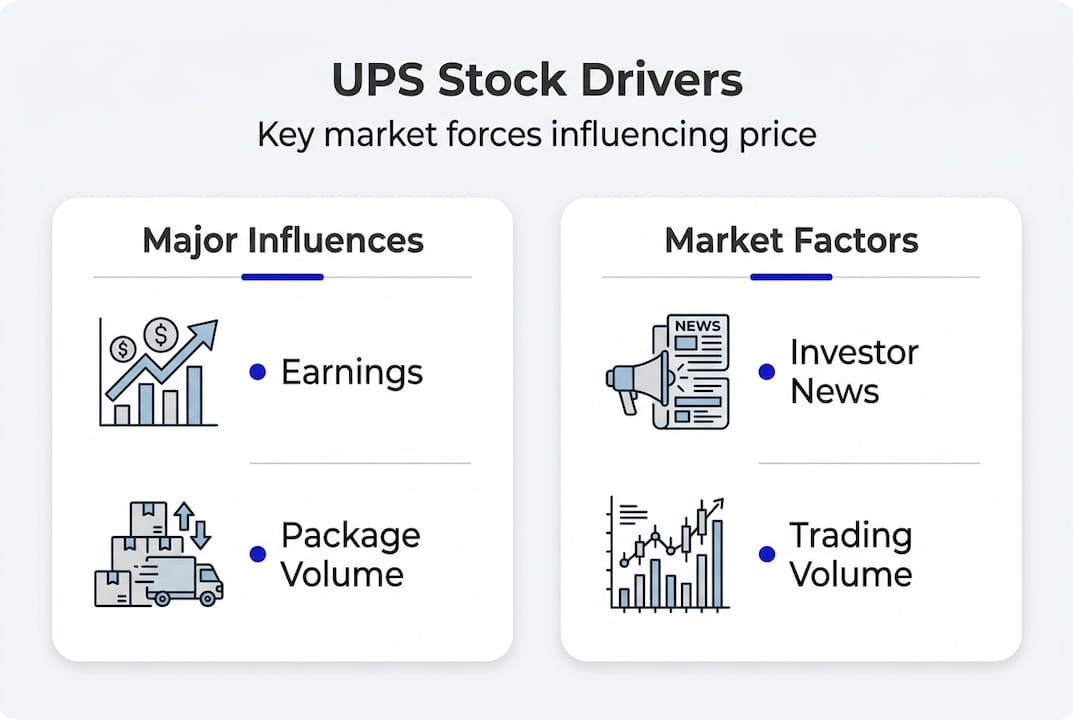
Pro Tip: Don’t just watch the price. Monitor trading volume and news sentiment together. A price spike on low volume is far less meaningful than one backed by heavy institutional buying.
Key drivers behind UPS stock price trends
With the mechanics clear, here are the specific forces that have the greatest impact on UPS’s price over time.
-
Quarterly earnings reports: Revenue, EPS, and package volume data released each quarter are the single biggest short-term price catalysts. Beats send the stock up; misses can trigger sharp selloffs.
-
Forward guidance: Management’s outlook for the next quarter or fiscal year often matters more than current results. Cautious guidance can erase a strong earnings beat within hours.
-
Labor agreements: UPS employs hundreds of thousands of unionized workers. Contract negotiations, strikes, or labor disruptions directly affect operational costs and investor confidence.
-
Fuel costs: Diesel and jet fuel represent a major expense. Rising energy prices compress margins and weigh on the stock; falling fuel costs do the opposite.
-
Dividend announcements: UPS has a strong dividend history. Changes to its payout ratio or yield signal management’s confidence in cash flow, influencing income-focused investors. You can model scenarios using the UPS dividend yield analysis tool.
-
Competitor and macro news: Rate decisions from the Federal Reserve, FedEx earnings surprises, and Amazon’s expansion of its own logistics network all create ripple effects on UPS’s price.
In early 2023, UPS shares dropped roughly 10% in a single session after the company issued weaker-than-expected volume guidance, even though quarterly earnings technically met analyst estimates. That gap between reported results and forward expectations is where many investors get caught off guard.
Quarterly earnings and package volume trends are among the most cited drivers of UPS price action, making earnings calendar awareness a non-negotiable habit for anyone tracking this stock.

Comparing UPS with other delivery and logistics stocks
Context matters enormously in stock analysis. UPS does not trade in isolation. Investors often benchmark UPS performance against FedEx, DHL, and regional competitors to assess relative value and sector momentum.
Here is a snapshot comparison of key metrics across major logistics stocks:
| Company | Market cap (approx.) | Dividend yield | 1-year price change | P/E ratio |
|---|---|---|---|---|
| UPS | ~$90B | ~4.5% | Negative trend | ~14x |
| FedEx | ~$60B | ~2.2% | Mixed | ~16x |
| XPO Logistics | ~$15B | None | Positive | ~25x |
| DHL (parent) | ~$40B | ~4.0% | Flat | ~12x |
Note: Figures are approximate and subject to change. Always verify with real-time data.
When comparing UPS to its peers, a few distinctions stand out:
-
Dividend commitment: UPS offers one of the highest yields in the sector, making it attractive to income investors even during price downturns.
-
Scale advantage: UPS’s global network is difficult to replicate, giving it pricing power that smaller regional carriers lack.
-
Margin pressure: UPS faces higher labor costs than some competitors, which can compress earnings during slow demand cycles.
-
Valuation: UPS trades at a lower P/E than growth-oriented logistics firms, reflecting its mature business model rather than high growth expectations.
For deeper financial comparisons, reviewing DXS financials comparison and JHX financials comparison can sharpen your benchmarking process.
Analyzing UPS stock price: Tools, signals, and practical moves
Technical indicators and return calculators help investors make more informed decisions by combining price history with momentum signals. Here is a practical process for evaluating a UPS trading signal:
-
Check the 50-day and 200-day moving averages. When UPS’s price crosses above its 200-day moving average, it often signals a longer-term uptrend. A cross below suggests caution.
-
Review the Relative Strength Index (RSI). An RSI above 70 indicates overbought conditions; below 30 suggests oversold. Neither is a standalone buy or sell trigger, but both add context.
-
Identify support and resistance levels. Key price levels where UPS has historically reversed can help you set realistic entry and exit targets.
-
Confirm with volume. Any breakout above resistance should be accompanied by above-average volume to be considered reliable.
-
Cross-reference with fundamentals. A bullish technical setup on weak earnings momentum is a lower-conviction trade.
Here is a simplified data snapshot for reference:
| Indicator | Approximate value |
|---|---|
| 50-day moving average | Varies by session |
| 200-day moving average | Varies by session |
| RSI (14-day) | Check real-time |
| Average daily volume | ~3.5M shares |
Use the UPS stock return calculator to model historical returns across different entry points, and the UPS profit/loss calculation tool to stress-test position sizing before you act. Review stock trading workflow tips to build a repeatable process.
Pro Tip: Combine technical and fundamental signals for the most reliable insights. A stock showing oversold RSI readings alongside a strong earnings beat is a far more compelling setup than either signal alone.
Our perspective: What most investors miss about UPS stock
Most investors react to UPS headlines and miss the underlying business cycle signals that actually drive sustained price moves. UPS’s stock tends to be less volatile than many peers precisely because of its scale and consistent dividend commitment, yet that relative calm can mask meaningful turning points. The real edge comes from watching competitor earnings, Federal Reserve rate signals, and consumer spending data before UPS reports its own numbers. Those external signals often telegraph what UPS’s management will say weeks in advance. Building that broader awareness, rather than fixating on UPS news alone, is what separates reactive investors from those making smarter investment decisions.
Leverage powerful tools for UPS stock analysis
Tracking UPS stock price trends manually is time-consuming and easy to get wrong without the right infrastructure behind your process.
Tickerplace gives you the tools to move faster and with greater confidence. Use the UPS return calculator to model scenarios across different time horizons, run targeted searches through the stock screener to identify comparable opportunities, and build your foundational knowledge through the investing education hub. Every feature is designed to support sharper, better-informed decisions on stocks like UPS.
Frequently asked questions
What is the current price of UPS stock?
You can find real-time UPS stock prices on most financial news platforms or by searching the ticker “UPS” on your brokerage site. Prices update continuously during market hours.
How does UPS’s dividend policy impact its stock price?
UPS’s dividend policy attracts long-term, income-focused investors, which supports price stability; consistent dividends can reinforce investor confidence even during periods of broader market weakness.
What are the biggest risks to UPS stock price?
Earnings shocks and competitive pressures can drive significant price moves, alongside rising fuel costs, labor disruptions, and negative macroeconomic signals like declining consumer spending.
How can I compare UPS stock performance to its peers?
Use data tables and comparison tools to view UPS’s metrics alongside major competitors; benchmarking UPS performance against earnings, price change, and dividend metrics gives you the clearest relative picture.