
Glancing at a live Dow number and feeling confident about your next move is a trap more investors fall into than most would admit. The raw figure tells you where the index stands, not why it moved, which stocks drove it, or what the shift means for your portfolio. Real-time data is only as powerful as the framework you use to interpret it. This guide walks you through what the Dow Jones Industrial Average actually measures, how to read its movements with precision, and how to translate live updates into decisions that hold up under scrutiny.
Understanding the Dow Jones Industrial Average in real time
The Dow Jones Industrial Average (DJIA) tracks 30 large, publicly traded U.S. companies selected to represent broad economic sectors. Unlike the S&P 500, which weights components by market capitalization, the Dow uses a price-weighted method. That means a stock trading at $500 per share influences the index far more than one trading at $50, regardless of the company's total market value.
This distinction matters enormously when you watch live market movements. A single high-priced component dropping 3% can drag the entire index down, even if 20 other components are rising. As a result, the Dow's composition and weighting method directly affect how its value changes minute to minute.
Understanding the difference between live and delayed data is equally critical. Most free financial platforms show quotes delayed by 15 to 20 minutes. For long-term investors, that lag is acceptable. For active traders, it can mean the difference between a well-timed entry and a costly mistake.
Here is what live Dow data actually gives you:
- Immediate price changes across all 30 components
- Intraday trend direction, showing whether momentum is building or fading
- Volume signals that reveal conviction behind a move
- Comparative context against prior session highs and lows
"A live number without context is just noise. The signal comes from understanding what moved it and why."
For long-term investors, live data helps confirm whether a dip is a buying opportunity or a structural shift. For traders, it is the core operational feed. Reviewing historical Dow performance alongside real-time figures adds the perspective needed to avoid overreacting to short-term swings.
How to interpret live Dow data for smarter decisions
With the fundamentals clear, let's break down how savvy traders leverage that data in real time. The Dow's number alone rarely tells the full story. What separates informed investors from reactive ones is the habit of asking the right questions before acting.
When the Dow moves sharply, work through these steps:
- Identify the catalyst. Is the move tied to an earnings report, a Federal Reserve announcement, or geopolitical news? Macro events drive index-wide moves; company-specific news affects individual components.
- Check sector performance. If technology stocks are falling but industrials are rising, the Dow's net change may mask a significant rotation worth trading.
- Compare with broader indices. If the S&P 500 and Nasdaq are moving in the same direction, the signal is stronger. Divergence often signals something specific to Dow components.
- Assess volume. A 300-point drop on low volume is less alarming than the same drop on record volume. Volume confirms or questions the move's significance.
- Review your time horizon. Intraday volatility is irrelevant to a 10-year position but critical to a same-day trade.
Pro Tip: Set price alerts on individual Dow components rather than just the index. Component-level alerts give you earlier warning of moves before they fully register in the headline number.
Reading market data with context leads to better outcomes than simple number-watching. One of the most common errors investors make is treating a Dow decline as a signal to sell broadly, without checking whether the drop is concentrated in one or two stocks. Learning to decode market overview data alongside the index number prevents that costly reflex.
Which stocks are driving the Dow today?
Those interpretation techniques are most effective when you know what's driving the Dow right now. Because the index is price-weighted, a small group of high-priced stocks can account for a disproportionate share of any given day's move. The most heavily weighted stocks can move the entire Dow disproportionately, which means tracking them individually is as important as watching the index itself.
Here is a simplified comparison of how component weighting affects index influence:
| Stock price range | Index influence | Typical role in daily moves |
|---|---|---|
| $400 and above | Very high | Can single-handedly shift the Dow by 50+ points |
| $150 to $399 | Moderate | Contributes meaningfully during sector-wide moves |
| Below $150 | Lower | Moves matter less unless accompanied by high volume |
To identify today's actual movers, focus on:
- Percentage change vs. point change. A $10 move in a $500 stock is 2%; the same $10 move in a $100 stock is 10%.
- Pre-market and after-hours activity. Significant moves outside regular hours often forecast intraday direction.
- News flow tied to specific components. Earnings surprises, analyst upgrades, and regulatory news move individual stocks sharply.
Browsing Dow component stocks by market cap and price gives you a quick read on which names carry the most weight on any given day. Pairing that with trending Dow stocks by volume helps you spot momentum before it becomes the headline.
Applying live Dow insights to your portfolio strategy
Understanding today's movers sets you up to refine your overall approach and apply those live insights productively. How you use live Dow data depends heavily on your investment horizon and risk tolerance.
| Use case | Relevant data points | Action framework |
|---|---|---|
| Short-term trading | Intraday price, volume, sector rotation | Enter or exit based on confirmed momentum |
| Swing trading | 3 to 10-day trends, earnings calendar | Position around catalysts with defined stop-losses |
| Long-term investing | Monthly trend, macroeconomic context | Use dips as accumulation opportunities |
Integrating live Dow data with your broader plan requires discipline. Earnings cycles, Federal Reserve meeting dates, and inflation reports all create predictable windows of volatility. Mapping those events onto your calendar before they arrive lets you prepare rather than react.
Pro Tip: Maintain a simple trading journal that logs the Dow's level, the catalyst you identified, and the action you took. Reviewing it monthly reveals patterns in your decision-making that pure data cannot show.
A disciplined approach to integrating index movements with your overall plan is key to sustainable returns. For risk management, consider setting position-size limits tied to intraday volatility levels. When the Dow swings more than 1% before noon, reducing new position sizes by 25% is a practical rule that limits exposure during uncertain sessions. Pairing live data with investing education resources builds the analytical foundation that keeps short-term noise from derailing long-term goals.
Why following the Dow live is only your starting line
Before reflecting on how to elevate your approach, consider this: every serious investor has access to the same live Dow feed. The number itself is not your edge. Your edge comes from the speed and accuracy with which you interpret it.
Emotional trading triggered by tick-to-tick shifts is one of the most documented causes of underperformance. Watching the index fall 400 points and selling immediately, only to see it recover within the hour, is a pattern that erodes returns over time. The investors who consistently outperform are not the fastest to react. They are the most disciplined in applying a framework before acting.
Tracking market movements perspective with a structured lens, rather than raw emotion, is what separates reactive trading from informed investing. Live data is your starting point, not your conclusion.
Turn live Dow data into strategy with Tickerplace
If you're ready to elevate your investing with live Dow insights, here's an easy way to apply what you've learned.
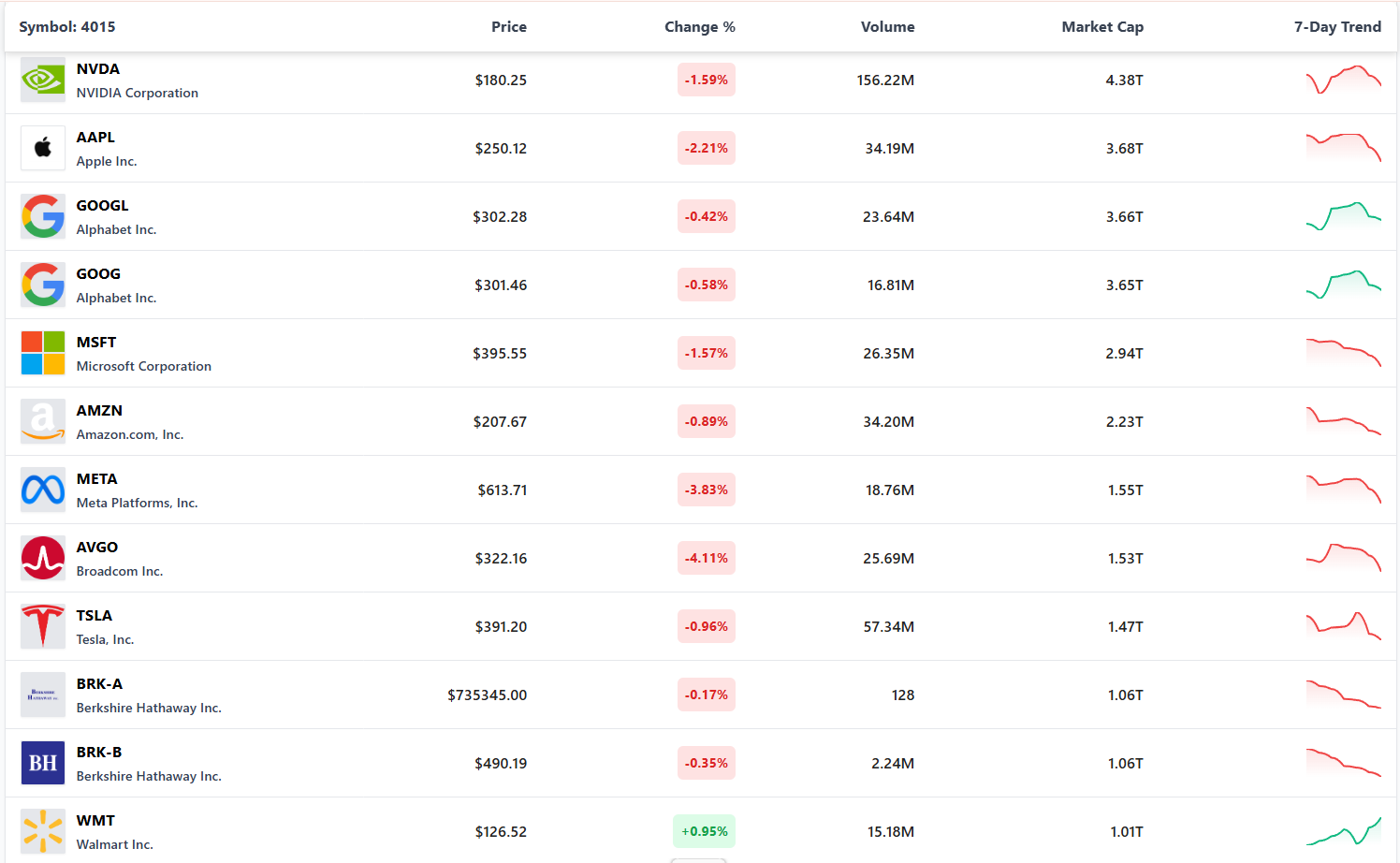
Tickerplace gives you the real-time market tracking and analytical depth to move beyond headline numbers. Use the stock screener to filter Dow components by price movement, volume, and fundamentals in seconds. Calculate potential returns on any position with the stock return calculator, and strengthen your analytical foundation through structured investing education resources. Every tool is built to help you act on live data with confidence, not guesswork.
Frequently asked questions
How often is the Dow Jones updated during trading hours?
Live Dow data is continuously updated throughout market hours, with each component's price change reflected almost instantly during U.S. trading sessions.
Which stocks have the biggest impact on the Dow's daily movement?
Higher-priced stocks carry more influence due to the price-weighted structure, meaning certain stocks can drive most of the Dow's daily move even when the majority of components are flat.
How can investors use live Dow data to make informed trades?
Combine real-time Dow numbers with sector news and component performance; actionable trading requires context beyond headline index moves to avoid knee-jerk reactions.
Where can I find historical Dow performance to compare with today's data?
Tickerplace's dedicated pages offer historical Dow performance comparisons, allowing you to benchmark current moves against long-term trends.
Does the Dow reflect the entire U.S. stock market?
No. The Dow tracks only 30 major companies, so pairing it with broader indices like the S&P 500 provides a fuller and more accurate picture of overall market health.