

TL;DR:
- A market overview provides a comprehensive snapshot including indices, sectors, economic data, and investor sentiment.
- Building an overview involves tracking indices, analyzing sectors, fundamental data, technical signals, and real-time info.
- Investors should interpret overviews critically, considering concentration risks, illiquidity, and geopolitical factors for better decision-making.
A market overview is far more than a scrolling ticker of stock prices. It is a structured snapshot of current market conditions, capturing everything from index movements and sector rotations to economic signals and investor sentiment. Many investors glance at headline numbers and assume they have the full picture, but that assumption can be costly. This guide breaks down what a true market overview actually contains, how it is constructed, where it gets complicated, and how you can use it to make sharper, more confident investment decisions.
Key Takeaways
| Point | Details |
|---|---|
| Market overview is comprehensive | It summarizes indices, sectors, returns, and key signals for investors. |
| Mechanics blend data and analysis | Market overviews combine index tracking, sector breakdowns, and fundamental/technical approaches. |
| Edge cases reveal hidden risks | Illiquidity, volatility, and concentration often challenge surface-level insights. |
| Actionable for strategy | Investors use overviews to rebalance, manage risk, and spot undervalued opportunities. |
| Nuance is critical | Headline numbers alone can mislead—deeper analysis uncovers real opportunities. |
What is a market overview and why it matters
At its core, a market overview is a structured summary of where financial markets stand at any given moment. It goes well beyond price changes on a few major indices. According to Morningstar's 2026 outlook, a complete market overview covers indices, sectors, asset classes, economic indicators, and investor sentiment, each layer adding context that raw prices cannot provide on their own.
For investors and analysts, this matters because no single data point tells the whole story. A rising S&P 500 might mask weakness in small-cap stocks or deteriorating credit conditions. A market overview pulls these threads together.
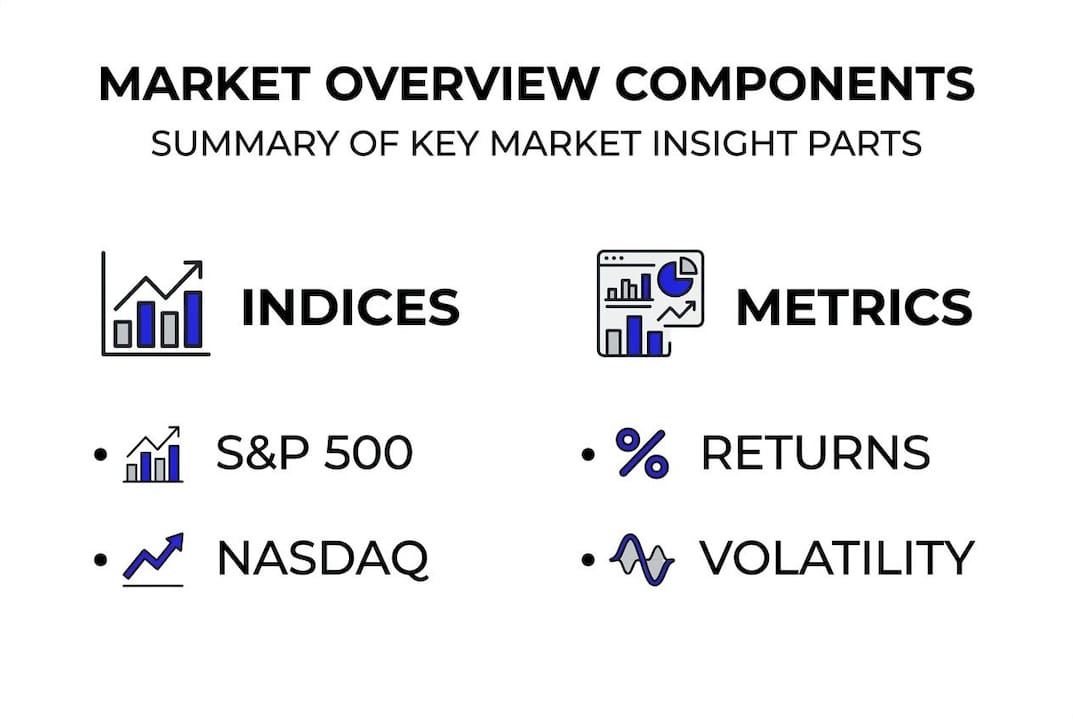
Key components typically included are:
- Major indices: Performance of benchmarks like the S&P 500, Nasdaq Composite, and Dow Jones Industrial Average
- Sector breakdowns: Which industries are leading or lagging, such as technology versus energy
- Asset class returns: Equities, fixed income, commodities, and currencies compared side by side
- Economic indicators: Inflation readings, employment data, and central bank policy signals
- Investor sentiment: Measures like the VIX volatility index or put/call ratios
A well-constructed market overview does not just describe what happened. It reveals the underlying forces shaping prices, giving investors a framework for what might happen next.
Understanding market index examples and how they are weighted is foundational here. You can also explore a full stock indices guide to sharpen your grasp of how benchmarks are built and what they actually measure. Knowing the basics of stock market fundamentals helps you interpret any overview with greater accuracy.

Core mechanics: How market overviews are built
Building a reliable market overview requires more than aggregating price data. It involves systematic processes that blend quantitative tracking with qualitative judgment. As outlined in Coursera's market analysis framework, the mechanics involve tracking indices, sector breakdowns, fundamental analysis, and approaches like comparable valuations to form a coherent picture.
Here is how the process typically works:
- Index tracking: Major indices are monitored continuously, with weighting methodologies (market-cap weighted for the S&P 500, price-weighted for the Dow) factored into interpretation.
- Sector and industry analysis: Each sector is assessed independently, identifying rotation patterns where capital moves from one area to another.
- Fundamental data integration: Earnings reports, revenue trends, price-to-earnings ratios, and debt levels are layered in to contextualize price movements.
- Technical signals: Moving averages, support and resistance levels, and momentum indicators add a short-term lens to the longer-term fundamental picture.
- Real-time data feeds: Platforms like Bloomberg aggregate live data streams, allowing analysts to monitor shifts as they happen rather than reacting after the fact.
For a deeper look at interpreting the numbers, reading market data is a practical skill worth developing. You can also build foundational knowledge through investing education resources that cover both technical and fundamental approaches. A solid fundamental analysis guide can further sharpen how you evaluate the data behind any overview.
Pro Tip: When reviewing a market overview, always check whether the index gains are broad-based or driven by a handful of mega-cap stocks. Narrow leadership often signals fragility beneath a strong headline number.
Edge cases and current market challenges
Not every market condition fits neatly into a standard overview format. Certain scenarios introduce complexity that demands extra scrutiny from investors and analysts alike. As noted in Damodaran's 2026 data update, edge cases include illiquidity, volatility spikes, concentration in mega-caps, and divergences between growth and value stocks.
Consider the following challenges currently shaping market overviews:
- Illiquid assets: Private equity, real estate, and certain fixed-income instruments lack continuous pricing, forcing analysts to rely on estimates and comparable sales rather than live quotes.
- Geopolitical volatility: Events such as renewed tensions in the Middle East in 2026 can trigger sharp, short-lived dislocations that distort sector-level data temporarily.
- Mega-cap concentration: A small number of technology companies now represent an outsized share of major indices, meaning index-level performance can diverge significantly from the average stock's experience.
When the top ten stocks in an index account for more than 35% of its total weight, the index is no longer a reliable proxy for broad market health.
The table below illustrates how different market conditions affect overview interpretation:
| Condition | Challenge | What to watch |
|---|---|---|
| High concentration | Index gains mask broad weakness | Equal-weight index vs. cap-weight index |
| Illiquid assets | Valuations are estimates, not market prices | Discount to NAV, bid-ask spreads |
| Geopolitical shock | Short-term volatility distorts signals | VIX, sector rotation speed |
| Growth vs. value divergence | One style dominates, skewing sector data | Factor performance spreads |
Understanding why market data matters for your decisions becomes especially important in these scenarios. For context on how growth stocks have performed relative to expectations, reviewing longer-term performance data adds useful perspective.
How investors use market overviews: Practical strategies for 2026
Knowing what a market overview contains is only half the equation. The real value comes from translating that information into portfolio decisions. Recent data provides a concrete starting point: the S&P 500 returned 17.72% in 2025, with the cyclically adjusted price-to-earnings ratio (CAPE) sitting near 40, implying forward returns in the 6 to 9 percent range. Value stocks outperformed growth in Q4 2025, though growth led for the full year.
Here is how experienced investors translate these signals into action:
- Benchmark your portfolio: Compare your returns against relevant indices to assess whether active decisions are adding or subtracting value.
- Identify rotation opportunities: When value outperforms late in a cycle, it often signals a shift worth positioning for, particularly in sectors like financials and industrials.
- Rebalance based on concentration data: If your equity allocation has drifted toward mega-caps through passive index exposure, consider trimming and reallocating to small-cap or international equities.
- Monitor the equity risk premium (ERP): The implied ERP, derived from earnings yields versus risk-free rates, tells you whether equities are fairly compensating for the risk you are taking.
| Metric | 2025 Reading | Implication for 2026 |
|---|---|---|
| S&P 500 annual return | 17.72% | Strong base; mean reversion risk rises |
| CAPE ratio | ~40 | Elevated; forward returns likely moderate |
| Value vs. growth (Q4 2025) | Value outperformed | Rotation signal worth monitoring |
For context on how different stock indices examples behave across cycles, reviewing historical patterns strengthens your interpretation. The 2026 market outlook from Morningstar provides additional forward-looking context. You can also access structured investing education to build the analytical framework needed to act on these signals confidently.
Pro Tip: Do not rely solely on the implied ERP from a single source. Cross-reference it with your own calculation using current 10-year Treasury yields and forward earnings estimates to validate the signal.
Market overview: What most investors overlook
Here is an uncomfortable truth: most investors read a market overview and walk away with the wrong takeaways. They see a strong index return and feel reassured. They miss the fact that concentration risk in mega-caps and sector divergences are quietly building vulnerabilities beneath the surface.
The implied ERP is one of the most underused tools in any investor's kit. When it compresses, equities are pricing in near-perfection, and the margin for error shrinks. Sector rotation signals, often buried in a market overview's sector table, frequently lead headline index moves by weeks.
Our view is that a market overview should be treated as a starting point, not a conclusion. Pair it with deep-dive investing education and stock-level analysis to move from observation to conviction.
Explore deeper market insights with Tickerplace
Reading a market overview is where analysis begins, not ends. Tickerplace gives you the tools to go further, faster.
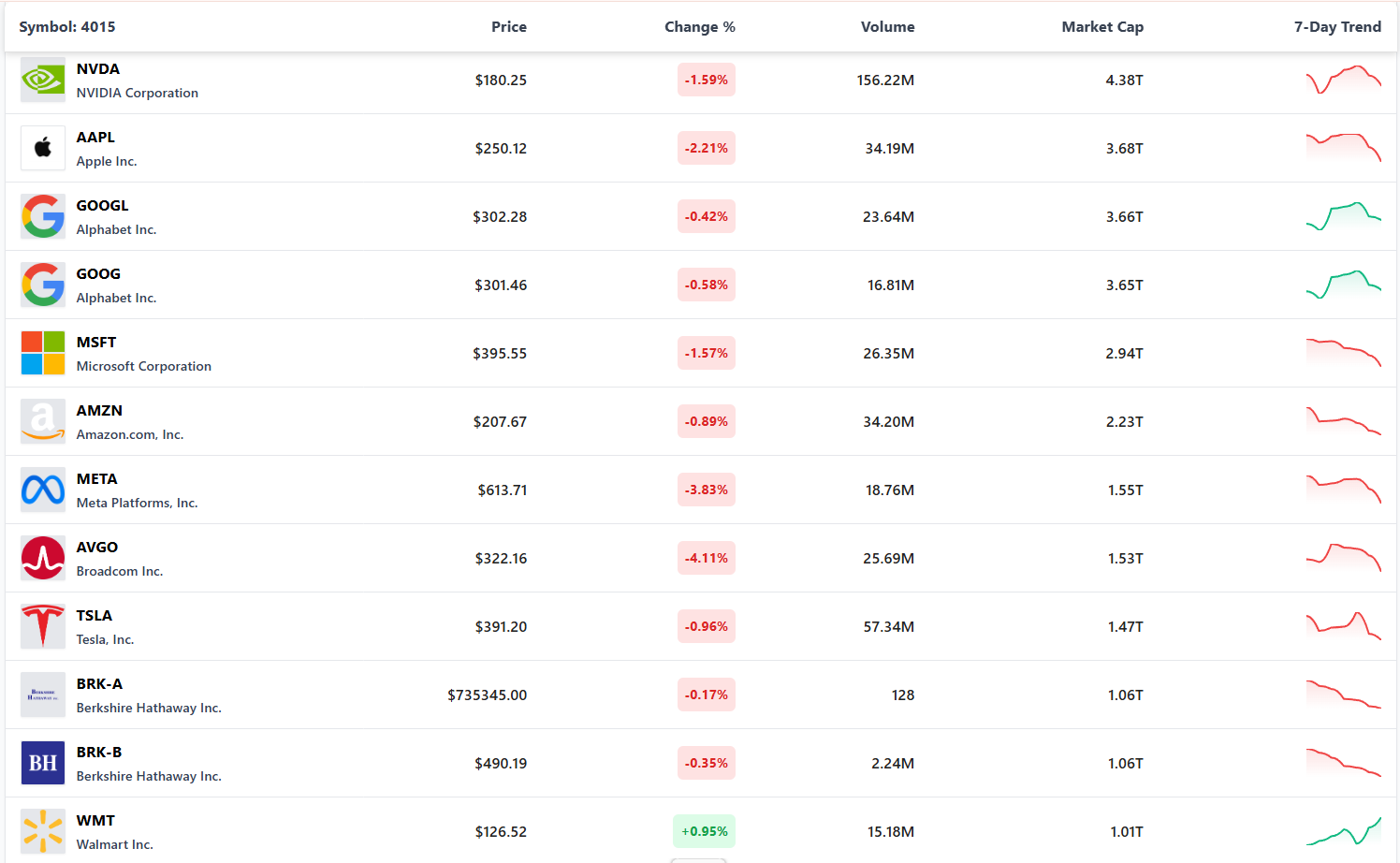
With real-time market dashboards, a powerful stock screener, and a stock return calculator that helps you model historical performance, Tickerplace puts institutional-grade analytics within reach of every investor. Explore structured investing education to build the frameworks that turn raw market data into actionable strategy. Whether you are monitoring sector rotations, screening for undervalued equities, or stress-testing your portfolio, Tickerplace is built for the depth your decisions require.
Frequently asked questions
What are the key components of a market overview?
A market overview covers major indices, sector performance, asset class returns, economic indicators, volatility measures, and notable market events. These components together provide a comprehensive market summary that goes well beyond simple price data.
How do market overviews help investors make decisions?
They supply real-time benchmarks and structured insights that support portfolio rebalancing, risk management, and the identification of undervalued assets. Real-time market dashboards allow analysts to adjust strategy as conditions shift rather than reacting after the fact.
Why is it important to look beyond headline index numbers?
Headline numbers can mask risks like mega-cap concentration and sector divergence, which only become visible when you examine equal-weight performance, factor spreads, and sector-level data.
What tools are best for getting a market overview?
Platforms like Bloomberg and Tickerplace offer real-time dashboards, market screening, and analysis features that give investors a structured, data-rich view of current conditions.
How are edge cases like illiquid assets handled in a market overview?
Illiquid assets typically rely on comparable sales methodologies and estimated valuations rather than live prices, with volatility tracked through specialized risk measures and discount-to-NAV analysis.