

The margin of safety formula is: MOS (%) = 1 − (Current Price ÷ Intrinsic Value). A positive result means the stock trades below your estimated intrinsic value, which signals a potential buying opportunity; a negative result means the market price already exceeds it. This applies whether that intrinsic value comes from a DCF model, a P/E multiple, or a P/S multiple.
TL;DR:
- A conservative margin of safety typically ranges from 10% to 40%, depending on the business's predictability and valuation uncertainties.
- Inaccurate inputs like stale share counts, outdated market prices, or enterprise values misaligned with per-share analysis can significantly distort results.
- Cross-checking DCF-based intrinsic values against peer P/E or P/S multiples helps identify wide discrepancies and avoid overconfidence.
- Mature, stable companies with predictable cash flows generally warrant lower safety margins, while high-growth or cyclical stocks require wider buffers.
- Using current, day-of-analysis data and verifying assumptions against balance sheets and recent corporate activity is essential before acting on a margin of safety signal.
How to Calculate Margin of Safety: A Step-by-Step Example
Once you have an intrinsic value estimate, the margin of safety calculation takes about thirty seconds. The formula has two equivalent forms, and knowing both helps you catch errors.
The algebraic version is MOS = (Intrinsic Value − Current Price) ÷ Intrinsic Value. The percentage version, used in most professional workflows, is MOS = 1 − (Current Price ÷ Intrinsic Value), then multiplied by 100. Both produce the same number; the second is just easier to run in a spreadsheet cell.
Here's the calculation with real numbers. Say your DCF model produces an intrinsic value of $60 per share, and the stock currently trades at $40. Divide $40 by $60 to get 0.667, then subtract that from 1. Investopedia's worked examples walk through the same conversion, including how to reverse it: if you want a 30% margin of safety on that same $60 valuation, your maximum purchase price is $42 ($60 × 0.70).
Follow this sequence every time you run the numbers:
- Confirm your intrinsic value is expressed per share, not as a total enterprise value. If your DCF spits out an enterprise value, subtract net debt and divide by diluted shares outstanding, not basic shares, since options and convertibles dilute your actual claim.
- Pull the current market price from the same day you're running the analysis. A price that's a week old can shift your margin of safety percentage by several points on a volatile stock.
- Divide current price by intrinsic value per share.
- Subtract that ratio from 1 and convert to a percentage.
- Double-check your currency and units match. Mixing a per-share DCF output with a total market cap, or comparing US dollar intrinsic value against a price quoted in a different currency, produces a number that looks plausible and is completely wrong.
The most common arithmetic mistake isn't the formula itself, it's the inputs feeding it. A stale share count from last year's 10-K, missed dilution from a recent capital raise, or intrinsic value quoted at the enterprise level rather than per share will all quietly corrupt an otherwise correct calculation.
Applying Margin of Safety Across DCF, P/E, and P/S Models
Margin of safety isn't tied to one valuation method. You calculate it the same way regardless of source, but each model carries its own failure points, and knowing them changes how much you should trust the number.
Discounted cash flow (DCF). Intrinsic value here comes from forecasting free cash flow and discounting it, along with a terminal value, back to the present using your weighted average cost of capital. Terminal value routinely makes up 60% to 80% of total DCF intrinsic value, which means a model that looks rigorous is often just a bet on a growth rate decades out.
Multiples (P/E and P/S). These work in reverse: pick a target multiple based on peer averages or historical norms, multiply it by the company's earnings or revenue per share, and that product becomes your intrinsic value estimate. If a stock earns $3 per share and you believe a fair P/E is 18, intrinsic value is $54; from there, MOS follows the same formula as any DCF-derived figure.
- Run your DCF and your multiples-based estimate side by side rather than trusting one in isolation.
- When the two disagree by a wide margin, favor the lower, more conservative estimate for your MOS calculation rather than averaging them blindly.
- Treat a wide gap between DCF and multiples output as a signal to dig into your assumptions, not as noise to smooth over.
Cross-checking models this way is standard practice among disciplined value investors, and scenario-based valuation guides consistently recommend anchoring on the more conservative figure precisely because DCF terminal value assumptions are so easy to overstate.
Choosing the Right Margin of Safety for Each Stock
There's no universal number here, and treating 25% or 30% as a fixed rule for every stock misses the point of the concept. The margin of safety you require should scale with how much uncertainty sits in your valuation inputs.
A mature utility with regulated, predictable cash flows carries far less forecasting risk than a fast-growing software company whose intrinsic value is almost entirely terminal value. Practitioner guidance) generally scales required MOS to business predictability, not to a fixed formula input.
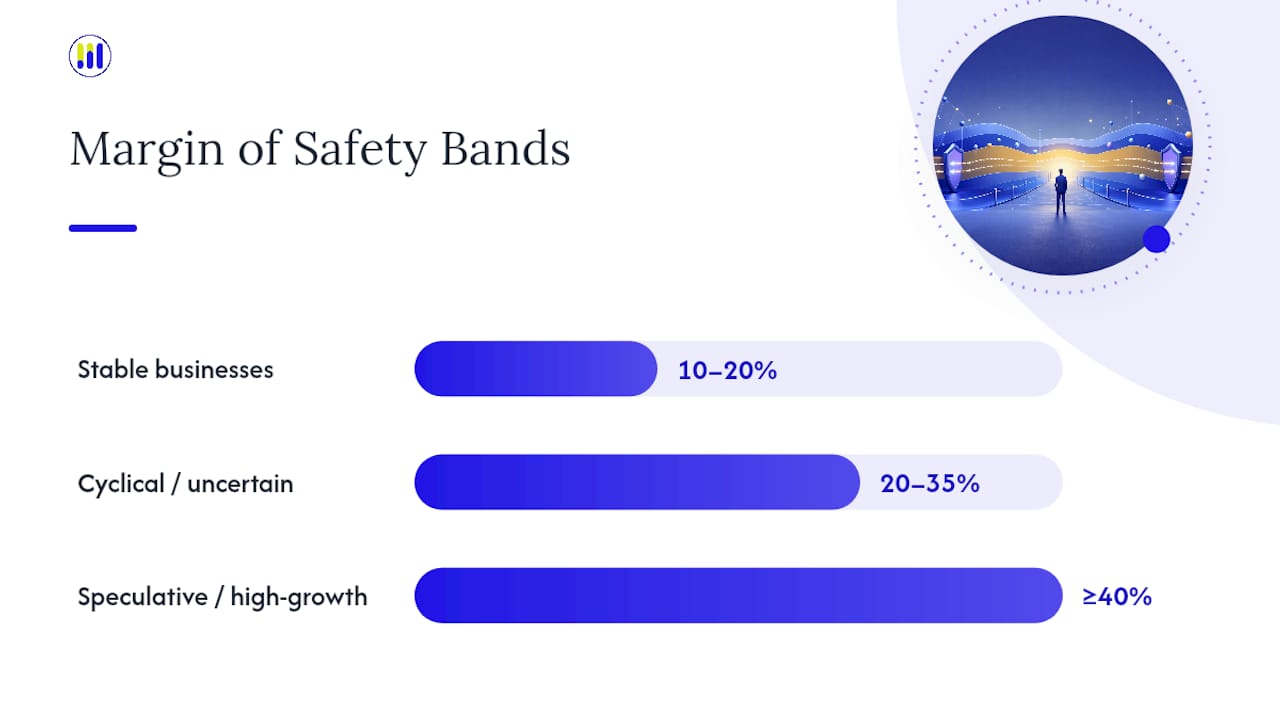
- Stable, cash-generative businesses with long operating histories and low cyclicality can often justify a smaller margin of safety, sometimes in the 10% to 20% range, because the inputs feeding intrinsic value are less likely to be wildly wrong.
- Cyclical or moderately uncertain businesses typically warrant something closer to 20% to 35%, given more variable earnings and less forecast reliability.
- Speculative, high-growth, or terminal-value-heavy companies deserve 40% or more, since a single change in assumed growth rate can move intrinsic value by tens of percentage points.
These bands are guidance, not law. The more of your intrinsic value estimate depends on assumptions you can't verify against hard historical data, the wider your required margin should be.
Before applying any MOS threshold, build a weighted intrinsic value from conservative, base, and optimistic scenarios rather than leaning on a single-point DCF output to better manage portfolio risk through understanding sequence-of-returns risk.
Common Pitfalls and a Pre-Purchase Verification Checklist
The single biggest mistake investors make with margin of safety is treating a DCF output as gospel rather than one input among several. Because terminal value can dominate the DCF result, an overly optimistic terminal growth rate quietly inflates intrinsic value, which then inflates your calculated margin of safety without you ever seeing the assumption that caused it.
Other recurring errors: using a stale market price, forgetting to reconcile diluted versus basic share counts, and comparing an enterprise-value output directly against a per-share market price without adjusting for net debt.
Run this checklist before you act on any margin of safety signal:
- Confirm the market price and share count are current, ideally same-day.
- Build a quick sensitivity table crossing WACC against terminal growth rate to see how much your intrinsic value moves under reasonable alternative assumptions.
- Cross-check the DCF figure against a P/E or P/S based estimate.
- Sanity-check the result against basic balance-sheet facts, cash runway, and net debt levels.
- Confirm there's been no recent dilution, buyback, or M&A activity that changes the share count you used.
How Tickerplace Approaches Margin of Safety
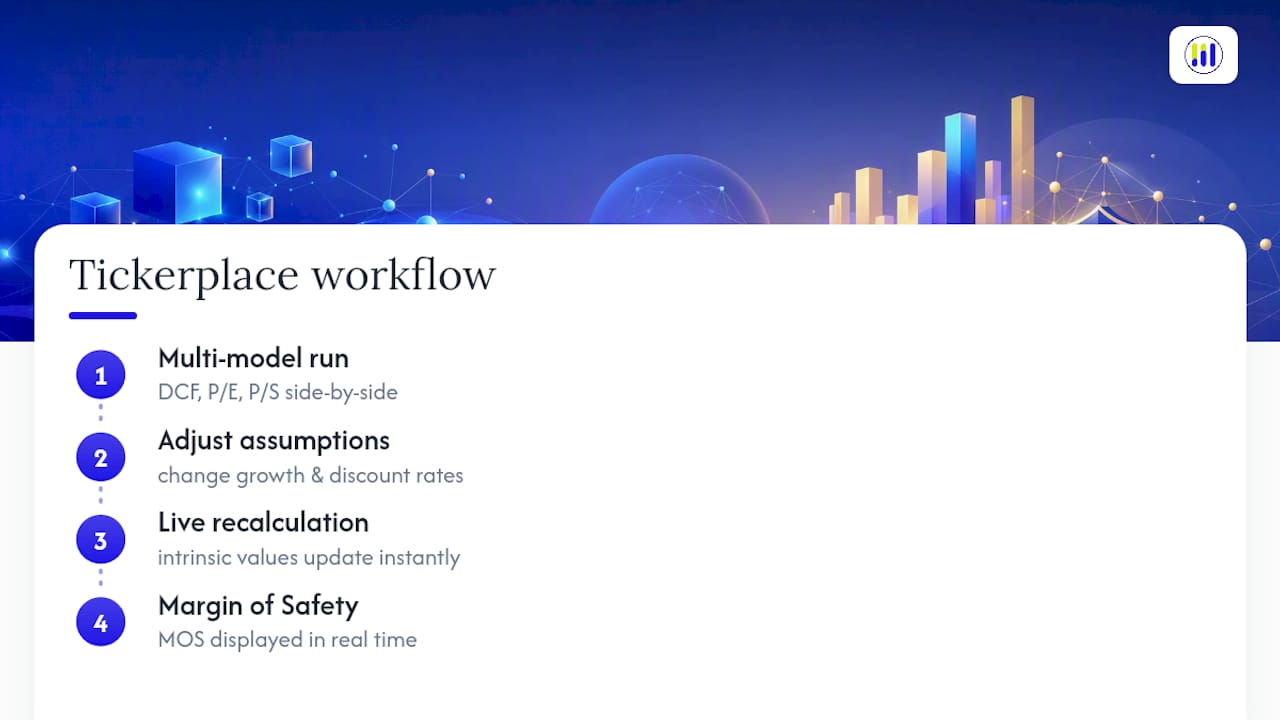
Some platforms build margin of safety directly into a multi-model valuation engine, running DCF, P/E, and P/S estimates side by side for thousands of US and ASX-listed companies. That structure exists because a single valuation model, however carefully built, is still one opinion about the future.
Readers can use available calculators to test how sensitive an intrinsic value estimate is to different growth and discount rate assumptions, then see the resulting margin of safety update in real time rather than rebuilding a spreadsheet from scratch.
— Tickerplace
Run the Numbers Before You Buy
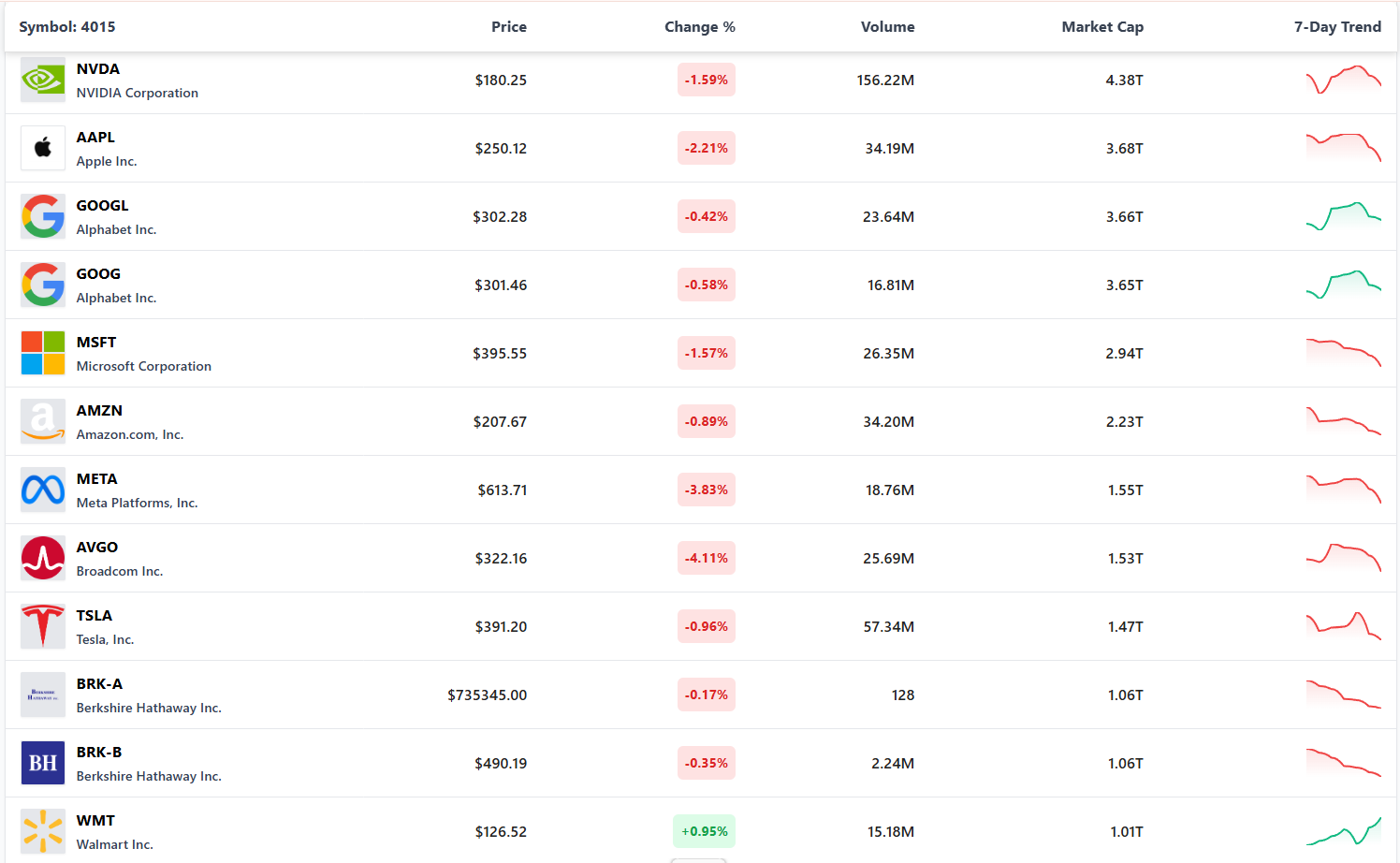
You don't need a finance degree to apply a margin of safety correctly, but you do need the right inputs, and getting those by hand is where most investors lose time or make errors. Tickerplace's Intrinsic Value Calculator generates DCF-based estimates for thousands of US and ASX tickers daily, so you're working from a current figure instead of a stale spreadsheet.
From there, a few tools cover the rest of the workflow described above:
- The Stock Valuation Calculator for P/E and P/S based intrinsic value, so you can cross-check your DCF output the way this article recommends.
- The Stock Valuation Checker to see at a glance whether a ticker is trading above or below its estimated fair value.
- The Stock Average Price Calculator to track your actual cost basis once you start scaling into a position under a target margin of safety.
Every tool draws on the same daily-updated valuation data, so the intrinsic value you plug into your margin of safety formula matches what the rest of your analysis is built on. Start with the Intrinsic Value Calculator, cross-check it against a multiples-based estimate, and you'll have a defensible margin of safety percentage in minutes instead of an afternoon.
Sources
- How to Determine and Use a Stock's Intrinsic Value — Investopedia
- Stock Valuation: DCF, Margin of Safety, and Scenarios — Prosperics Learn
FAQ
What Is the Margin of Safety Formula?
Margin of safety equals 1 minus the current price divided by intrinsic value, expressed as a percentage. A positive number means the stock trades below your intrinsic value estimate.
What Counts as a Good Margin of Safety Percentage?
It depends on business stability.
Can I Use Margin of Safety With P/E or P/S Models, Not Just DCF?
Yes. Once you derive an intrinsic value from a target P/E or P/S multiple, you apply the same margin of safety formula used for DCF output.
Does Tickerplace Calculate Margin of Safety Automatically?
Tickerplace's Intrinsic Value Calculator and stock valuation tools generate daily intrinsic value estimates you can use directly in the margin of safety formula for thousands of US and ASX-listed stocks.