
TL;DR:
- Market indices measure the performance of baskets of stocks across sectors and regions, guiding investment decisions. Investors should select indices aligned with their risk tolerance, time horizon, and diversification goals because they are benchmarks, not direct investment assets.
A list of market indices is a categorized collection of benchmark measures representing baskets of stocks across sectors, company sizes, themes, and regions. The S&P 500 carries a market capitalization near $30 trillion as of Q2 2026, making it the most referenced benchmark for US equity performance. The MSCI World tracks large companies across 23 developed markets with approximately $60 trillion in market capitalization, offering the broadest global exposure available. Understanding these benchmarks is the foundation of any serious investment strategy, whether you are allocating capital, measuring portfolio performance, or assessing risk.

What is a list of market indices and why does it matter?
Market indices, also called stock market indexes, are statistical measures that track the performance of a defined group of securities. Each index answers a specific question: How is the US large-cap market performing? How are technology stocks moving? What is happening in Japanese equities? The answers shape decisions across asset allocation, risk management, and performance benchmarking.
Market indices divide into five main types: Broad Market, Sector-based, Market Capitalization-based, Thematic, and International. Each type serves a distinct investment purpose.
- Broad market indices track the overall economy of a country or region, giving investors economy-wide exposure in a single measure.
- Sector-based indices isolate specific industries such as technology, energy, or healthcare, letting analysts monitor sector rotation and relative strength.
- Market capitalization-based indices divide the market into small-cap, mid-cap, and large-cap segments, which carry different risk and return profiles.
- Thematic indices focus on current investment trends like ESG (environmental, social, and governance) criteria or artificial intelligence, capturing structural shifts in the economy.
- International indices track specific countries or regions, from the Eurozone to emerging markets, enabling geographic diversification.
Knowing which category an index belongs to tells you immediately what kind of market signal it delivers.
Major global indices by type and region
The table below organizes the most widely followed indices by category, with key operational details.
| Index | Type | Region | Key Feature |
|---|---|---|---|
| S&P 500 | Broad market | United States | ~$30 trillion market cap; 500 large-cap US companies |
| MSCI World | International | 23 developed markets | ~$60 trillion market cap; global large-cap exposure |
| Wilshire 5000 | Broad market | United States | Broadest US equity measure; covers nearly all US stocks |
| Nasdaq-100 | Sector-based | United States | Technology-heavy; higher volatility profile than S&P 500 |
| Russell 2000 | Market cap-based | United States | Small-cap benchmark; 2,000 smaller US companies |
| FTSE 100 | International | United Kingdom | 100 largest London Stock Exchange companies |
| DAX | International | Germany | 40 major German companies; Frankfurt-listed |
| Nikkei 225 | International | Japan | 225 Tokyo-listed companies; includes a lunch break from 11:30–12:30 JST |
| Euro Stoxx 50 | International | Eurozone | 50 blue-chip Eurozone companies; reduces single-country risk |
| MSCI Emerging Markets | International | Global emerging markets | Covers 24 emerging economies; higher growth, higher risk |
The Nikkei 225 detail is worth noting for traders: its midday pause differs from the continuous sessions of US indices, which affects intraday liquidity and order timing.
Pro Tip: When tracking regional indices like the DAX or Nikkei 225, always account for currency effects. A rising index in local currency terms can still produce negative returns for a US dollar-based investor if the local currency weakens.
How index weighting methods shape performance
The weighting scheme of an index significantly impacts its behavior and volatility. Two methods dominate the major financial indices.
- Market-cap weighting assigns each stock a weight proportional to its total market value. The S&P 500 uses this method. Larger companies like Apple or Microsoft therefore exert more influence on the index's daily movement than smaller constituents.
- Price weighting assigns influence based on a stock's share price, regardless of company size. The Dow Jones Industrial Average uses this method. A high-priced stock moves the index more than a low-priced one, even if the low-priced company is far larger by market capitalization.
Price-weighted indices can skew performance interpretations because a stock split at one company reduces its index weight overnight, with no change in underlying business value. This creates distortions that market-cap-weighted indices avoid.
Pro Tip: When comparing the Dow Jones Industrial Average to the S&P 500, remember you are comparing two different weighting philosophies. A divergence between the two often signals that large-cap stocks are moving differently from the broader market.
Selecting the right indices for your investment strategy
No single index suits all investors. The right choice depends on your risk tolerance, investment horizon, and diversification goals. Here is how to match indices to common investment objectives.
- Long-term, low-risk growth: Broad market indices like the S&P 500 or MSCI World provide diversified exposure with lower single-stock risk. They suit investors with a 10-plus year horizon.
- Growth with higher volatility tolerance: The Nasdaq-100 concentrates in technology and growth companies. It outperforms in bull markets but draws down sharply in corrections.
- Geographic diversification: Indices like the Euro Stoxx 50 reduce dependence on a single country's economic cycle. Experts recommend broad regional indices for Eurozone exposure specifically to reduce local market risk.
- Small-cap exposure: The Russell 2000 captures US small-cap performance, which historically diverges from large-cap trends during economic recoveries.
- Thematic alignment: ESG indices or AI-focused indices let investors express views on structural trends, though they carry concentration risk.
One critical misconception to address directly:
Indices are benchmarks, not investable assets. You cannot buy an index directly. Investment happens through products like ETFs and index funds that track an index, and these products carry tracking error risks — meaning their returns may not perfectly match the index they follow.
Indices cannot be directly purchased; ETFs and index funds are the vehicles. Tracking error, expense ratios, and liquidity differences between the fund and its underlying index all affect your actual return. Understanding this distinction protects you from a common and costly misunderstanding.
You can explore types of stock indices in more depth to see how each category maps to specific investment strategies.
Key Takeaways
The most effective approach to using market indices is to match each index's type, weighting method, and regional focus to your specific investment goals and risk profile.
| Point | Details |
|---|---|
| Five index categories exist | Broad, sector, market-cap, thematic, and international indices each serve a distinct purpose. |
| Weighting method matters | Market-cap-weighted indices like the S&P 500 behave differently from price-weighted ones like the Dow Jones. |
| Indices are not investable | You invest through ETFs or index funds, which carry tracking error and expense ratio risks. |
| Geographic diversification is measurable | Regional indices like Euro Stoxx 50 or MSCI World reduce single-country concentration risk. |
| No universal best index | Index selection must align with your risk tolerance, time horizon, and diversification needs. |
The index you choose reveals the question you are asking
No index is neutral. Every index embeds assumptions: which companies count, how they are weighted, and which geography or sector defines the universe. At Tickerplace, the most common mistake we see investors make is treating the S&P 500 as a proxy for "the market" when their actual portfolio has significant exposure to small-cap or international equities. That mismatch produces misleading performance comparisons.
Thematic indices around AI and ESG are multiplying fast. That is not inherently bad, but concentration risk in thematic indices is real and often underestimated. An AI-focused index may hold 15 companies. A single regulatory shift or earnings miss can move it 5% in a day.
The indices gaining the most attention in 2026 are not always the ones best suited to a long-term investor's goals. Analytical rigor means asking what an index actually measures before you use it as a benchmark or a basis for allocation. Understanding market capitalization is the first step toward reading any index correctly.
— Tickerplace
Apply index insights with Tickerplace tools
Tracking major financial indices is only half the work. The other half is evaluating whether the individual stocks within those indices are priced fairly relative to their intrinsic value.
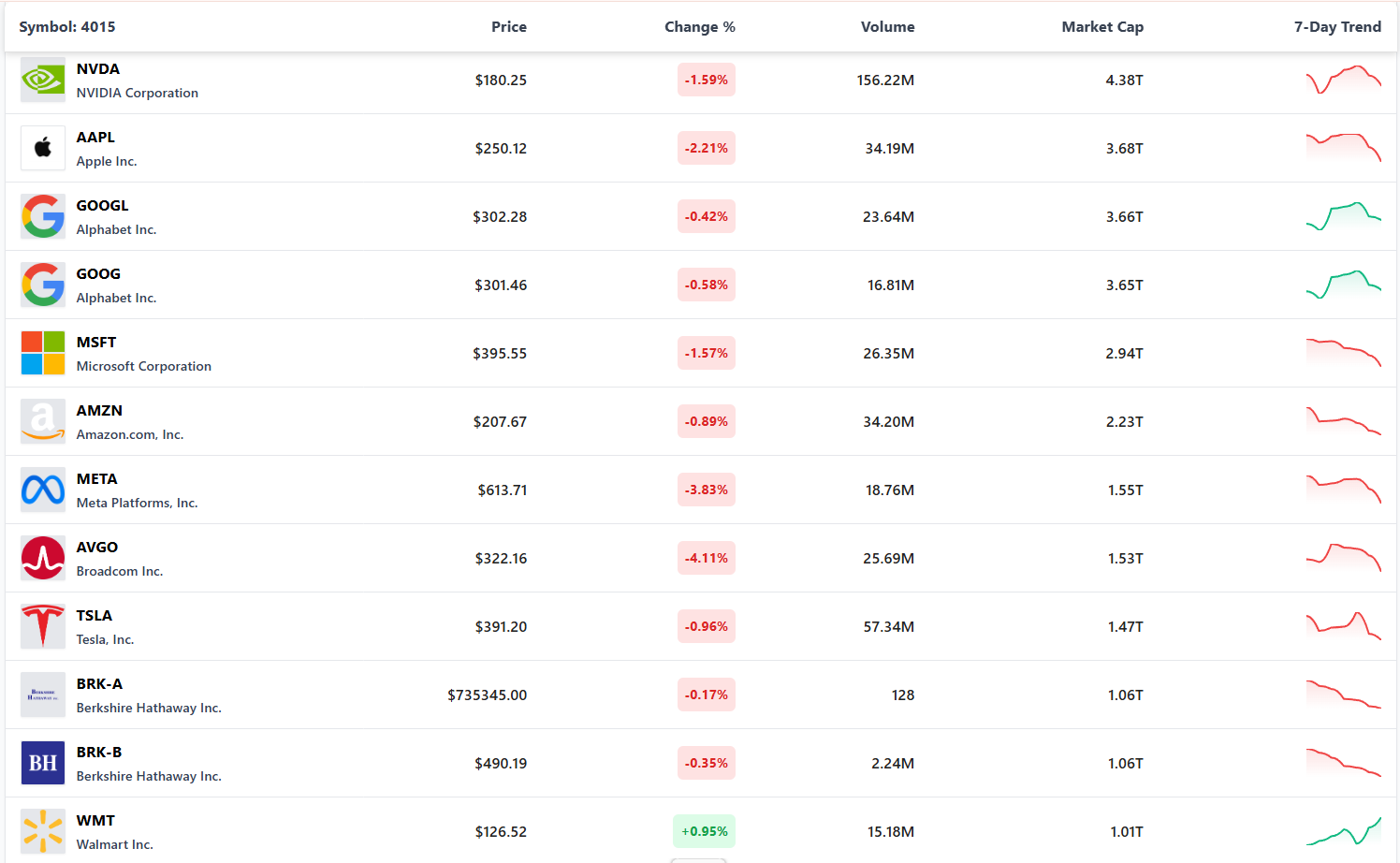
Tickerplace provides free, institutional-grade valuation tools built for individual investors. The stock average price calculator helps you manage cost basis as you build positions in index-tracked stocks. The stock valuation calculator applies DCF, P/E, and P/S models to generate fair value estimates across 10,000+ US and ASX-listed equities, updated daily. Use these tools alongside index analysis to move from market-level signals to stock-level decisions with confidence.
FAQ
What is a market index?
A market index is a statistical measure that tracks the performance of a defined basket of securities, representing a market segment, sector, or region. It serves as a benchmark for comparing portfolio returns and assessing overall market conditions.
How many types of stock indices are there?
Market indices divide into five main types: broad market, sector-based, market capitalization-based, thematic, and international. Each type serves a distinct analytical and investment purpose.
Can you invest directly in a market index?
No. Indices are benchmarks and cannot be purchased directly. Investors gain index exposure through ETFs and index funds, which carry tracking error and expense ratio risks that affect actual returns.
What is the difference between the S&P 500 and the Dow Jones Industrial Average?
The S&P 500 is market-cap-weighted and covers 500 companies, making it a broader US market measure. The Dow Jones Industrial Average is price-weighted and covers only 30 companies, which can distort its representation of overall market performance.
How do I choose the right index for my portfolio?
Index selection depends on your risk tolerance, investment horizon, and diversification goals. Broad indices like the MSCI World suit long-term, low-risk strategies, while sector or thematic indices suit investors with specific views on industries or trends.