

TL;DR:
- An intrinsic value calculator estimates a stock's true worth based on financial fundamentals and future cash flows. It helps investors identify undervalued stocks by analyzing different valuation methods and understanding key assumptions. Using multiple approaches and applying a margin of safety enhances investment discipline and reduces risk.
An intrinsic value calculator is a tool that estimates the true worth of a stock based on fundamental financial metrics and projected future cash flows. Unlike market price, which reflects sentiment and momentum, intrinsic value reflects what a business is actually worth. The concept traces back to Benjamin Graham and Warren Buffett, who built entire investment philosophies around buying stocks priced below their calculated worth. For individual investors and financial analysts, these calculators translate complex valuation theory into a repeatable, disciplined process for identifying undervalued opportunities.
How does an intrinsic value calculator work?

The two most widely used methods inside any stock value estimator are discounted cash flow (DCF) analysis and Benjamin Graham's earnings-based formula. Each approach answers the same question differently: what are this company's future earnings worth in today's dollars?
1. Discounted Cash Flow (DCF)
DCF projects a company's free cash flow over a forecast period, typically 5–10 years, then discounts those flows back to present value using a chosen discount rate. The formula also includes a terminal value to capture earnings beyond the forecast window. Estimating future free cash flows accurately requires understanding a company's operations, competitive position, and capital expenditure needs. A present value calculator handles the discounting math once you have your inputs set.
2. Benjamin Graham Formula
Graham's formula estimates intrinsic value using earnings per share (EPS), a projected growth rate, and a base price-to-earnings (P/E) multiple. The growth rate in Graham's formula should not exceed 20%, because higher assumptions produce fragile and unreliable valuations. This ceiling forces discipline and prevents investors from pricing in unrealistic futures.
3. Asset-Based Valuation
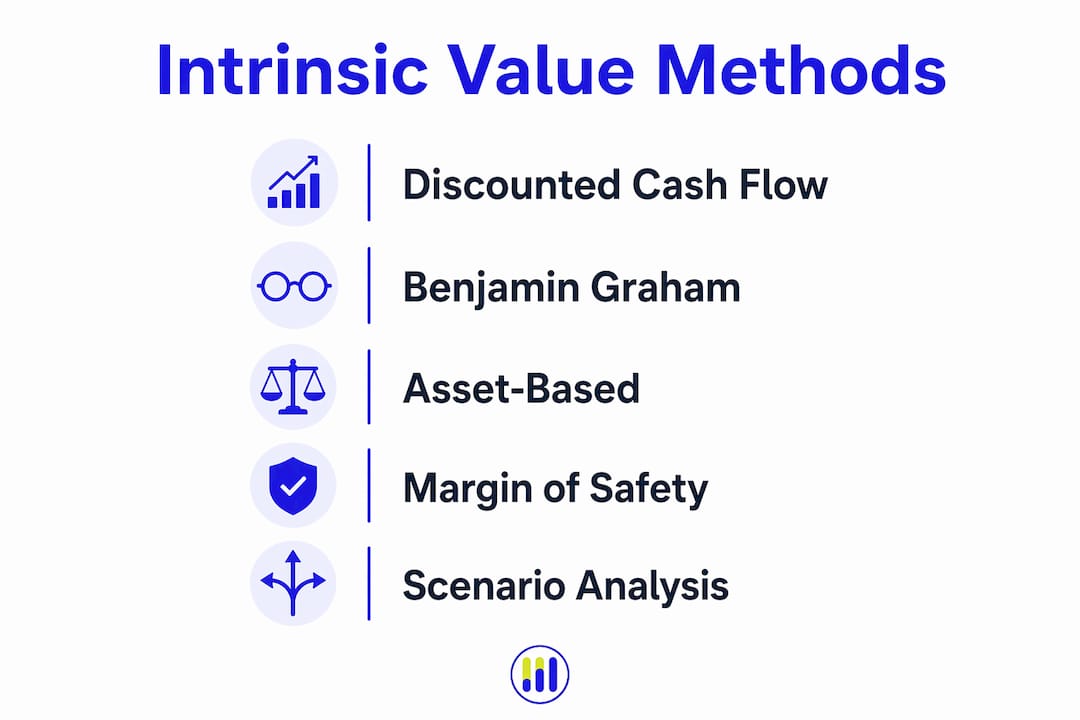
Asset-based methods calculate intrinsic value from a company's net assets on the balance sheet. This approach suits asset-heavy or financially stressed businesses where earnings are volatile or negative. The Earnings Power Value (EPV) model takes a related approach: it values companies on current sustainable earnings while assuming zero growth, removing speculative elements entirely.
Pro Tip: Run your DCF with at least three scenarios: base case, bear case, and bull case. The spread between those outputs tells you more about the stock's risk profile than any single number.
What assumptions and variables impact intrinsic value calculations?
Input assumptions drive every output from an investment value calculator. Small errors compound quickly, which is why understanding each variable matters as much as knowing the formula.
Growth rate is the most influential and most abused input. Investors frequently project recent revenue growth far into the future, ignoring competitive pressures and market saturation. A company growing at 30% today will almost certainly slow. Anchoring your growth assumption to a realistic long-term rate produces a more defensible valuation.
Discount rate reflects the minimum return you require and the risk embedded in the business. A higher discount rate shrinks the present value of future cash flows. A lower rate inflates it. A 1% change in growth or discount rate can shift intrinsic value by up to 30%. That sensitivity is not a flaw in the method; it is a signal that your margin of safety must be wide enough to absorb estimation error.
Margin of safety is the gap between intrinsic value and the price you actually pay. Value investors, following Graham and Buffett, recommend a margin of safety of 20–50% below calculated intrinsic value. Buying at a 30% discount means the stock can be worth 30% less than you calculated and you still break even.
The table below shows how intrinsic value shifts with different growth and discount rate combinations for a hypothetical stock with $5 EPS.
| Growth Rate | Discount Rate | Estimated Intrinsic Value |
|---|---|---|
| 5% | 10% | $60 |
| 8% | 10% | $85 |
| 10% | 10% | $105 |
| 10% | 12% | $88 |
| 15% | 10% | $145 |
Pro Tip: Professional analysts use sensitivity tables to map how intrinsic value changes across a range of inputs. Build one before making any buy decision.
Which valuation method suits different types of stocks?
No single formula works for every company. Financial analysts treat intrinsic value as a theoretical anchor, not a precise price target, and triangulate results across multiple methods. Choosing the right starting model depends on the company's cash flow profile, dividend history, and business stage.
- DCF analysis works best for companies with stable, forecastable cash flows. DCF is most effective for stable cash flow companies; cyclical or early-stage firms require alternative approaches because their cash flows are too unpredictable to project with confidence.
- Dividend Discount Model (DDM) suits mature companies with consistent dividend histories, such as utilities or consumer staples. DDM calculates intrinsic value as the present value of all expected future dividends, making it reliable when payout policy is predictable.
- Asset-based valuation applies to distressed companies, holding companies, or real estate firms where the balance sheet tells a clearer story than the income statement. Book value and net asset value become the primary anchors.
- Relative valuation multiples such as P/E and P/S ratios serve as a cross-check rather than a standalone method. Comparing a stock's multiple to its sector average quickly flags whether the market is pricing it at a premium or discount.
- Earnings Power Value removes growth assumptions entirely, making it useful when you want a conservative floor estimate for a business with uncertain prospects.
Experienced analysts adjust discount rates, growth assumptions, and model choice based on company life cycle, industry dynamics, and economic conditions. Matching the model to the business is as important as running the numbers correctly.
How to use an intrinsic value calculator effectively
Applying a valuation tool well requires more than plugging in numbers. The quality of your inputs determines the quality of your output.
- Source reliable financial data. Pull free cash flow, EPS, book value, and revenue growth from audited financial statements. Tickerplace aggregates this data for 10,000+ US and ASX-listed equities, updated daily, so you are working from current figures rather than stale reports.
- Select conservative growth and discount rates. Use the company's five-year average free cash flow growth as your base case. Apply a discount rate that reflects the business's risk, typically 8–12% for established companies.
- Compare intrinsic value to market price. The gap between your calculated value and the current stock price is your signal. A stock trading at $60 with a calculated intrinsic value of $100 offers a 40% margin of safety. Use a stock valuation checker to see this comparison instantly across multiple equities.
- Apply a margin of safety before acting. Never buy at exactly your calculated intrinsic value. Build in a buffer of at least 20–30% to account for estimation error and unforeseen business changes.
- Use multiple methods and run scenario analysis. Smart investors use several valuation methods in combination rather than relying on a single output. If DCF, Graham's formula, and a P/E comparison all point to the same conclusion, your conviction is justified.
Key takeaways
Intrinsic value is best understood as a range, not a single number, and the margin of safety is what converts that range into a disciplined buy decision.
| Point | Details |
|---|---|
| Use multiple methods | DCF, Graham's formula, and DDM each capture different aspects of value; combine them for accuracy. |
| Cap growth assumptions | Benjamin Graham's formula caps growth at 20% to prevent unreliable, over-optimistic valuations. |
| Apply a margin of safety | Buy at 20–50% below calculated intrinsic value to protect against estimation errors. |
| Inputs drive outputs | A 1% change in growth or discount rate can shift intrinsic value by up to 30%; choose conservatively. |
| Match model to company | Use DCF for stable cash flow businesses, DDM for dividend payers, and asset-based methods for distressed firms. |
The case for treating intrinsic value as a range, not a verdict
At Tickerplace, we have run valuations across thousands of equities, and the single most common mistake we see is treating a calculator output as a precise answer. It is not. Every intrinsic value estimate is a function of assumptions, and assumptions are wrong to varying degrees. The number that comes out of a DCF is only as reliable as the growth rate and discount rate that went in.
What we have found actually works is building a valuation band. Run your base case, then stress-test it with a pessimistic scenario and an optimistic one. If the stock looks undervalued in all three, you have a genuinely compelling opportunity. If it only looks cheap in the bull case, you are speculating, not investing.
Over-optimism in growth projections is the most persistent error we observe, particularly with technology stocks. Investors anchor to recent growth rates and project them forward for a decade. Businesses rarely cooperate with that assumption. A disciplined approach means updating your inputs every quarter as new financial data arrives, not locking in a number and waiting for the market to agree with you. Patience and regular recalibration are what separate investors who use these tools well from those who use them to confirm what they already want to believe.
— Tickerplace
Tickerplace valuation tools for serious investors
Tickerplace provides free, institutional-grade valuation tools built for individual investors who want to move beyond guesswork and apply real financial analysis to their decisions.
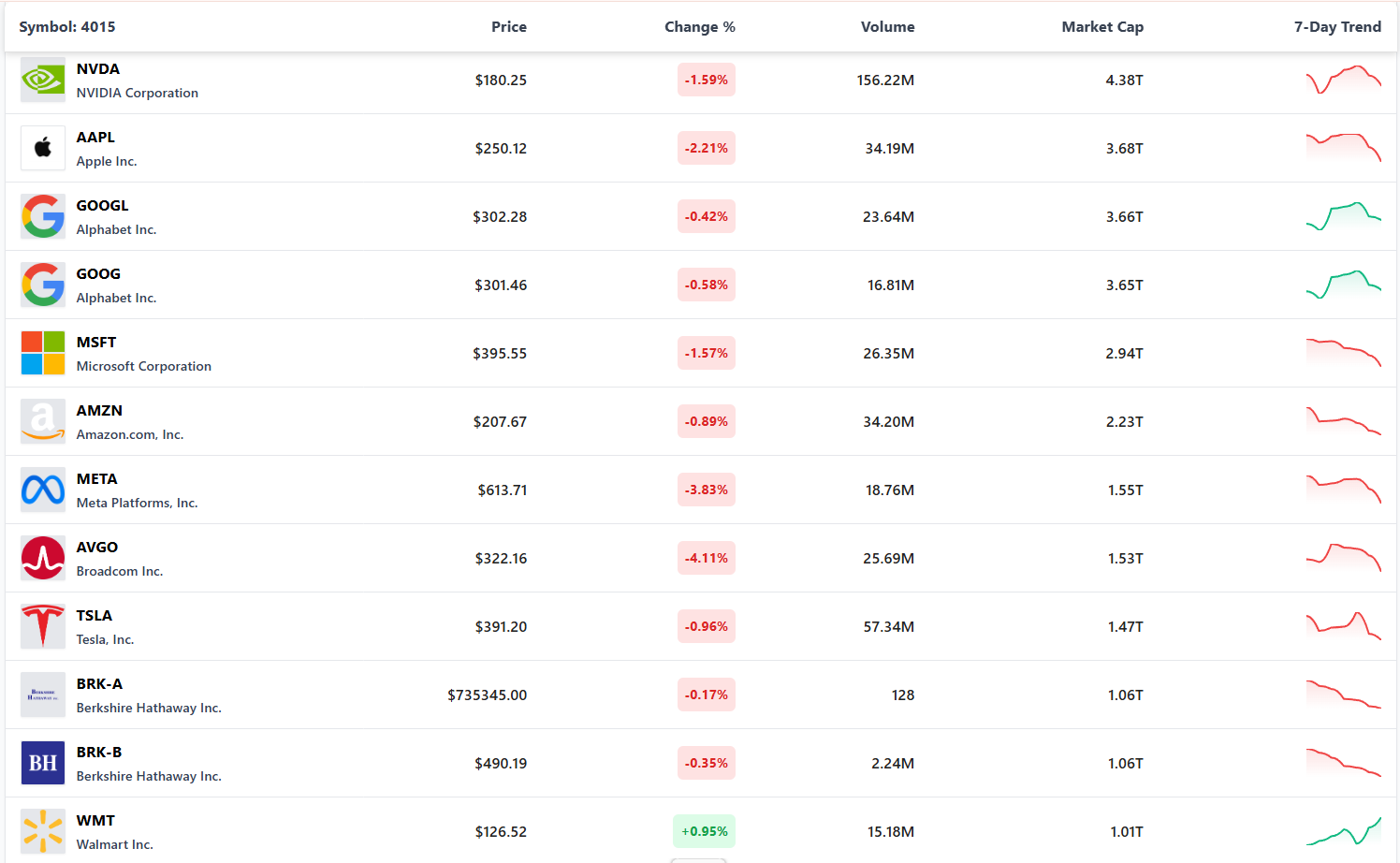
The Tickerplace intrinsic value calculator supports both DCF and Benjamin Graham methods, pulling current financial data so your inputs reflect actual company performance. The stock valuation calculator extends this further with P/E and P/S ratio models, giving you a multi-model view of any stock's fair value. Both tools cover 10,000+ US and ASX-listed equities, updated daily. For investors who want to see how a stock's calculated value compares to its current market price across an entire watchlist, Tickerplace makes that comparison fast and clear.
FAQ
What is an intrinsic value calculator?
An intrinsic value calculator estimates a stock's true worth using financial fundamentals such as free cash flow, earnings per share, and growth projections. It helps investors determine whether a stock is undervalued or overvalued relative to its market price.
Which formula is most commonly used to calculate intrinsic value?
The discounted cash flow (DCF) method and Benjamin Graham's earnings-based formula are the two most widely used approaches. DCF discounts projected future cash flows to present value; Graham's formula uses EPS and a capped growth rate to estimate fair value.
How accurate are intrinsic value calculations?
Intrinsic value outputs are estimates, not precise targets. A 1% change in growth or discount rate can shift the result by up to 30%, which is why analysts present intrinsic value as a range and apply a margin of safety before acting.
What is a good margin of safety when buying a stock?
Value investors recommend buying at 20–50% below calculated intrinsic value. This buffer absorbs estimation errors and unexpected business deterioration without resulting in a capital loss.
Can I use one valuation method for all stocks?
No single method suits every company. DCF works best for stable, cash-generative businesses; the Dividend Discount Model suits consistent dividend payers; and asset-based methods apply to distressed or asset-heavy firms. Combining multiple methods produces more reliable conclusions.