
An economic moat is a durable structural advantage that lets a company defend its market position and earn returns above its cost of capital for years, sometimes decades. Economic moat analysis is the process of identifying that advantage, testing whether it's real with hard financial metrics, and using the conclusion to shape how much you pay for the stock. A moat matters because it's the difference between a business that compounds capital and one that erodes it the moment a competitor shows up with a cheaper offer.
TL;DR:
- A company's moat is confirmed by a sustained positive spread between return on invested capital and weighted average cost of capital, lasting over 20 years for a wide moat.
- Key indicators include stable margins across economic cycles, consistent free cash flow, and market share trends over five to ten years.
- Quantitative checks should be incorporated into valuation models to test the sensitivity of fair value to moat duration assumptions.
- Regular re-evaluation of earnings signals, margin trends, and industry dynamics twice a year ensures the moat remains durable and relevant.
- Overpaying for a real moat or relying on management claims without rigorous testing can undermine investment returns; verification is essential.
How Analysts Test Moat Durability
A moat claim is a hypothesis until you run the numbers. The single most important quantitative test is the spread between return on invested capital (ROIC) and the weighted average cost of capital (WACC). Morgan Stanley's moat-measurement framework treats a sustained positive ROIC-WACC spread, paired with the ability to reinvest at that same spread, as the clearest sign a company is compounding value rather than just posting a good quarter.
Statistic to anchor your analysis: Morningstar defines a wide moat as an advantage expected to last more than 20 years, and a narrow moat as one likely to hold for 10 to 20 years. Anything shorter isn't a moat. It's a head start.
Beyond ROIC versus WACC, look at:
- Gross and operating margin stability across at least one full economic cycle, not just the last two good years.
- Market share trends over a 5 to 10 year window, since a moat that's losing share is already cracking.
- Free cash flow consistency relative to reported earnings, which flags aggressive accounting before it shows up anywhere else.
- Evidence of failed entry attempts, a rival that tried and retreated tells you more than a rival that never bothered trying.
Pull this data from 10 years of company filings where available, quarterly earnings call transcripts, and segment-level disclosures rather than headline consolidated numbers, which can mask a weakening core business.
A Step-by-Step Moat Analysis Workflow
Treat moat analysis as two separate jobs done in sequence: collecting evidence, then interpreting it. Skipping straight to interpretation is how confirmation bias creeps in.
- Gather raw intelligence. Pull filings, earnings call transcripts, and even job postings, which often reveal where a company is investing (or retreating) before it shows up in reported numbers.
- Map industry structure with Porter's Five Forces. Score supplier power, buyer power, threat of new entrants, threat of substitutes, and rivalry intensity, one to five, to see whether the industry itself supports high returns.
- Build a feature-gap and switching-cost checklist. List what a customer would have to rebuild, retrain, or re-certify to leave, and score each item as high, medium, or low friction.
- Run the quantitative checks. Feed ROIC-WACC spread, margin stability, and market share trend into your valuation model as explicit scenario inputs, not footnotes.
- Write a one-paragraph confidence statement. State the moat type, its estimated duration (wide, narrow, or none), and the single data point most likely to prove you wrong.
This sequencing mirrors how structured competitive analysis training approaches the problem, separating fact-finding from judgment so the two don't contaminate each other.
Pro Tip: Write your confidence statement before you check the current stock price. Anchoring on price first is the fastest way to talk yourself into a moat that isn't there.
Common Pitfalls in Business Moat Evaluation
Moat analysis fails in predictable ways, and most of them come from mistaking a good story for good evidence.
- Treating a management team's "we have no real competition" claim as data rather than marketing.
- Confusing scale with a moat. A large company in a low-barrier industry can be undercut just as easily as a small one.
- Ignoring erosion signals: a wave of new entrants, compressing margins, or a regulatory shift that levels the playing field overnight.
- Anchoring on a single glowing customer anecdote instead of the switching-cost checklist built in the workflow above.
- Overpaying for a real moat, which is arguably the most common mistake of all, since even a durable advantage can't rescue a valuation built on unrealistic growth assumptions.
McKinsey's research on top-performing companies found the best operators actively validate and monitor their competitive position using external data, rather than assuming yesterday's advantage still holds today. Investors should borrow that habit rather than treating a moat rating as a one-time verdict.
Connecting Moat Strength to Valuation and Position Sizing
A moat conclusion should change specific numbers in your model, not just your confidence in the story. A wide moat with a stable ROIC-WACC spread supports a longer explicit forecast period in a discounted cash flow model, sometimes 10 to 15 years instead of the standard five, because the company has demonstrated it can defend returns that long already.
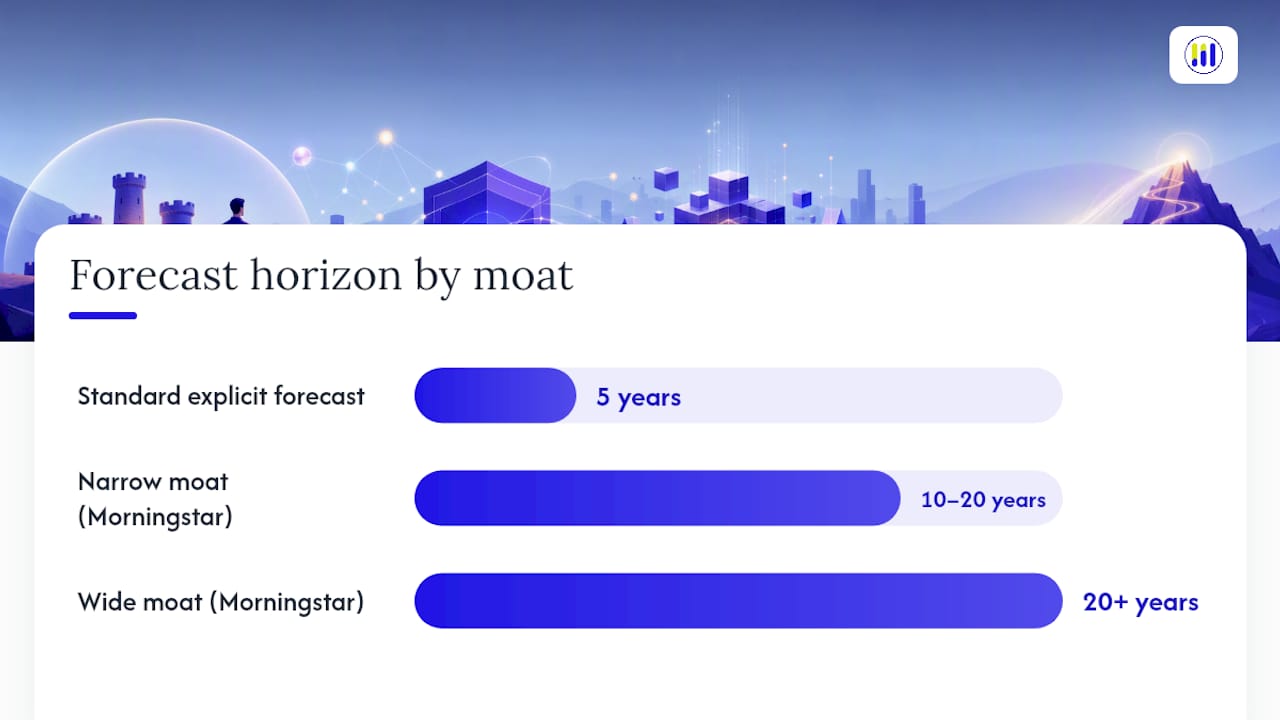
The number that matters most here: Morningstar's own duration bands, wide moats over 20 years and narrow moats between 10 and 20, give you a defensible ceiling for how far out you should extend those assumptions rather than guessing.
Practical adjustments to make:
- Widen your margin of safety when moat confidence is low or based on limited data, even if the growth story is compelling.
- Cap position size for "story" moats you haven't been able to verify quantitatively, regardless of how good the pitch sounds.
- Set a monitoring trigger, a specific margin or market-share level, that would force you to revisit the thesis rather than waiting for a price crash to notice something changed.
As Investopedia notes, a moat helps a business keep competitors at bay, but moat strength has to be paired with management quality and a reasonable entry price to actually produce investment returns.
Running a Moat Check With Tickerplace's Free Tools
The workflow above turns into a fast desktop exercise if you know where to pull the numbers. Start on a company's financials page to gather historical margins and returns, then use the operating margin calculator to check stability across cycles rather than eyeballing a single year.
Once you have a sense of the ROIC-WACC spread, run a scenario-based discounted cash flow to see how sensitive fair value is to your moat duration assumption, wide versus narrow versus none. These calculators are provided for free as part of a broader valuation platform and are designed to support this kind of check. They don't replace the judgment call at the end, the one-paragraph confidence statement is still yours to write.

How Long-Term Investors Should Monitor Moat Signals
A moat conclusion isn't a one-time stamp. Recheck earnings-driven signals, margin trend, ROIC spread, quarterly, and revisit the broader industry-structure picture, new entrants, regulatory shifts, twice a year. Treat moat analysis as a filter that narrows your universe to durable businesses, not as a substitute for judging management capital allocation or checking whether the price already reflects the advantage. The best moat in the world doesn't help you if you paid for the next twenty years of it upfront.
— Tickerplace
Put This Moat Workflow Into Action With Tickerplace
A platform exists that offers individual investors institutional-grade valuation tools, without the subscription price a professional terminal demands. The stock valuation calculator runs the DCF and scenario checks described above, letting you test how a wide versus narrow moat assumption shifts fair value before you commit capital.
Pair it with the intrinsic value calculator to translate your moat confidence into a specific target price and margin of safety, or check a ticker's fair value directly if you already know which company you're evaluating. These tools handle the math. The judgment call on moat durability, and whether management deserves your trust, still belongs to you. Open a company page on Tickerplace and run the numbers on your next candidate today.
Sources
- How top economic performers lean into their competitive advantage to guide their strategy — McKinsey
- Measuring the moat — Morgan Stanley
- Economic Moat — Morningstar
- How an Economic Moat Provides a Competitive Advantage — Investopedia
This article is general information, not a substitute for advice from a qualified financial advisor. Consult a qualified financial professional about your own circumstances before acting on anything here.
FAQ
What does economic moat mean?
An economic moat is a durable structural advantage, like a network effect or a cost edge, that lets a company defend market share and earn returns above its cost of capital for an extended period.
What does Warren Buffett say about moats in investments?
Buffett has long argued that a business worth owning needs a "moat" wide enough to keep competitors out for years, and that protecting or widening that moat should be a management team's central job.
What does "moat analysis" mean?
Moat analysis is the process of identifying which type of competitive advantage a company has, then testing it with metrics like the ROIC-WACC spread, margin stability, and market share trends rather than relying on management's own claims.
What are the five economic moats?
The five sources identified in Morningstar's framework are network effects, intangible assets, cost advantage, switching costs, and efficient scale.
How long does a moat need to last to be considered "wide"?
Morningstar classifies a wide moat as an advantage expected to persist more than 20 years, while a narrow moat is expected to last 10 to 20 years.