

TL;DR:
- The cap rate measures a property's income potential relative to its market value, excluding financing costs. It serves as a quick, market-agnostic screening tool but is highly sensitive to input assumptions and ignores growth prospects. Relying solely on cap rate can mislead investors; it should be complemented with other metrics and careful analysis.
The capitalization rate, or cap rate, is one of the most frequently cited metrics in real estate investment, yet it is also one of the most misunderstood. Many investors treat it as a universal signal of a deal's quality, when in fact it is a context-sensitive screening tool that can mislead if applied without care. Mastering the cap rate formula means understanding not just the math, but the assumptions buried inside every number you feed into it. This article breaks down the formula, clarifies the inputs that matter most, and shows you how to apply cap rate analysis without falling into the traps that catch unprepared investors.
Key Takeaways
| Point | Details |
|---|---|
| Cap rate formula basics | Cap rate is found by dividing net operating income by property value, showing income yield independent of financing. |
| NOI assumptions matter | How you calculate NOI—including reserves and vacancy—will greatly affect your cap rate and property value estimates. |
| Cap rate is a screening tool | Use cap rate to compare and filter deals, but don’t use it as your only investment decision metric. |
| Complementary metrics needed | Pair cap rate with cash-on-cash return and growth projections for a more comprehensive investment analysis. |
What is cap rate and why does it matter?
The capitalization rate expresses a property's income-generating potential as a percentage of its current value. It is calculated by dividing net operating income (NOI) by the property's market value. According to Freddie Mac guidance, cap rate = NOI / property value, where NOI is gross operating income minus operating expenses, and critically, it excludes mortgage payments and debt service entirely.
This exclusion is intentional. By stripping out financing costs, cap rate becomes a pure, property-level performance metric that is comparable across deals regardless of how each investor chooses to finance them. It answers one clear question: what return does this property generate on its own?
NOI is the engine of cap rate analysis. Before debt, before taxes on financing, and before depreciation schedules, NOI tells you what the asset actually earns from operations.
Understanding net operating income is therefore the prerequisite to using cap rate correctly. Investors and analysts rely on cap rate because it enables rapid screening across multiple properties without needing to model each deal's unique capital structure.
Cap rate advantages:
- Fast comparison across properties and markets
- Financing-neutral, so it reflects asset quality rather than deal structure
- Widely understood by brokers, lenders, and appraisers
Cap rate limitations:
- Ignores future income growth entirely
- Reflects only one year's income
- Quality of result depends entirely on quality of NOI inputs
- Does not account for leverage, tax benefits, or exit proceeds
Now that we've set the stage, let's break down the actual formula used in cap rate calculations.
Breaking down the cap rate formula
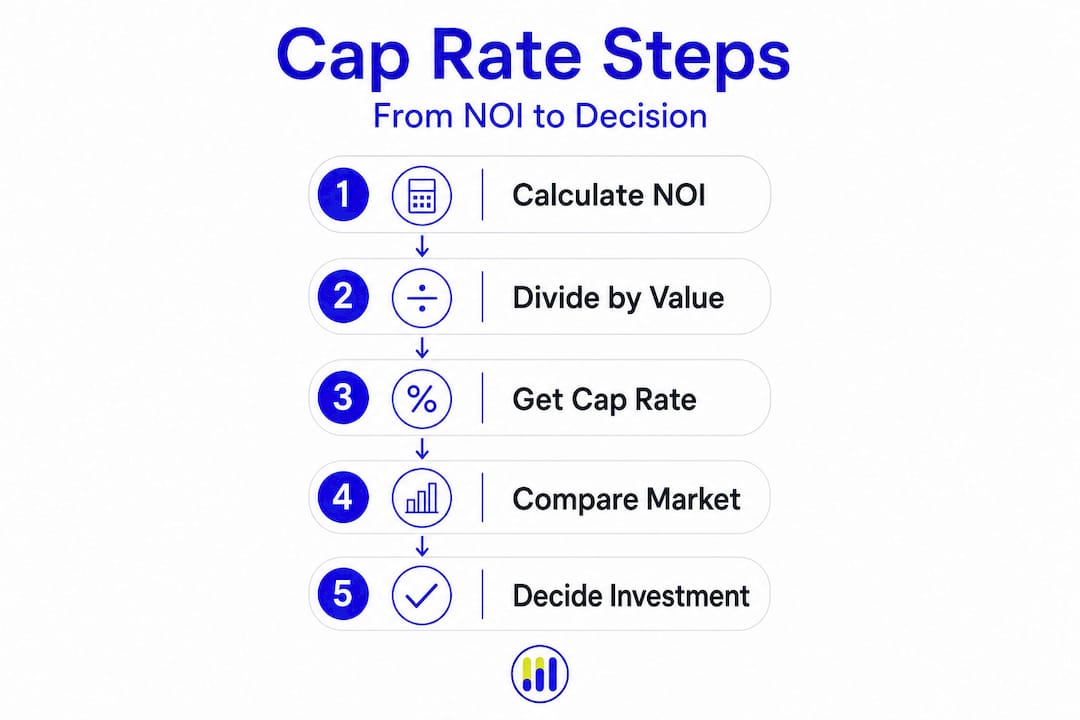
The formula itself is straightforward. As stated in the Property CEO guide, Cap Rate = Net Operating Income (NOI) ÷ Property Value × 100. Expressed as a decimal, the cap rate is simply NOI / Value; multiply by 100 to convert to a percentage that is easier to communicate and compare.
Here is a practical example using real numbers:
| Property | NOI ($) | Market Value ($) | Cap Rate (decimal) | Cap Rate (%) |
|---|---|---|---|---|
| Property A | 80,000 | 1,000,000 | 0.08 | 8.0% |
| Property B | 55,000 | 900,000 | 0.0611 | 6.1% |
| Property C | 120,000 | 1,500,000 | 0.08 | 8.0% |
| Property D | 40,000 | 750,000 | 0.0533 | 5.3% |
Notice that Properties A and C share the same cap rate despite very different sizes. This is precisely what makes cap rate useful for screening investments with ratios: you are normalizing income relative to value.
Steps to calculate cap rate:
- Calculate gross rental income for the full year.
- Subtract a vacancy and credit loss allowance (typically 5 to 10 percent of gross income).
- Add any other operating income (parking, laundry, etc.).
- Subtract all operating expenses: property taxes, insurance, maintenance, management fees, and replacement reserves.
- The result is your NOI.
- Divide NOI by the property's current market value (not purchase price, when the two differ).
- Multiply by 100 for the percentage expression.
Statistic callout: Direct capitalization converts first-year NOI into an indicated property value. Only first-year income is explicitly considered, making the cap rate a snapshot rather than a projection.
Pro Tip: Always use first-year stabilized NOI, meaning income and expenses as they would look once the property is at normal occupancy and operations, not mid-renovation or mid-lease-up numbers. Using unstabilized figures inflates the cap rate and sets false expectations on calculating investment value.
With the formula clear, it's time to look at the nuanced inputs that affect the reliability of your cap rate estimates.
How inputs and assumptions shape your cap rate
The formula is simple. The inputs are not. Cap rates are highly sensitive to how NOI is defined, specifically how you handle reserves, vacancy rates, and expense assumptions. Two analysts looking at the same property can arrive at materially different cap rates based purely on modeling choices.

Consider this comparison:
| Assumption | Conservative model | Aggressive model |
|---|---|---|
| Vacancy allowance | 8% of gross income | 3% of gross income |
| Replacement reserves | $8,000/year | $0/year |
| Management fee | 6% of effective gross | 4% of effective gross |
| Resulting NOI | $72,000 | $91,000 |
| Cap rate at $1,000,000 value | 7.2% | 9.1% |
The difference between 7.2% and 9.1% on a $1,000,000 property is nearly $190,000 in implied value if you invert the formula to solve for price. That is a significant gap generated purely by modeling assumptions, not actual property performance. Tracking operating margin calculation discipline matters enormously here.
Analysts should always verify the following in any NOI model:
- Vacancy and credit loss assumptions relative to local market data
- Whether replacement reserves are included (roof, HVAC, appliances)
- Management fee accuracy, especially if self-management is currently in place
- Utility allocations and any owner-paid expenses not properly reflected
- One-time costs that may be inflating or deflating the baseline NOI
Pro Tip: Always ask for two to three years of historical operating statements. Compare the seller's pro forma to actuals. Large discrepancies between projected and historical NOI are a red flag worth investigating before proceeding.
But what about the limits of cap rate when comparing investment returns, especially with financing involved?
Cap rate limitations: What it misses and how to compare
Cap rate is financing-neutral by design, which is also its biggest limitation. Cap rate is not financing-aware; comparing deals requires also considering cash-on-cash return and related leveraged return metrics to get a full picture of what an investment will actually deliver to you as an equity investor.
Two properties with identical cap rates can produce dramatically different cash-on-cash returns if they carry different levels of debt, different interest rates, or different amortization schedules.
Metrics to use alongside cap rate:
- Cash-on-cash return: Measures annual pre-tax cash flow relative to the equity invested; this accounts for financing directly.
- Internal rate of return (IRR): Projects total return across a full holding period, including appreciation and exit proceeds.
- Equity multiple: Shows total capital returned over the investment life as a multiple of what was invested.
- Debt service coverage ratio (DSCR): Measures how comfortably NOI covers loan payments; critical for lender underwriting.
Using cap rate in isolation is like evaluating a company based only on revenue. It tells you something real, but it misses too much context to stand alone. A thorough analysis of calculating leveraged returns alongside cap rate gives you a far more accurate picture.
Now that you're equipped with both the formula and its limitations, let's see how professionals apply this in real investment analysis.
Applying the cap rate formula: Workflow for real estate analysis
Professional underwriters follow a structured process when applying cap rate. A practical underwriting workflow follows three core steps: first, model and stabilize the NOI; second, select the overall rate (OAR) using market evidence from comparable sales; third, infer property value using Value = NOI / OAR.
Step-by-step cap rate application workflow:
- Gather trailing 12 months of actual operating statements.
- Normalize NOI by removing one-time items and adjusting for below-market rents or vacancies.
- Build a stabilized, forward-looking NOI based on current market rents and realistic expense ratios.
- Research recent comparable sales in the same submarket and property type to establish a market-derived cap rate range.
- Select an OAR that reflects the subject property's risk profile relative to comparables.
- Divide stabilized NOI by the selected OAR to determine indicated value.
- Cross-check against asking price to assess relative value.
Statistic callout: Cap rate is best used as a one-year income-snapshot metric for screening and comparing properties, not as the sole investment decision tool.
The OAR selection step is where expertise matters most. Market evidence means actual transaction data, not broker opinions or automated estimates. For projecting investment growth beyond year one, you will need IRR modeling alongside the cap rate framework.
Why cap rate judgment trumps simple calculation
Here is a perspective that most guides avoid: the math behind cap rate takes about 30 seconds to learn. The judgment required to apply it reliably takes years. Nearly every significant error in real estate valuation traces back not to a wrong formula, but to a careless or optimistic NOI model.
Sellers and their brokers have every incentive to present aggressive NOI projections. Skimping on vacancy estimates, excluding replacement reserves, or ignoring management fees are the three most common ways a cap rate gets inflated before it reaches your desk. A property marketed at an 8% cap rate may realistically be a 5.5% deal once expenses are modeled conservatively.
The other overlooked risk is treating cap rate as a growth-neutral metric while assuming the property will appreciate. Cap rate says nothing about growth-adjusted screening or how income will change over time. A 5% cap rate in a high-growth urban submarket may outperform a 9% cap rate in a stagnant secondary market over a ten-year hold period. Context always governs.
Use cap rate as your entry point, your first filter. Then build the full model.
Get sharper with data-driven investment tools
Understanding cap rate is one piece of a larger investment analysis puzzle. Whether you are evaluating real estate income metrics or comparing asset classes for portfolio allocation, having access to reliable screening and analytical tools makes the difference between confident decisions and guesswork.
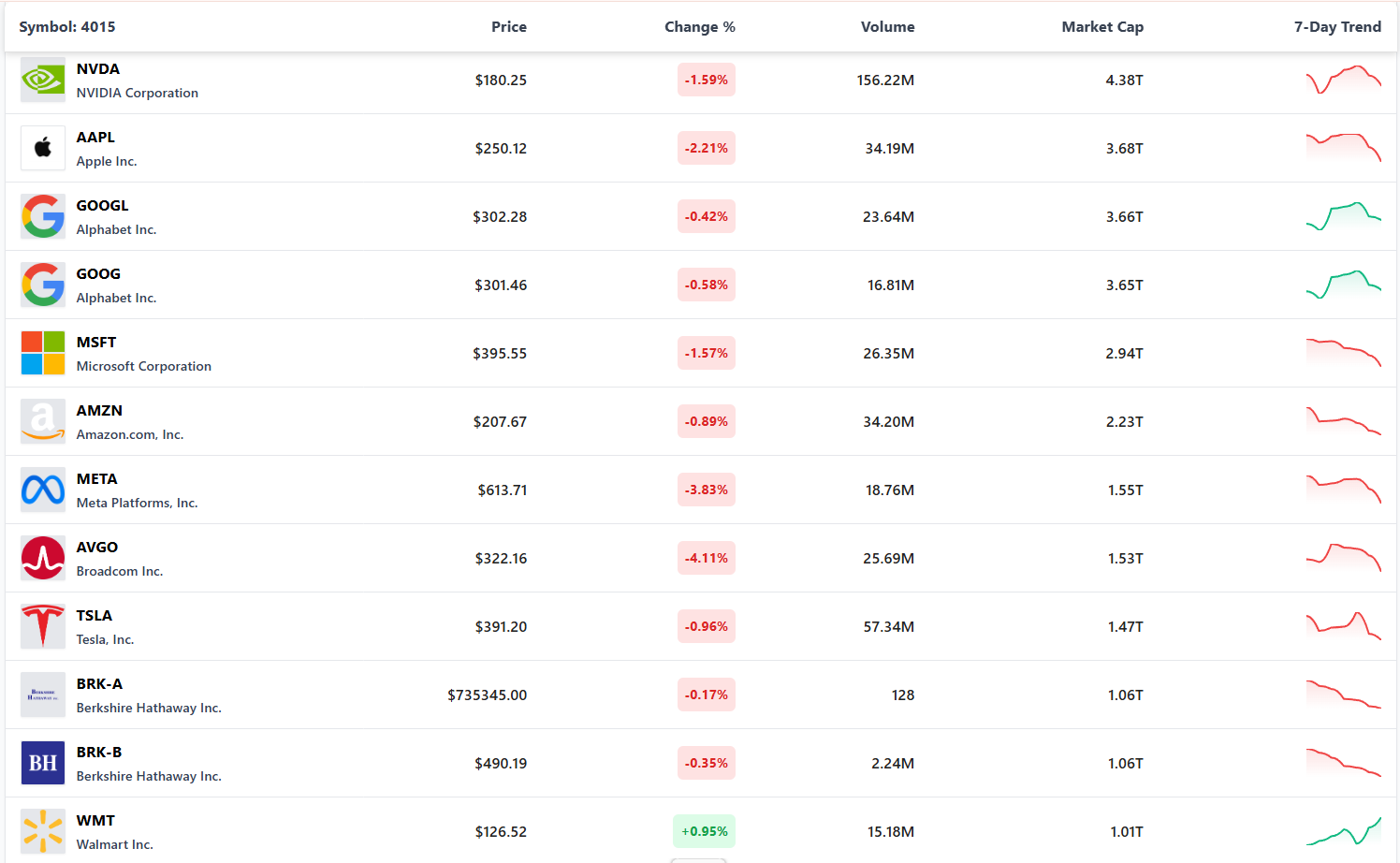
At Tickerplace, you can apply the same rigorous, data-first discipline to equity analysis that this article advocates for real estate. Use the advanced stock screener to filter investments by key financial ratios, or explore Tickerplace tools to access market data, ratio calculators, and research resources built for serious investors and analysts. The same critical thinking that sharpens cap rate analysis translates directly into smarter, more confident equity research.
Frequently asked questions
How do you calculate cap rate on a rental property?
Divide the net operating income (NOI) by the property's current market value. Cap Rate = NOI ÷ Property Value × 100 for the percentage format used in most market comparisons.
Why doesn't the cap rate factor in mortgage or loan payments?
Cap rate = NOI / property value, where NOI excludes mortgage and debt service by design, keeping it as an unlevered, market-based metric suitable for comparing properties regardless of how they are financed.
What is a "good" cap rate for real estate investing?
A good cap rate depends entirely on the market, property type, and risk tolerance. Because cap rates are highly sensitive to NOI assumptions and local conditions, always compare against recent transactions in the same submarket rather than relying on a universal benchmark.
Can you rely solely on cap rate to decide if a property is a good investment?
No. Cap rate is not financing-aware, and it captures only one year of income, making it an effective screening tool but an insufficient basis for a final investment decision without complementary metrics like cash-on-cash return and IRR.
Why is first-year NOI used in cap rate calculations?
Direct capitalization relies on first-year stabilized income because projecting multi-year income introduces uncertainty that the cap rate framework is not designed to handle; it is a point-in-time valuation tool, not a forecasting model.