

TL;DR:
- AMP Limited's stock price often lags real-time market data by at least 20 minutes, leading to potential misinterpretation. Its technical signals show short-term recovery momentum but still face long-term resistance, making patience essential for investors. Market volume and sector comparisons highlight AMP's stability as a lower-growth, income-focused company rather than a growth stock.
For many investors, a single glance at the AMP limited share price tells an incomplete story. The number on screen is often delayed by 20 minutes or more, stripped of volume context, and divorced from the technical benchmarks that actually signal where the stock is headed. AMP Limited (ASX: AMP) is a mature financial services company with a market capitalization exceeding A$3.8 billion, yet its price behavior is frequently misread by analysts who rely on surface-level snapshots rather than the deeper indicators that reveal genuine momentum or resistance.
Key Takeaways
| Point | Details |
|---|---|
| Delayed pricing | AMP share prices shown on most free sites are delayed at least 20 minutes and should be viewed as indicative. |
| Technical benchmarks | 50-day and 200-day moving averages are essential to understand AMP’s short- and long-term price trends. |
| Volume analysis | Trading volumes and liquidity patterns must be analyzed over multiple days to confirm price moves. |
| Sector context | Comparing AMP’s market cap and beta offers insight into its relative stability within financial services. |
| Use analytical tools | Advanced stock screeners and financial platforms improve accuracy when assessing AMP’s share price. |
Understanding the current trading price of AMP Limited
To understand AMP's share value, let's first examine the recent trading prices and how real-time visibility affects interpretation.
As of mid-May 2026, AMP shares traded around A$1.525 to A$1.53 per share, with intraday highs reaching A$1.545 and lows touching A$1.500. That is a relatively narrow daily range, reflecting the stock's low volatility profile. For most retail investors, however, the price they see on free market platforms is already 20 minutes old before they act on it.
Key stat: Most free market data providers display AMP share prices with a minimum 20-minute delay, meaning the "current AMP share price" you see during active sessions is almost always indicative, not executable.
This distinction matters more than it sounds. In a low-volatility stock like AMP, the daily range may only span a few cents, so a 20-minute delay could represent a significant portion of the day's price movement. Traders relying on delayed quotes for entry timing risk buying at the top of an intraday range they cannot actually see.
Key considerations when reading AMP's quoted price:
- Verify whether the price is real-time or delayed before acting on it
- Cross-reference quotes from your brokerage platform, which typically provides live data
- Note the bid-ask spread alongside the last traded price for more accurate entry assessment
- Review the AMP latest financials to contextualize price moves within fundamental performance
The ASX trading overview can also help you benchmark AMP's intraday behavior against broader market conditions on any given session.
Key technical indicators for assessing AMP share price trends
With recent price data in mind, let's explore the technical benchmarks that contextualize these movements for deeper insight.
Technical analysis is where AMP's story becomes genuinely interesting. AMP shares sit 14.51% above their 50-day moving average, signaling short-term recovery momentum. At the same time, the stock remains 5.95% below its 200-day moving average, which indicates that longer-term resistance has not yet been cleared. This split signal is one of the most commonly misread patterns among retail investors.
| Indicator | Value | Signal |
|---|---|---|
| 50-day moving average | Below current price | Short-term bullish |
| 200-day moving average | Above current price | Long-term resistance |
| Beta | 0.32 | Low volatility |
| 52-week range | A$1.14 to A$1.98 | Defined price corridor |
A price above the 50-day moving average (MA) often reflects improving sentiment or recent positive catalysts; it means buyers have been more active over the past two months than sellers. The 200-day MA, by contrast, reflects a broader consensus built over nearly a year of trading, and it acts as a heavier gravitational pull on price. AMP has not yet convincingly broken above that longer-term ceiling.
Understanding ASX real-time data is critical here, because MA calculations look different depending on whether you are using delayed or live price feeds.
Key technical signals to monitor for AMP stock performance:
- A confirmed close above the 200-day MA would represent a structurally bullish shift
- Sustained price above the 50-day MA for three or more consecutive weeks strengthens the short-term case
- Beta of 0.32 means AMP moves roughly a third as much as the broader market, which is valuable in volatile conditions
Pro Tip: When two moving averages send conflicting signals, weight your decision toward the longer-term average for strategic positioning, and use the shorter-term average to time entries and exits.
Market dynamics influencing AMP's share price movements
Beyond technical indicators, market mechanics like volume and liquidity play a critical role in interpreting AMP's price behavior accurately.

A price move on low volume is a very different event from the same move on high volume. Intraday liquidity spikes and concentrated institutional positioning can distort perceived price movements significantly, which is why analyzing volume distribution over multiple sessions matters more than any single day's print.
Consider a scenario where AMP's price jumps 2% in a single afternoon session. Without volume context, that looks like a breakout. With context, it might reveal a single large block trade from an institutional rebalance, with little genuine retail demand behind it. The price retraces the next session, and investors who chased the move are left holding a position at a premium.
Factors driving AMP share price movement at the market mechanics level:
- Institutional positioning: Large funds holding or trimming AMP shares shift prices in ways that don't reflect retail sentiment
- Volume confirmation: Genuine trend changes are typically accompanied by above-average volume sustained over two to three sessions, not just one
- Liquidity windows: AMP's most reliable price discovery happens in the first and last 30 minutes of the ASX trading session
- Avoid single-session overreaction: One high-volume day is not a trend; wait for confirmation across multiple sessions
Reviewing AMP financial news alongside ASX stock data helps separate price moves driven by real news from those caused by mechanical trading flows.
Pro Tip: Set a volume threshold alert at 150% of AMP's 20-day average daily volume. Any session crossing that level warrants closer scrutiny of the underlying cause before drawing trend conclusions.
Comparing AMP's share price performance within the financial sector
To gain full perspective, it helps to see how AMP's share price stacks up against other financial services firms on the ASX.
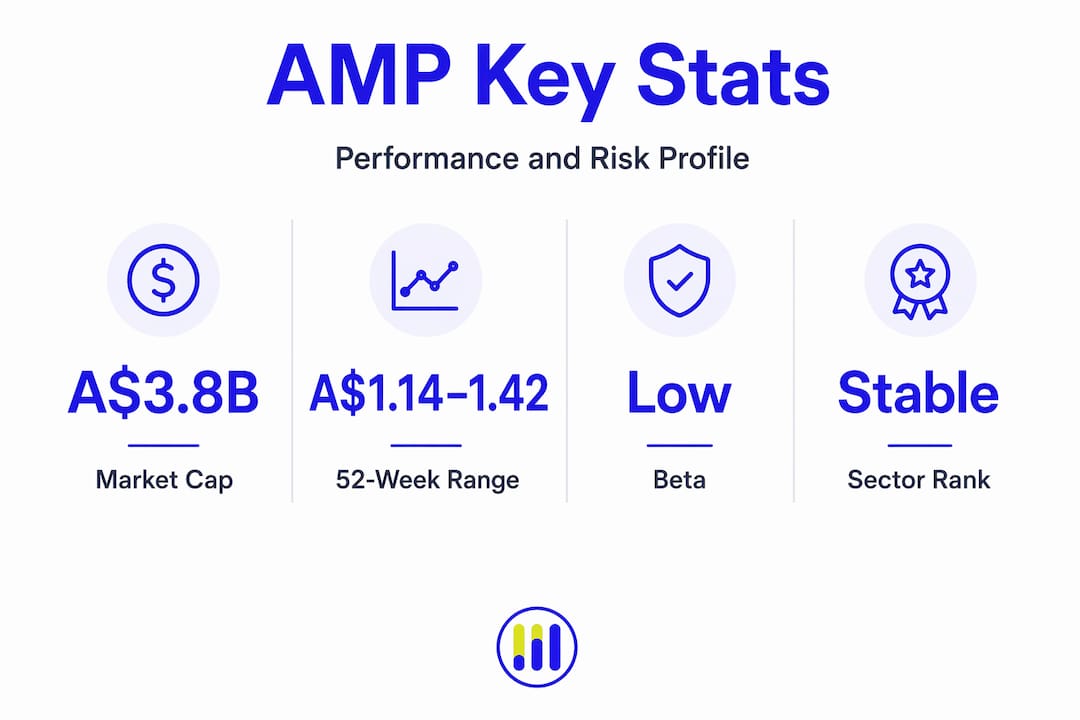
AMP Limited carries a market capitalization of approximately A$3.8 billion, with a 52-week range spanning A$1.14 to A$1.98 and a beta of 0.32. Those three numbers together tell a clear story: this is a mature, lower-growth financial services company with defined price boundaries and limited sensitivity to market-wide swings.
| Company type | Approx. market cap | Beta profile | 52-week range width |
|---|---|---|---|
| AMP Limited | A$3.8 billion | 0.32 (low) | A$0.84 |
| Mid-cap financial services | A$2–6 billion | 0.6–1.0 (moderate) | A$1.50–A$3.00 |
| Growth-oriented financials | A$500M–A$2B | 1.2–1.8 (high) | A$2.00–A$8.00+ |
The narrow 52-week range and low beta make AMP a candidate for income-focused investors more than growth seekers. Its AMP share valuation reflects a company that is recalibrating after years of restructuring rather than one expanding aggressively into new revenue streams.
Viewing ASX financial sector stocks in aggregate confirms that AMP's stability profile is genuinely differentiated from smaller or more growth-oriented peers, which tend to exhibit far wider price swings.
Practical steps for investors analyzing AMP's share price
With a broad understanding of technical and market factors, here are practical steps to apply this knowledge when evaluating AMP shares.
- Check both moving averages before forming a view. Pull the 50-day and 200-day MAs from a reliable data source. Note whether price is above or below each, then assess the gap. A narrowing gap between price and the 200-day MA often signals an approaching decision point.
- Validate price moves with volume data. Before treating any single-day price change as significant, verify that volume was at least 20% above AMP's 20-day average. Moves on thin volume are noise until proven otherwise.
- Use live data for execution, not delayed quotes. Your brokerage platform, not a free market website, should be the source of truth for live pricing when placing orders. Delayed prices are acceptable for research; they are unsuitable for real-time decision-making.
- Monitor AMP stock news today for catalysts. Earnings releases, regulatory updates, and dividend announcements are the events most likely to generate sustainable price shifts rather than mechanical fluctuations.
- Apply stock screening tools to compare AMP against sector peers across multiple metrics simultaneously, saving time and improving decision quality.
Tickerplace stock tools provide both the fundamental and technical data layers needed to execute this kind of multi-factor analysis efficiently.
Pro Tip: Build a simple tracking sheet with AMP's closing price, volume, and distance from the 200-day MA updated weekly. Patterns become visible over four to six weeks that are invisible in daily watching.
A realistic take on AMP Limited's share price outlook
There is a tendency among retail investors to read AMP's modest price recovery as a launchpad for a breakout, when the data suggests something more measured is happening. AMP is not a growth story. It is a restructuring story, and those play out slowly.
The stock's low beta is not a flaw; it is a feature for investors who prioritize capital preservation and dividend stability over rapid appreciation. AMP's financial analysis shows a company methodically simplifying its business model, reducing costs, and returning capital to shareholders. That is a different value proposition from a high-growth tech stock, and it deserves to be evaluated on its own terms.
The more common mistake is not missing a rally. It is overreacting to a short-term spike above the 50-day MA and treating it as confirmation of a new bull run, only to be surprised when the 200-day MA acts as a ceiling. The investors who navigate AMP well are the ones who wait for multiple confirming signals rather than acting on any single indicator. Patience, in this case, is a genuine edge.
Explore AMP Limited and other stocks with Tickerplace tools
Making sense of AMP's price requires more than a single quote. Delayed data, conflicting moving averages, and volume nuances demand a platform built for serious analysis.
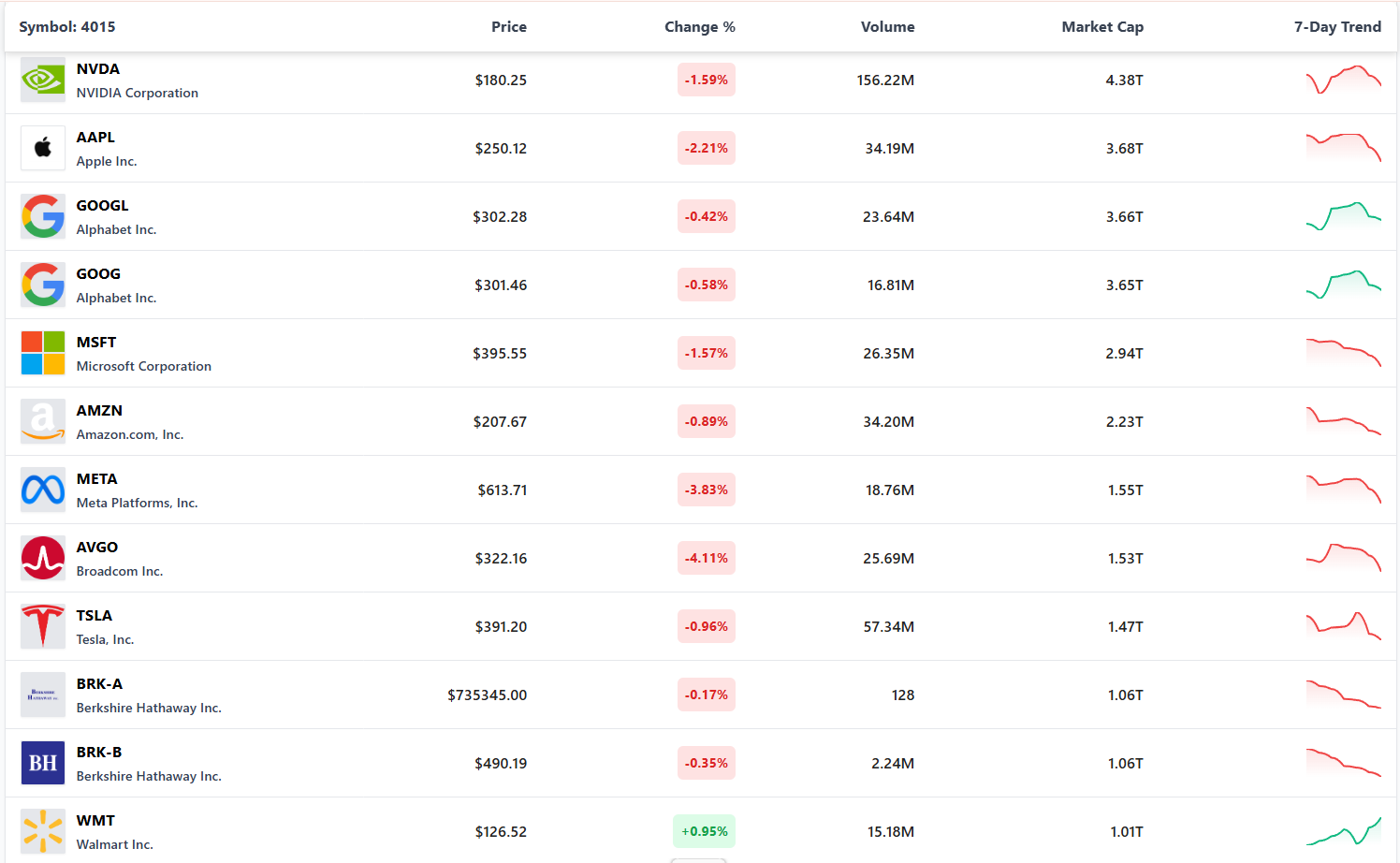
Tickerplace gives you access to real-time and historical price data, fundamental metrics, and technical indicators for AMP and hundreds of other ASX-listed stocks. The Tickerplace screener lets you compare AMP directly against financial sector peers using the exact metrics covered in this article, from beta and market cap to 52-week ranges and moving average positions. For investors who want a complete picture before committing capital, the AMP financial data page is the logical starting point.
Frequently asked questions
Why does AMP Limited's share price often show delayed quotes?
Free market platforms display AMP share prices with at least a 20-minute delay to reduce data costs, so any price labeled "current" on these sites should be treated as indicative only and not used for live trade execution.
What technical indicators are important when analyzing AMP's stock?
The 50-day and 200-day moving averages are the primary benchmarks for evaluating AMP's short-term momentum and longer-term resistance, with a confirmed close above the 200-day MA representing the most significant bullish signal for the stock.
How does trading volume affect AMP's share price reliability?
Intraday liquidity spikes can distort price movements significantly, so a single high-volume session requires follow-through across multiple days before being treated as evidence of a genuine trend shift.
What sector comparisons help in evaluating AMP's share price?
Comparing AMP's A$3.8 billion market cap, 52-week range of A$1.14 to A$1.98, and beta of 0.32 against mid-cap and growth-oriented financial services peers reveals AMP's relative stability, which positions it as a more conservative income-oriented holding than most sector alternatives.